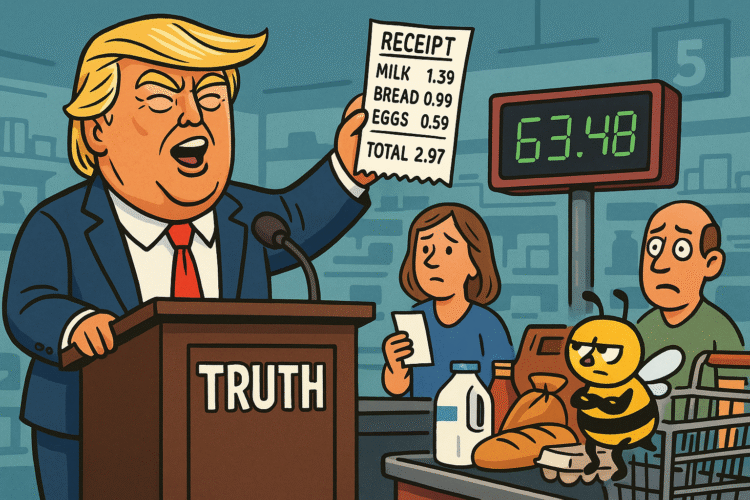
An official memo from the alternate universe where gas is two dollars, milk is basically free, and your checking account is lying to you/
Americans have endured many strange plot twists in public life, but few moments rival the latest presidential message that rolled out like a weather alert from a parallel dimension. Donald Trump, standing at a podium that might as well have been wrapped in a velvet curtain, announced that prices are down. Not a little down. Not trending down. Not inching down with the timid energy of a shy turtle. Fully down. Apparently gas is two dollars, groceries are cheaper than ever, and the only reason you do not feel this is because the media has convinced you that inflation exists by holding up a mirror and whispering spooky stories about your own bank statement. It is a bold strategy to tell an entire country that its lived experience has been misfiled, as if America collectively hallucinated over the last several years while the president kept receipts that none of us recognize.
In this new script, we are not paying more for groceries. We are misremembering the price of food because journalists have seeded moral panic by showing us our own receipts. We are not bleeding money at the pump. We are simply forgetting the true price of gas because the news has hypnotized us with charts that apparently reflect a fictional universe. If this logic holds, every American freezer should be auditioning for a Marie Antoinette biopic because according to the president, meat is practically free. He did not provide exact figures, which makes sense because exact figures would have to survive a collision with reality.
This gaslighting, though rooted in politics, reads more like a psychological experiment. Imagine waking up, checking your bank app, seeing the sad little minus sign where your grocery budget used to be, then turning on the TV only to be informed that you are actually thriving. That extra forty dollars you paid for a bag of produce, a carton of eggs, and the privilege of existing inside a grocery store was a clerical error in your imagination. Economic indicators, according to this worldview, have a political bias. Your wallet is a saboteur. Your eyes, compromised. Your anxiety at checkout, a liberal plot.
The American public is being asked to participate in a national trust fall exercise in which the person behind us is promising to catch us with hands that do not appear to be open. It is a performance of confidence, built on the premise that if you repeat a thing loudly enough, it becomes true. This rhetorical sleight of hand asserts that the media manufactures price hikes by reporting on them. A fascinating claim, especially coming from someone who has spent years treating numerical reality as a suggestion rather than a constraint.
There is also a delightful symmetry to the message. When prices went up, the president insisted they were catastrophic. A tragedy. A crime. A sign that society was collapsing into a canyon of government mismanagement. Now that he is back in charge, the prices are not just stable. They are corrected. They have plunged. They have adopted a new attitude and started wearing sensible shoes. It does not matter that those price drops did not happen. The narrative has no obligation to coordinate with the facts, only with emotional resonance. It is the political equivalent of declaring gravity optional, then wondering why reporters are not headlining your bravery.
The gas claim might be the most audacious. Gas is two dollars, the president has said, with the confidence of a man who has not pumped gas since the invention of the QR code. It is a number chosen with the nostalgic flourish of someone remembering an old commercial rather than an actual economy. For many Americans, the price at the pump is the most tangible measurement of the cost of living. You cannot fudge it. You cannot frame it as a misunderstanding. You cannot tell working class people that the number glowing in front of them is a hologram created by liberal graphic designers. The pump does not lie. The pump does not negotiate. The pump also does not accept political talking points as legal tender.
The grocery claims follow the same logic. Food, we are told, is cheaper than ever. It is unclear where this grocery store exists, but it is possible it lives somewhere near the mythical Venezuela that Fox News warns us about nightly, only in reverse. Maybe the produce floats down from trees. Maybe someone has discovered a new species of chicken that lays eggs directly into the shopping cart. Or maybe the supermarket has relocated into the realm of allegory, a symbolic marketplace in which the price of bread reflects patriotism rather than supply chains.
The funhouse effect becomes even more pronounced when this narrative is presented as a correction rather than a reinterpretation. The president insists not only that prices are down, but that any reporting to the contrary is dishonest. Deliberately dishonest. Coordinated dishonesty. A conspiracy so sophisticated it apparently persuaded Americans to believe their grocery bills were higher when in fact they were lower. It takes an impressive level of confidence to accuse the entire population of being tricked by receipts printed by machines that do not read Twitter.
The media, in this story, is the villain not because it is wrong but because it is observable. Journalists are blamed for covering the cost of living crisis as if they personally boosted the price of chicken by writing it down. This narrative treats economic reporting as sorcery, where describing a problem conjures it into being. It is an attempt to turn public frustration into a cognitive error, not a legitimate reaction to market conditions. The economy, under this theory, is not struggling. Americans are simply too sensitive to sticker shock.
Meanwhile, corporate earnings from major grocery chains have been strong, driven by pricing power that has not meaningfully reversed. Food manufacturers continue to announce small price increases justified by supply chain explanations that sound more like excuses every quarter. But none of this matters in a political ecosystem where reality is a choose your own adventure story and the executive gets to decide the ending.
The president’s assertion that consumer perception is the real problem creates a peculiar moral universe. If you cannot afford groceries, the new message implies, the issue is not affordability but awareness. If prices feel high, it is because you have been poisoned by pessimism. If your budget is stretched, you may simply need to meditate harder on the idea of abundance. It is the economic equivalent of telling people with broken bones that they are actually fine if they stop listening to the mainstream medical establishment.
There is a pattern here. When conditions do not cooperate, reality becomes negotiable. When data is inconvenient, data becomes biased. When the public pushes back, the public becomes misinformed. In this story, the president is the sole arbiter of truth, and the economy is performing beautifully because he says so. It is a narrative designed not to comfort people but to erase their experience, to replace lived pain with curated optimism. It is an odd form of leadership, one that treats discomfort as a loyalty test.
The irony is that this tactic is risky. Americans may disagree about politics, but they do not disagree about their own bank accounts. You cannot gaslight someone out of their rent payment. You cannot convince a parent that diapers are cheaper when they are literally holding the receipt. You cannot tell someone that the price of gas has plunged when they watched the numbers climb like an aggressive elevator that does not believe in mercy. The president is attempting to perform a magic trick in a room full of people who have already seen behind the curtain.
And yet the rhetoric persists, partly because it resonates with those who want a clear villain and a simple narrative. It is easier to blame the media for pessimism than to grapple with the structural reasons why prices remain sticky even as inflation slows. It is easier to claim that the public is confused than to admit that corporate consolidation has given companies the power to raise prices with little fear of losing customers. It is easier to insist that everything is fine than to acknowledge how fragile the economy feels to millions of workers one unexpected bill away from insolvency.
This is not just political messaging. It is a worldview. It is the belief that public perception can be scolded back into alignment with political objectives. It is the conviction that leadership is a performance art in which saying a thing with confidence matters more than whether that thing is true. It is the faith based economy, where facts are optional and vibes are policy.
Trump’s new message is not only that prices are down. It is that the public is wrong. Not mistaken. Not misled. Wrong. And this is the real tell. Strongmen rarely admit that conditions are bad. If the people say they are struggling, then the people must be corrected. If the economy feels unstable, the feeling must be pathologized. In this universe, truth flows downward from the podium, not upward from experience.
This attempt to rewrite reality is also a form of political insulation. If the leader says things are great, and you say they are not, then you have revealed yourself as the problem. Your hardship becomes a sign of insufficient belief, not insufficient policy. It is a clever maneuver because it reframes dissatisfaction as disloyalty. The economy is fine. Your attitude is not.
But Americans are not passive consumers of political narratives. They are active participants in an economy that touches them every hour of every day. They know the price of milk. They know the cost of gas. They know the rising expense of childcare, utilities, car insurance, and medicine. The president can claim the opposite, but this only widens the gap between power and the people it claims to serve.
What They Want You to Pretend
The administration can declare that everything is cheaper now. It can insist that the public has been fooled by a cabal of pessimistic reporters. It can claim that inflation has been defeated by sheer force of presidential charisma. But millions of Americans walk into grocery stores every week. Millions of Americans fill their gas tanks. Millions of Americans open their banking apps with the quiet dread of someone bracing for impact. The economy does not exist on a podium. It exists in the day to day calculations of people trying to stay afloat. And no amount of political certainty can force those numbers to shrink.