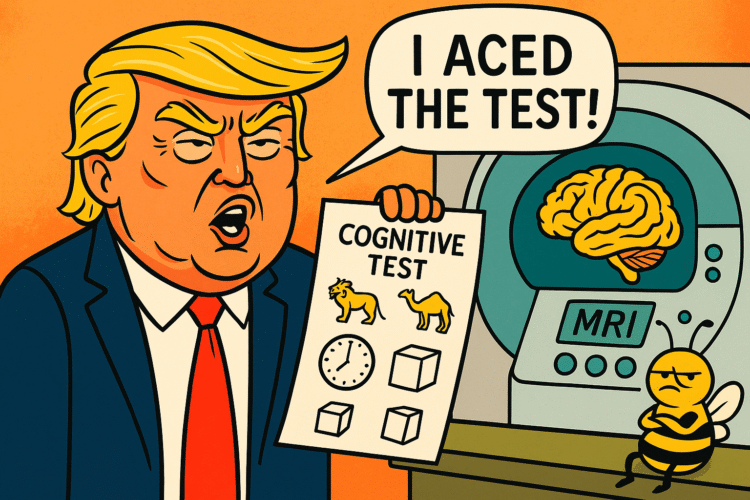
Some presidents measure success by legislation passed, crises avoided, or wars prevented. Ours measures it by whether he can remember five random words in the right order. This week, President Donald Trump announced—again—that he “aced” his dementia test, a boast that feels less like an assurance of cognitive health and more like a cry for help from a country running on fumes. As the federal government drags into a fourth week of shutdown, hundreds of thousands of workers go unpaid, and agencies triage their operations like field hospitals, the Commander in Chief is busy conflating the Montreal Cognitive Assessment with a Mensa application.
It was the kind of moment that would be funny if it weren’t a eulogy for seriousness. Trump told reporters aboard Air Force One that he’d taken the test at Walter Reed and “passed it perfectly,” adding that Representatives Jasmine Crockett and Alexandria Ocasio-Cortez should “try taking it themselves.” He also bragged about a “perfect MRI,” because apparently we now grade brain scans the way we grade beauty pageants. The subtext was obvious: intellect by radiology. America’s got talent, and it lives in a lesion-free frontal lobe.
The MRI Heard ’Round the World
In a normal country, a presidential MRI would be a private medical note. In this one, it’s campaign merch. Trump described his exam results as proof of superior intelligence, as if the Montreal Cognitive Assessment were designed to identify the next Einstein rather than detect early dementia. Dr. Ziad Nasreddine, the neurologist who created the test, clarified years ago that it’s a screening tool, not a measure of IQ. You take it to determine if your brain is breaking, not to flex that it’s functioning.
But that’s the Trump doctrine in miniature: turn any diagnostic into a declaration of genius. He’s the only man who could look at a colonoscopy and see an opportunity for branding. The message is simple: nothing means anything except the spin. A dementia test isn’t medical; it’s political. A government shutdown isn’t a crisis; it’s a stage. A country isn’t a democracy; it’s a ratings vehicle.
A Government on Pause
While the president brags about recognizing animals on flashcards, the government he leads is collapsing into inertia. Four weeks into the shutdown, the Congressional Budget Office estimates billions in economic losses, hundreds of thousands of federal employees are either furloughed or forced to work without pay, and critical programs are running on fumes. The FDA has slowed inspections. National parks are overrun with trash. Agencies are cannibalizing contingency funds meant for emergencies. The White House calls it leverage. Everyone else calls it chaos.
Appropriations law during a funding lapse is straightforward: if Congress doesn’t pass the money, the executive branch can’t spend it. Agencies go dark, except for functions protecting “life and property.” That’s bureaucratic code for “we’re improvising until further notice.” Yet Trump’s public remarks suggest a different understanding of governance—one where shutdowns are set pieces, and the only thing to measure is how well he performs them.
He’s not the first president to lean into distraction, but he’s the first to make it his governing philosophy. The shutdown isn’t collateral damage; it’s choreography.
The Bessent Interlude
In the same news cycle that brought us “perfect MRI,” Treasury Secretary Scott Bessent went on Face the Nation to announce that a TikTok divestiture deal would be finalized at a high-profile meeting later this week. The timing was exquisite: as the government bleeds, the administration is negotiating influencer policy. Bessent’s claim raises old CFIUS-style questions—who controls the data, who enforces the decree, and who makes sure “national security” doesn’t mean “corporate donor preferences.”
Even under normal circumstances, the Committee on Foreign Investment in the United States has to review foreign ownership and potential security risks. During a shutdown, the staff that conducts those reviews is either furloughed or juggling multiple crises. But this White House has always treated process like an inconvenient subplot. It’s easier to declare a deal done than to check whether it’s legal.
Bessent’s remarks offered the illusion of motion, the administration’s favorite optical trick. Announce a thing, call it resolved, move on. Like the Montreal test, it’s governance by show-and-tell.
Spectacle as Strategy
To understand this presidency, you have to understand its relationship with spectacle. It’s not a byproduct—it’s the entire business model. Trump’s MRI brag wasn’t a tangent; it was the policy. The man treats reality as a focus group, facts as punchlines, and medical evaluations as trophies. Each announcement, each self-congratulatory aside, is another episode in the long-running reality series called Crisis, Interrupted.
This week’s plot twist? The genius brain test. Last week’s? The perfect trade meeting that never materialized. Next week’s? Maybe a moon base or a new nickname for whoever still reads the briefing book.
The spectacle serves a purpose: it fills the vacuum left by the absence of policy. It gives supporters something to cheer about while the machinery of the state rusts in place. Republicans and right-wing media framed the dementia boast as proof of stamina, discipline, and “mental sharpness.” Democrats and press freedom advocates called it what it was: a distraction. But in this ecosystem, the distraction is the message.
The Doctor Is Out
There’s a tragicomedy in watching a superpower mistake medical clearance for leadership. The Montreal Cognitive Assessment asks questions like “What day is it?” and “Can you draw a clock?” These are not brain-teaser riddles. They’re the neurological equivalent of checking if your computer still turns on. The test’s creator says passing it means “you’re normal for your age,” not that you’re ready to command a nuclear arsenal.
But Trump’s genius has always been linguistic, not intellectual. He redefines the words until they orbit his ego. “Perfect” becomes whatever he says it means. “Test” becomes “victory.” “Cognitive” becomes “smart.” It’s a linguistic Ponzi scheme where the meaning collapses the second you ask for a withdrawal.
So when he says he passed the test “with flying colors,” what he really means is that he remembered what an elephant looks like.
The Real Costs
Meanwhile, in the world that still runs on paychecks and policies, the shutdown’s damage compounds. The Office of Management and Budget estimates that each week of closure costs the economy billions in lost output. Federal contractors won’t get back pay. Small Business Administration loans are frozen. Food assistance programs are one accounting trick away from collapse. Air traffic controllers are working unpaid.
The longer it lasts, the harder the recovery. Each week of shutdown erodes institutional muscle memory. Career staff leave. Public trust disintegrates. The people least responsible for the gridlock bear the heaviest burden. Yet the president frames it as negotiation, a “showdown” he intends to win.
There’s no evidence he knows what the fight is about anymore. The budget talks have devolved into circular blame, legislative leadership talks past itself, and the executive acts like Twitter polls count as constitutional authority. This is what happens when governance becomes an attention economy. The louder you yell about your brain scan, the less anyone asks why the government’s on fire.
Markets, Mortgages, and Missed Meals
Markets are jittery, not because of one shutdown, but because of the pattern it represents. Policy uncertainty has become the baseline. Investors crave predictability, and this administration feeds them chaos. Families dependent on federal aid are making impossible choices between rent and groceries. States are fronting money for federal programs because Washington can’t get its act together.
The irony is that Trump’s supporters are among those most affected. Rural areas rely disproportionately on federal programs. Military families wait for paychecks delayed by appropriations gaps. But grievance politics is an effective narcotic. If you can convince people that humiliation is patriotic, they’ll tolerate hunger as long as their enemies suffer too.
The Timeline of Delusion
Here’s how it unfolded.
Day 1: The president undergoes a routine checkup at Walter Reed. White House aides spin it as proof of vigor.
Day 2: He tells the press he “aced” his cognitive test. The clip goes viral. MAGA accounts celebrate.
Day 3: Dr. Nasreddine, bewildered, explains that the test identifies cognitive impairment, not brilliance.
Day 4: Air Force One hosts an impromptu press gaggle. Trump doubles down, calling it an “IQ test” and daring opponents to “take it themselves.”
Day 5: Bessent announces the pending TikTok deal, citing “progress” in divestiture negotiations. No agencies confirm.
Day 6: Federal employees miss their fourth paycheck. The White House press team posts an AI-generated meme of Trump’s “perfect brain.”
Day 7: Markets dip. The government’s partial operations begin to buckle. And the only headline that trends is about whether a dementia screening can measure genius.
This is governance by distraction, and it’s working exactly as designed.
The Science of Self-Delusion
Let’s pause on the MRI for a second. An MRI can show lesions, swelling, or anomalies. It cannot show genius. It cannot show competence. It cannot show leadership, empathy, or understanding of basic civics. It’s a machine that produces images, not character. To claim a “perfect MRI” is to misunderstand both medicine and metaphor. It’s the political equivalent of bragging that your blood pressure proves your greatness.
But the president’s worldview runs on that logic. If you can label it “perfect,” it becomes true. A hurricane path can be redrawn with a Sharpie. A test can become an IQ metric. A failing government can be declared the “best in history.” The absurdity isn’t the flaw—it’s the engine.
The Policy Graveyard
Behind the noise, actual governance grinds toward paralysis. Treasury is half-staffed. Federal IT systems are outdated. Regulatory reviews languish. The shutdown’s legacy will outlast the headlines: backlogs, delayed infrastructure projects, and demoralized civil servants.
Even the promised TikTok deal, the week’s supposed policy highlight, rests on procedural quicksand. Divestiture requires enforceable terms, verification of ownership structure, and compliance monitoring. None of that happens by tweet or executive whim. Without a functioning bureaucracy, “deal” is just another word for press release.
The Faith of the Followers
Republicans frame the president’s boasting as strength. They call his self-diagnosed brilliance a symbol of vitality, his shutdown brinkmanship a sign of discipline. It’s not belief—it’s brand maintenance. You can’t admit the emperor failed the pop quiz if your career depends on selling his wardrobe.
Democrats and the press call it distraction, but even that underestimates the problem. It’s not a distraction; it’s the main event. The point isn’t to convince anyone that he’s a genius. The point is to make intelligence itself look suspicious. If expertise is elitism and ignorance is authenticity, then the MRI becomes the new diploma.
The Coming Checkpoints
In the next few days, three outcomes will define the next chapter.
First, will the shutdown negotiations move in either chamber, or will appropriations talks remain hostage to ego? Second, will the rumored TikTok deal actually produce a binding consent decree with enforceable terms? Third, will any outlet force plain language about competence and cost instead of letting euphemism carry another news cycle?
The odds aren’t good. But the test results are apparently perfect.
The Joke That Writes Itself
When historians revisit this week, they’ll see a superpower reduced to cheering a man for identifying a camel on a flashcard while the country starved for paychecks. They’ll see a shutdown treated as a subplot, an economy treated as a prop, and a presidency that mistook attention for accomplishment.
Trump’s defenders will say he’s “mentally sharp.” His critics will say he’s “mentally unfit.” Both miss the point. The problem isn’t cognition. It’s conscience.
SECTION TITLE: The IQ of a Nation
The tragedy isn’t that a man mistook a dementia test for an IQ test. The tragedy is that the country went along with him. We keep grading his behavior on a curve that gets lower every year, until the only thing left to measure is how well he performs his own delusion.
The MRI is perfect. The test was flawless. The shutdown is fine. The government is open, except where it isn’t. The facts don’t matter because the narrative feels good.
If intelligence means learning from mistakes, we’ve failed our own exam. The president passed his test. The rest of us didn’t.