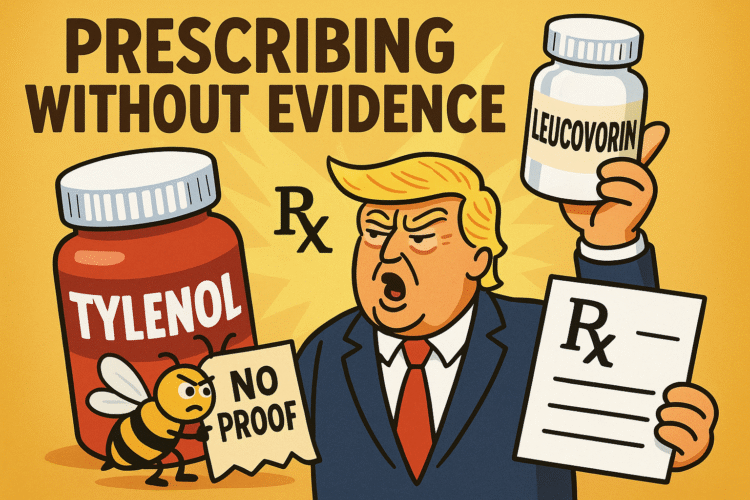
On September 22, 2025, the White House did something most of us reserve for Facebook comment threads and extended family group chats: it held a medical symposium based entirely on vibes.
There, under the grand chandeliers, President Donald J. Trump—flanked by Health Secretary Robert F. Kennedy Jr.—announced that the real culprit behind autism might not be bad policy, broken healthcare systems, or underfunded research, but Tylenol. Yes, the humble acetaminophen tablet. The thing most Americans consume like breath mints after a bad day. The drug so boring it doesn’t even get an opioid crisis. Suddenly, it was treated like the final boss of childhood neurodevelopment.
And like clockwork, the record fought back.
Act I: The Tylenol Theory
Trump’s line was simple enough to fit in a chyron: women take Tylenol in pregnancy, children develop autism, therefore case closed. His delivery, solemn and certain, was what you might expect from a man who once suggested bleach as an IV therapy.
He declared, “The American people deserve answers, not cover-ups.” Behind him, Kennedy nodded gravely, a man who has built an entire brand out of fusing medical jargon with conspiracy-flavored energy drinks.
The problem? There’s a difference between association and causation.
Act II: What the Record Actually Says
Let’s consult the data.
- A Swedish cohort study of roughly 2.4–2.5 million births reviewed acetaminophen exposure during pregnancy and autism outcomes. The verdict: no causal link. Some correlation noise, yes—because correlation happens when you study millions of messy human lives—but nothing to justify pulling Tylenol off the shelf and replacing it with essential oils and prayer.
- The American College of Obstetricians and Gynecologists (ACOG) reiterated this same point the day of Trump’s event: acetaminophen is safe when used as directed, and untreated maternal fever poses greater risks to pregnancy than the pill that quells it.
So, to recap: the President announced a link that does not exist, while the FDA, ACOG, and one of the largest cohort studies ever published were practically waving neon signs screaming, “NO EVIDENCE HERE.”
But evidence has never been a speed bump for Trump.
Act III: The Leucovorin Detour
As if one misfire wasn’t enough, the White House doubled down with a cure preview: leucovorin.
Leucovorin is an FDA-approved drug—for something called cerebral folate deficiency (CFD). A rare condition, CFD involves folate transport problems in the brain, sometimes producing autism-like symptoms. In these cases, leucovorin can help.
On the very same day, however, the FDA approved leucovorin only for CFD-related symptoms, not for autism broadly. The label reads like a polite rejection letter: “We recognize your enthusiasm but remain committed to evidence.”
Trump, meanwhile, skipped the nuance. He unveiled leucovorin as if it were the moon landing, a panacea, a campaign promise disguised as pharmacology. By morning, desperate parents were Googling “leucovorin autism cure” and doctors were sighing into their coffee, again.
Act IV: Enter the ACIP
As if this circus wasn’t enough, the autism event collided with another live wire: vaccines.
On September 18, 2025, just four days earlier, the Advisory Committee on Immunization Practices (ACIP) had voted to:
- Restrict MMRV (measles-mumps-rubella-varicella) vaccine use in children under age 4.
- Postpone any changes to the hepatitis B birth-dose policy.
These were nuanced, evidence-driven recommendations. But nuance doesn’t trend. Trump lumped them into his narrative of medical betrayal, presenting ACIP as either villains or pawns, depending on the tweet.
So the timing was perfect: science issued careful guidance, and politics responded by throwing acetaminophen under the bus and hinting at miracle cures.
Act V: The Theater of Causation
This is where satire writes itself.
Imagine someone noticing that ice cream sales and drowning deaths both spike in the summer. They conclude ice cream causes drowning. Then imagine that same someone gets to run a White House event, issue press releases, and retweet polls asking whether Americans should ban ice cream.
That’s what happened with Tylenol. Association ≠ causation. But in a culture that values gut instinct over peer review, the President’s gut is apparently the gold standard.
Act VI: Stakeholders, Stakes, and Steak Dinners
The fallout was instant.
- Clinicians worried parents would now avoid Tylenol, leading to untreated fevers in pregnancy—risking miscarriage, preterm birth, or worse.
- Drug labeling risked politicization: the FDA might be pressured to slap warnings on bottles to appease political bosses rather than medical evidence.
- Public trust continued its nosedive. Parents don’t know who to believe: the obstetrician citing a million-birth cohort study or the President citing his instinct.
And for Trump? The event was another steak dinner on the taxpayer tab, complete with applause lines and headlines.
Act VII: The Media Collision
The next day, the New York Times “The Daily” podcast did what Trump didn’t: it explained the context. Listeners got a guided tour through the Swedish data, the FDA’s leucovorin approval, and ACOG’s position. In other words, journalism did the bare minimum of due diligence—enough to make the White House event look like performance art.
But here’s the kicker: while the Times carefully outlined evidence, Musk’s X was trending with hashtags like #TylenolTruth and #LeucovorinMiracle. The megaphone wins. The record loses.
Act VIII: Why It Matters
We can laugh at the absurdity, but here’s why it matters:
- Clinical guidance gets muddied. Doctors spend more time debunking presidential press conferences than treating patients.
- Drug labeling risks becoming a political football. Once the FDA bows to vibes, the precedent is set.
- Public trust erodes. Every time science is undermined by spectacle, parents second-guess medicine and children suffer.
It’s not just about Tylenol. It’s about whether evidence stands a chance against a microphone.
Act IX: The Irony of Evidence
The irony is delicious. Trump, who never reads the fine print, outpaced the FDA on leucovorin by mere hours—only to have the FDA clarify that his miracle cure wasn’t approved for autism.
It’s like bragging you invented the wheel, only for engineers to explain you just reinvented a pothole.
Act X: The Bee in the Room
And so we end with the bee, sitting unimpressed on a stack of peer-reviewed journals, watching politicians play doctor. The bee holds a tiny sign: “Association ≠ Causation.” But the crowd doesn’t notice, because the cameras are pointed at the podium, not the evidence.
Satirical Summary
On September 22, 2025, Trump and Kennedy turned autism into a campaign rally, Tylenol into a villain, and leucovorin into snake oil. The FDA, ACOG, and a 2.5 million-birth Swedish study stood in the wings waving receipts, but nobody looks at the receipts when the show is this loud.
Association was mistaken for causation. A rare disorder (CFD) was conflated with autism. ACIP’s careful votes on vaccines were folded into a conspiracy narrative. And through it all, the megaphone outpaced the evidence.
The stakes are simple: when leaders outshout science, trust collapses. And when trust collapses, public health becomes just another casualty of the culture war.