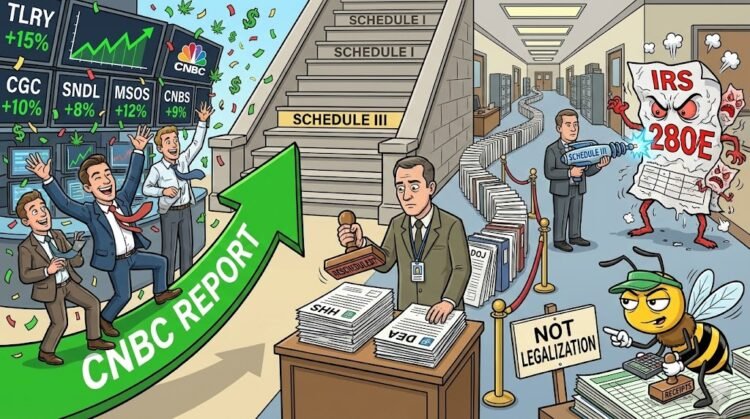
A CNBC headline, a market rally, and an entire industry watching the federal government like it’s a moody landlord who might finally fix the heater.
Cannabis stocks and marijuana-focused ETFs just did that thing they always do when Washington coughs in their direction: they levitated. After a CNBC report said President Donald Trump is expected to sign an executive order as soon as Monday directing a major easing of federal marijuana restrictions by moving cannabis from Schedule I to Schedule III under the Controlled Substances Act, traders treated the news like a starter pistol and sprinted into the sector with the enthusiasm of people who have never been harmed by the phrase “expected to.” Names like Tilray Brands, Canopy Growth, SNDL, and Curaleaf got the love. Marijuana-focused ETFs like the AdvisorShares Pure US Cannabis ETF and the Amplify Seymour Cannabis ETF surged too, because nothing says disciplined investing like a regulatory rumor and a chart that points upward.
If this executive order arrives on the reported timeline, rescheduling would be a meaningful shift. Schedule III would acknowledge medical use and reduce regulatory friction. But the real firework, the one that makes traders grab their phones, is tax. The move would potentially neutralize the industry’s punishing treatment under IRS 280E, the federal tax rule that blocks standard business deductions for businesses trafficking in Schedule I and II substances. For cannabis companies that have been living in the financial wilderness, 280E is not a footnote, it’s the monster under the bed. It forces operators to pay taxes like they’re printing money while simultaneously drowning in compliance costs, banking workarounds, and a capital market that loves the idea of weed but hates the inconvenience of federal illegality.
So Wall Street did what it always does. It priced the dream, not the process.
Schedule I vs Schedule III and the Federal Government’s Longstanding Commitment to Pretending
Schedule I is the government’s top-tier “no accepted medical use” category. It’s where the law parks substances it wants to treat as inherently suspicious. Schedule III, by contrast, includes drugs recognized as having medical use and lower abuse potential than Schedule I or II. Moving cannabis to Schedule III would be the federal government admitting, in an official filing-cabinet sense, what millions of Americans have known for years: cannabis has medical use, and the current classification is a political artifact that has outlived whatever logic it claimed to have.
That admission matters. It can change research rules. It can soften compliance burdens. It can send signals to regulators and financial institutions that the federal posture is thawing. It can create a path for more pharmaceutical distribution and expanded research opportunities. It can make the industry feel less like it’s operating inside a legal funhouse where every door looks like an exit until you push on it.
But the most immediate and material change is 280E. Investors aren’t buying cannabis stocks because they suddenly became emotionally invested in scientific research protocols. They are buying because they want companies to stop paying taxes like a cartel while being expected to operate like a normal business.
If Schedule III rescheduling neutralizes 280E for cannabis operators, that changes margins. It changes cash flow. It changes whether “profitability” becomes a real word instead of a PowerPoint fantasy. It changes whether multi-state operators can reinvest in growth rather than mailing checks to the IRS that feel like punishment for existing.
That’s why the rally happened. It wasn’t about moral progress. It was about spreadsheets.
The Great American Cannabis Contradiction
The cannabis sector has been trapped for years in a contradiction that only the United States could sustain with this much confidence. State legalization is widespread. Dispensaries operate openly. Consumers buy regulated products with receipts. Whole economies have formed around cultivation, retail, and ancillary services. And yet at the federal level, cannabis remains illegal, which turns every normal business function into a workaround.
Banking becomes a nightmare. Payments become complicated. Institutional financing becomes skittish. Compliance costs spike. Operators pay for security like they’re guarding diamonds. They build internal systems designed not just to sell a product but to survive the legal ambiguity. Everyone lives inside a regulated market wrapped in federal risk, like a circus tent pitched on quicksand.
Rescheduling to Schedule III doesn’t solve the contradiction entirely. It doesn’t make cannabis federally legal in the way people casually mean when they say “legal.” It doesn’t automatically create expungement policies. It doesn’t erase state-federal conflicts overnight. But it is a large signal that the federal government might be moving from “absolutely not” to “fine, whatever, but we still want control.”
That is enough for markets to celebrate, because markets celebrate direction more than destination.
Wall Street’s Favorite Drug: Regulatory Anticipation
The CNBC report said Trump is expected to sign an executive order as soon as Monday. The phrase “expected to” is the financial equivalent of “my friend totally knows someone,” and it has moved more money than most congressional committees. Traders piled in on the assumption that the White House will deliver the order quickly, and that rescheduling will follow in a form that materially improves the operating environment.
This is the moment where the market becomes a mood ring. It reflects hope. It reflects impatience. It reflects the belief that a presidential signature is the same thing as a regulatory outcome. It is not. A headline can be immediate. Implementation is slow. Rulemaking is slower. Litigation is a slow-motion tar pit. And agencies interpret directives through their own institutional instincts, which often include protecting turf and avoiding blame.
The report also stressed that rescheduling is not full legalization and would still require follow-through across agencies and procedural mechanics that could slow, narrow, or litigate the practical impact. That’s the part traders always skim, like the terms and conditions box you click without reading because the app is already open and you want your dopamine.
The cannabis industry has lived through this cycle. There’s a headline. There’s a rally. Then there’s a long period where lawyers and regulators argue about what the headline actually means. During that period, companies still have to pay bills. They still have to comply. They still have to navigate banking. They still have to manage capital costs. The gap between “federal thaw” and “functional reform” is where a lot of hope goes to die.
The Bureaucracy: The Part Where the High Wears Off
Even if the White House issues an order quickly, the scheduling process involves agencies like HHS, the DEA, and the Justice Department. That is where the fun begins, because bureaucracies move like glaciers with email. HHS can evaluate medical use. The DEA has formal scheduling procedures. Justice can interpret. There are timelines, notices, comment periods, and the kind of administrative steps that make normal people want to lie down on the floor and become furniture.
This matters because markets are pricing an immediate federal thaw, while the legal structure still contains choke points. The choke points are not theoretical. They are how the system is built. Agencies can interpret the scope narrowly. They can slow-walk. Opponents can sue. States can complicate. Congress can posture. The result is that a rescheduling headline can become a bureaucratic drag race where nobody’s foot actually touches the gas.
The optimistic scenario is that rescheduling proceeds smoothly, 280E relief arrives, banking improves, and the industry finally gets to behave like an adult sector rather than a tolerated outlaw. The pessimistic scenario is that rescheduling becomes a prolonged procedural fight, with partial changes that leave 280E relief uncertain or delayed, while the industry remains stuck in a half-legal limbo that’s great for consultants and terrible for operators.
Markets are betting on the optimistic scenario because markets love optimism, especially when the alternative is patience.
Trump, Optics, and the Strange Politics of Weed
The political angle is its own kind of weird. Cannabis reform has long been associated with civil liberties arguments, criminal justice reform, and cultural change. It’s also deeply popular across many demographics. That makes it ripe for opportunistic positioning. A Trump move on rescheduling would signal a friendlier posture without committing to full legalization. It would allow the administration to claim a “common sense” reform while avoiding the more uncomfortable questions about criminal justice, expungement, and the human wreckage of the drug war.
Rescheduling is the version of reform that can be framed as administrative pragmatism rather than moral reckoning. It’s a way to help an industry and acknowledge medical use, while still leaving the enforcement architecture largely intact. It can be sold as modernizing policy without explicitly admitting the past policy caused harm.
That is politically convenient. It is also why reform advocates will immediately push the next questions. If the administration is moving cannabis to Schedule III, what does that mean for people still suffering legal consequences from cannabis offenses. What does it mean for expungement. What does it mean for federal arrests and prosecutions. What does it mean for the broader reform measures that have been hanging in legislative limbo, like banking legislation.
Those questions are the part of the story that markets don’t price in because they don’t show up as quickly in earnings reports. But they matter, because the cannabis debate isn’t just about corporate margins. It’s also about who got punished and who gets to profit now.
Banking, Payments, and the Long Walk From Signal to Service
One of the reasons rescheduling matters is the signal it sends to banks and payment processors. Federal illegality has made many financial institutions unwilling to touch cannabis money. That has forced businesses into cash-heavy operations, which increases crime risk and logistical costs. It has also created a cottage industry of workaround finance, charging fees for access to basic services.
If rescheduling to Schedule III is seen as reducing legal risk, banks might become more willing to serve the industry. Payment systems might open up. Institutional investors might feel less squeamish. Financing might get cheaper. Those changes would be meaningful, but they won’t happen automatically because a president signs something.
Banks are cautious. They have regulators. They have compliance departments that treat ambiguity like poison. They will want clarity from agencies and guidance that makes it safe to do business. That takes time. It takes rulemaking. It takes policy alignment. It takes the slow process of trust being rebuilt after years of federal contradiction.
So yes, rescheduling could be a major step. But the timeline is not the same as a stock chart.
The Multi-State Operators and the Hope of Normal Margins
Multi-state operators have been living with a cost structure shaped by federal limbo. They juggle different state regulations, different tax rules, different licensing regimes, and federal constraints that make national scale harder. They also carry the burden of 280E, which punishes them for selling a product that states have legalized.
If 280E relief becomes real, it would change the math for these companies. It could stabilize margins. It could improve cash flow. It could reduce the need for financial engineering. It could make the industry less dependent on expensive capital.
That’s why traders are piling into names associated with the sector. They are betting that the federal government is about to stop treating cannabis businesses like unrepentant criminals for tax purposes. They are betting that “normal” might finally apply.
But the industry has been burned before by Washington almost doing something. Investors have watched legislative efforts stall. They’ve watched regulatory signals get complicated. They’ve watched hype cycles crash into procedural reality. The sector is full of people who can read a rumor and still feel a cold sweat.
Receipt Time The Market Bought the Headline, Not the Rulebook
Cannabis stocks and marijuana ETFs surged on a report that Trump may sign an executive order as soon as Monday pointing toward moving cannabis from Schedule I to Schedule III, a shift that would acknowledge medical use and potentially deliver the industry’s biggest prize by neutralizing 280E and unlocking more normal tax treatment and a friendlier banking and financing path, while also reminding everyone that rescheduling is not legalization and still has to survive agency procedures at HHS, DEA, and Justice plus the slow grind of rulemaking and possible litigation, leaving the next few weeks defined by whether the order actually arrives on schedule, how regulators interpret the directive, how quickly tax and banking realities change for operators, and whether the political system treats reform as a profit-friendly thaw or a doorway to the harder questions about justice, expungement, and what real federal change looks like beyond a market rally.