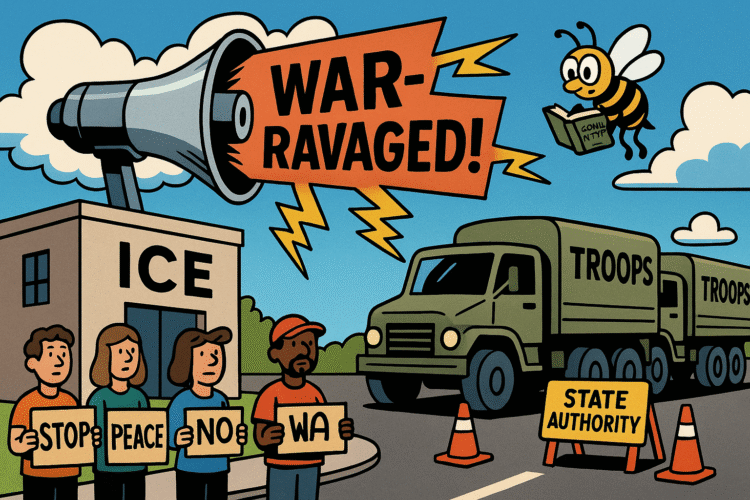
The president has dusted off his 2020 scrapbook and decided Portland, Oregon, looks best under military occupation. Once more, the word “domestic terrorist” has been stretched to cover anyone carrying a megaphone near an ICE building. Once more, federal power has been dressed up as patriotism and pointed at a blue city that never asked for it. And once more, the law is being treated like a prop on the set of a reality show that never got canceled.
Governor Tina Kotek and Mayor Keith Wilson did what adults are supposed to do: they told the president no. No to his convoys, no to his fantasy of urban warfare, no to his “full force, if necessary.” Portland is not war-ravaged. It’s not on fire. It’s a city with potholes, bike lanes, and a healthy protest culture. That is called democracy. And democracy is apparently intolerable to a man who prefers the optics of troops against his own citizens.
The Timeline Nobody Asked For
Morning: The president announces troops to Portland, threatening “full force” to protect ICE. He names no units, no plan, just the promise of military hardware on American streets. The social media clips are ready before the lawyers have even brewed their coffee.
Midday: Oregon’s leadership pushes back. No consultation. No need. No legal basis. They remind the White House that city conditions are calm and the only violence currently present is in presidential rhetoric.
Afternoon: Reporters try to decode what “troops” means. Are we talking Guard under state control? Federalized Guard under Title 10? Active-duty Army? The Insurrection Act? The Pentagon and DHS offer only fog, as though the plan itself is a mirage designed for headlines, not streets.
Evening: Congress and civil-rights groups enter the chorus: this is unlawful, unnecessary, and exactly the sort of provocation guaranteed to turn a quiet weekend into a campaign rally. Portlanders, meanwhile, keep doing what they do best: live.
The Law Is Not a Mood
There are only a few tools in the toolbox for deploying troops at home. Posse Comitatus restricts the Army and Air Force from acting as police. Title 32 allows state-controlled Guard to assist, but the governor holds the keys. The Insurrection Act is the nuclear option, reserved for rebellion or collapse. None of those conditions are met. What we have instead is a president leaning on military language because law enforcement doesn’t give him the footage he wants.
To deploy “full force” here would be not only authoritarian—it would be unlawful. The Constitution sets limits for a reason: to restrain the mood of the executive. The president’s mood is not the same as an emergency. The president’s boredom is not the same as a rebellion. And the president’s desire for riot footage is not the same as lawful justification.
The Pentagon’s Eternal Question: “Define ‘Troops.’”
Officials inside the Pentagon have been here before. They know a presidential order can mean anything from “send a few marshals” to “roll tanks into downtown.” They know clarifying can cost them their jobs. They know obeying can cost them their reputations. And DHS knows its role too: print out a threat bulletin, deploy more fencing, and hold a press conference in front of a door. The spectacle matters more than the details. The military isn’t supposed to be a stage prop, but here it is again.
Portland’s Crime Data: The Dog That Didn’t Bark
Violent crime in Portland is not spiking. Saturday’s scene was a small, peaceful protest. The governor said the city was “doing just fine.” That phrase infuriates authoritarians. They require burning streets to justify their response. They require chaos to feed order. When the chaos doesn’t exist, they import it, narrate it, and demand cameras pan tighter until the fiction looks real. But fiction isn’t law. And fiction isn’t justification for sending troops into a state that has refused them.
Federalism vs. The Chyron
This is where the stakes sharpen. If the president can override a governor and deploy troops without consent, then federalism is reduced to a slogan. Today it’s Portland. Tomorrow it could be any city that displeases him. Federal property does not mean federal martial law. There are marshals for that. There are federal police for that. Replacing them with soldiers is like using a chainsaw to spread cream cheese: dangerous, clumsy, and entirely unnecessary.
The Authoritarian Playbook
Call protestors “terrorists.” Call dissent “war.” Announce “full force.” Pretend the Insurrection Act is a switch you can flip at will. That is the playbook. It’s been used before. It will be used again. The goal is not order; the goal is submission. The difference between lawful protest and rebellion collapses, and suddenly the First Amendment is a threat rather than a right.
This is not just fascist in spirit—it is fascist in practice. Using the military against your own people is the textbook definition of authoritarian overreach. It’s what the Constitution was written to prevent. It’s what generations of soldiers swore they would never do. To say “by any means necessary” in defense of a federal building is to announce that rights, laws, and limits are optional. That is not democracy. That is autocracy wearing a flag as a cape.
The Stakes Beyond Portland
Set the precedent here, and you invite it everywhere. Deploy troops today in Portland, and tomorrow in Detroit, Dallas, or Des Moines. Blue cities are the opening act, but the play runs long. Once normalized, the line between military and police blurs, then vanishes. The First Amendment becomes a casualty of convenience. And every protest, no matter how peaceful, becomes one commander-in-chief’s excuse to rattle sabers.
Portland’s Answer
The city refused the script. No riots, no flames, no manufactured backdrop for campaign ads. Just people, governing themselves, insisting that troops are not needed. Portlanders refused to burn for his storyline. That refusal is powerful. Authoritarians depend on spectacle; without it, they look ridiculous. And ridicule is lethal to power built on theater.
The City That Wouldn’t Burn
A president tried to conscript Portland into his war movie. Oregon told him no. The Pentagon hesitated. DHS hedged. Congress muttered. Residents brewed coffee. And the law remained: troops do not belong in cities that never asked for them, rights are not props for weekend rallies, and the First Amendment is not negotiable. Fascism is loud. Democracy is steady. Portland chose steady. The real danger was never the protestors. It was the script.