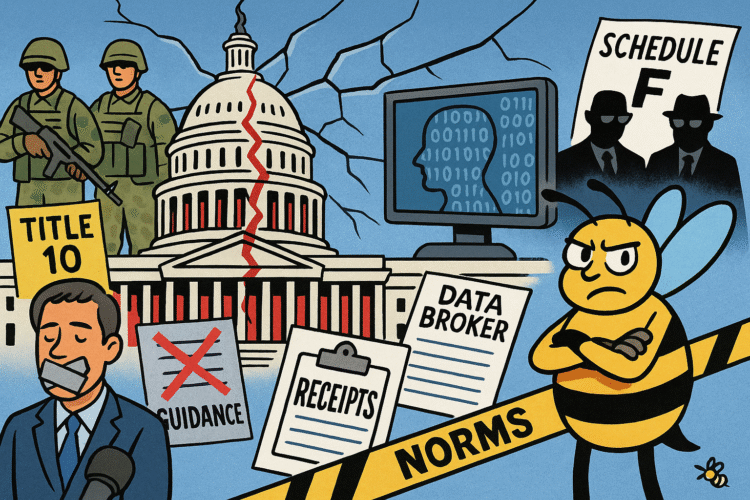
Grief and fury arrived together, like relatives who cannot stand each other but share a last name. One sits with a box of tissues and tells you to breathe. The other opens a window and says jump or move. I remember the moment the country broke, not as metaphor but as sound, a brittle snap in dry winter air. It was 2015, and the crack ran along places I had trusted to hold, the seams of shame, the seams of fact, the quiet seams that keep a carnival barker on the midway and out of the Situation Room. The break did not heal in 2016. It did not scab in 2017 or 2018. It became weather. We learned to live inside a drafty house, taping towels along the baseboards, telling ourselves this is fine. It was not fine. We know that because 2025 has turned grief into inventory and fury into a ledger. If satire is going to do any work at all, it needs receipts.
Two threads, braided tight. First, the ache that the country never snapped back to decent form. Second, the names, offices, statutes, and timelines that make the ache real. The jokes stay only if the steel stays under them. When soldiers stand on American streets, when masked agents wait outside clinics, when a federal memo teaches line attorneys to rename crimes, when an inspector general is escorted to a windowless room with a broken copier and a smile, you need nouns and verbs. You need plain English.
Start where the sound first echoed. The weekend of Access Hollywood. A confession spoken like a boast. The party decided character was negotiable. The country bent. By late October, a letter vague enough to be explosive and official enough to be treated like scripture dropped into the campaign like a grenade. We learned that norms are not guardrails. They are etiquette. They hold only if someone chooses to honor them. Many people prefer a broken country if they believe they can own the pieces.
The pattern that followed was a method, not a mood. The Muslim ban that pretended geography is smarter than principle. Family separation that treated toddlers as leverage and parents as cautionary tales. A first impeachment that asked us to accept extortion as diplomacy. A second that asked us to forgive incitement as commentary. A call to find votes as if certification were a scavenger hunt. Indictments and plea deals that drew the outline in ink. A Supreme Court remade with three justices who delivered Dobbs and converted medicine into criminal exposure. Pandemic stewardship that measured success in ratings while refrigerated trucks testified otherwise. January 6 that tried to nullify certified votes and then posed for photos inside a looted chamber. None of it snapped back. The Senate filibuster stayed. The Electoral Count Act limped to repair after the fire. Gerrymanders drew districts that look like cartoons and govern like kings. Dark money paid for moods. Algorithms discovered that rage is profitable and shame is free. Newsrooms learned to speak in euphemism so they would not be called names.
The decade’s arc bends toward exhaustion. We staggered into 2025 like people who slept in their cars, congratulating ourselves on survival while the house keys quietly changed hands. That is the context for the 2025 ledger. No flourish. Just items.
Uniformed troops in U.S. cities under a patchwork of Title 10 signals and Title 32 cover, a blurry chain of command marketed as order. Local officials disputed both need and authority. The footage shows soldiers standing where social workers used to stand. That is not symbolism. It is policy.
Masked ICE and Homeland Security task forces saturating neighborhoods with expanded surveillance. Unmarked SUVs, midnight perimeters, names withheld, cameras out of frame. Ankle monitors as daily attire. A round the clock social media watch floor that scans your feed for keywords and convenient dissent. The press release says targeted. The effect is generalized. A nephew posts a joke about a march. A mother ties her shoes and asks if today is the day someone knocks.
A resurrection of Schedule F in spirit if not label. Civil service protections thinned. Career posts converted to loyalty slots. Mass firings and forced transfers across DOJ, Defense, DHS, State, EPA, Education, HHS. Prosecutors sidelined. Inspectors general moved to corners. Expertise recast as disloyalty. The apolitical state turned into a staff pool that serves the leader, then learns it was never supposed to be anything else.
A Justice Department culture of gag rules and memo rewrites. January 6 evaporates from filings as if the date itself were defamation. Line attorneys disciplined for insisting that facts remain nouns. Discipline reads tidy in a performance evaluation. It looks like a lawyer packing a plant into a cardboard box.
Pentagon churn. Political commissar style appointees installed with résumés built on cable segments instead of commands. Retirements accelerate among officers who thought an oath was a promise, not a prop. Civilian control of the military is a democratic principle. Partisan micromanagement is a slow poison disguised as civilian control.
Rulemaking blitzes that shovel through labor, environment, consumer protection, and civil rights with interim final rules and guidance built to dodge notice and comment. Publish now and dare courts to catch up later. The interim period becomes the policy. The damage is measured in lungs, wages, water, and teeth.
Grant freezes that punish blue jurisdictions with cheerful bureaucratic delay. Press access limits, blacklists, and pool games for outlets that insist on plain language. Asylum bans by fiat. Refugee admissions as a campaign lever. Family detention rebranded as care. Raids at kitchens and factory floors. Medicaid data and data broker dossiers siphoned into enforcement pipelines. Health information and location histories turned into maps with arrows and dates.
Public broadcasting independence consolidated into a patronage system. Civil society grants tilted to friends and themes. Boards and commissions restaffed with loyalty first appointees who turn science advice into repetition. Preservation review becomes a rubber stamp for donor friendly projects that will outlast the donors. The old rule measured twice and cut once. The new rule cuts now and edits the press release.
If you are waiting for a reassuring pivot, you are reading the wrong ledger. The point is not that everything is lost. The point is that much has been repurposed and many people in the building are new. The repair is not sentimental. It is personnel and statute and time.
Thread the ledger back through the long arc. Access Hollywood to the letter that landed like a hammer. Muslim ban to family separation. Impeachment one to impeachment two. A county level request to find votes. Indictments and plea deals. A post Roe world of bounty style laws that deputize neighbors against neighbors. Book bans and anti trans crusades that narrow the public square and rename persecution as parental rights. Voting restrictions that reverse the slow arc of enfranchisement while posters shout fraud. Pandemic lies that metastasized into a genre. Shutdown brinkmanship treated as governing. Tariff theatrics that hit workers and prices and then pretended to be patriotism on sale. A second term defined by censorship by intimidation, watchdogs mocked as the deep state, prosecutors pushed aside, civil servants taught to be grateful for silence.
Institutions bent because bending was easier. The filibuster smothered majoritarian policy. The Electoral Count Act limped forward after damage. Gerrymanders hardened. Dark money flowed without names. The media marketplace paid better for outrage than accuracy. The newsroom euphemism machine converted plain facts into passive sentences until the subject disappeared. Everything that should have been a brake became a cushion.
Grief stays because this is the home we live in. Fury stays because reality deserves more than a shrug. But neither of them is a plan. What is left is the part we prefer to skip, the portion without uplift. The country has three more years of this presidency on the clock. That is the arithmetic. It will get worse before it gets better. That is not melodrama. It is what happens when a purge repopulates a government and settles in to write procedures as inheritance.
So what does truth sound like when you remove the pep talk. It sounds like a tally. It sounds like a schedule. It sounds like instructions a tired country would rather not read.
The path back, if there is one, runs through majorities that do not exist yet. It runs through statehouses that have been treated like hobbies. It runs through courts where facts must compete with faction and patience is not a luxury. It runs through agencies where professionals still show up with a bag packed under their desks. It runs through local newsrooms and civic classrooms that need money and independence more than they need slogans. It runs through antitrust work that strips monopoly and algorithmic rage of their subsidies. It runs through inspectors general who need budgets and allies and a public willing to read the footnotes.
And it runs through our willingness to speak plainly about loss. Ten years is a long time to watch a break become the shape of the room. Ten years is a long time to accept the idea that the loudest voice is the truest voice. Ten years is long enough for neighbors to forget how to argue without trying to erase each other. We do not get those years back. We will lose more. This is not a promise of doom. It is a reminder that timelines are real. Rebuilding an apolitical state after a loyalty purge is generational work. Undoing a judiciary stacked for outcome is generational work. Recreating trusted local information is generational work. Teaching students how to spot manipulation is generational work. Convincing a discouraging electorate that power has not abandoned them, and that their time is worth spending again, is generational work.
Satire helps only when it keeps the light harsh. I can list the images that stay in my head because they are the point. A soldier at dusk on a domestic street. A woman tugging an ankle monitor at a bus stop. A lawyer closing a box and nodding to a colleague who keeps typing because deadlines do not avert their eyes. A science panel stuffed with slogans where expertise should sit. A library shelf with empty spaces that a child traces with a fingertip. None of this is theory. None of it is temporary in the way people like to use that word. The damage is already coded into policy, staffing, contracts, calendars.
If you want a final act with redemption music, stop reading here. If you want a statement of truth, stay with me. The next three years will be harder than many people are willing to admit out loud. The machinery that commands troops, prints rules, sets dockets, freezes grants, grants waivers, writes guidance, and restrains speech has been tuned to serve power, not the public. The camera will always find a different story to tell, because profit prefers spectacle to spreadsheets. The courts will sometimes help and sometimes consecrate the harm. Some states will build parallel institutions that soften the blow. Others will sharpen it. The federal civil service will keep showing up, and some of its best will leave.
There is one part of the ending I will not sand down. If we do not fight, if we do not try, then democracy hangs in the balance. This is not uplift. It is a warning label. Fighting is not performative. It is procedural and sustained. It is ballots cast in boring elections at unglamorous times. It is plaintiffs with clean records and lawyers who like building a record more than building a brand. It is lawful mass presence that says the street still belongs to the public. It is grants for local reporters who cover zoning boards and contracts. It is tuition stipends for teachers who want to teach civics without being turned into targets. It is alliances across people who do not like each other much but like freedom more. It is refusing to talk like a press release when something ugly deserves a subject and a verb.
We tend to ask what victory looks like. Wrong question for the time we live in. The right question is what survival looks like. Survival looks like winning enough of the ballot battles to keep gatekeepers honest, enough of the court fights to force rulemaking back into the law, enough of the street to remind officials that silence is not consent. Survival looks like buying time for institutions to unlearn loyalty tests and remember what public service is. Survival looks like telling younger people the truth so they are not gaslit into thinking this was normal.
It will not feel heroic. It will feel like maintenance. It will feel like standing in lines. It will feel like reading documents no one else wants to read and then showing up again. It will feel like watching defeats pile up and refusing to walk away. It will feel like voting for options that disappoint you and then harassing those options into acting like the adults they claim to be. It will feel like donating to outlets that will never get a Netflix deal. It will feel like holding two truths without dropping either, that the country is worse than we tell ourselves and that the work is still worth doing.
The country cracked like sugar glass. The edges cut. The shards glitter. We will be tempted to call the glitter beauty. It is not. It is evidence. Say what was broken. Say who broke it. Say what they took. Say what they are taking next. Then decide, without romance, to spend the next decade acting like the stakes are what they are. We have three more years of this presidency. It will get worse before it gets better. Our job is to build the coalition, speak out, stay realistic, be pragmatic. We will not get what we want. We must still make sure we win, at the ballot box, in the court, and on the streets. Not for a happy ending. For a future that still has elections, still has courts that accept facts, still has streets that belong to the people who walk them. Our democracy, and the future of this country, depends on telling the truth about what has been lost, admitting what more will be lost, and doing the work anyway.