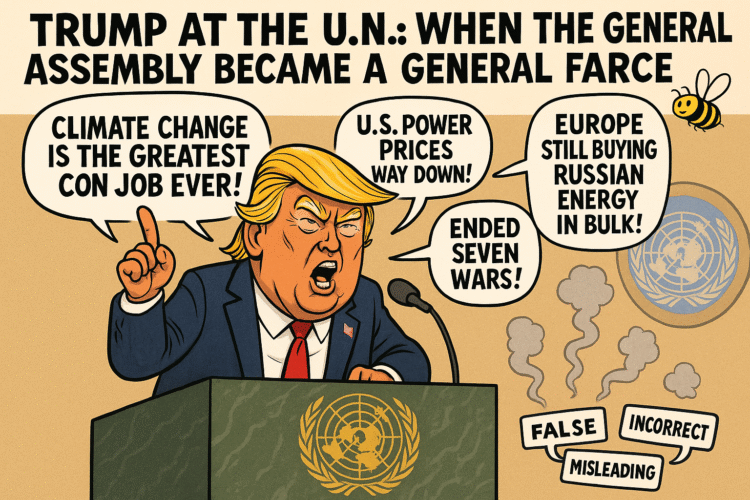
There are speeches you remember because they alter the course of history. There are speeches you remember because they contained a moral appeal so clear that even enemies nodded. And then there are speeches you remember because the escalator broke, the teleprompter glitched, and the President of the United States called climate change “the greatest con job ever” while delegates quietly googled how to fake appendicitis to escape the hall.
Yes, President Donald J. Trump’s address to the United Nations General Assembly has already joined the pantheon of ignominy, filed somewhere between Khrushchev’s shoe and Muammar Gaddafi’s 96-minute ramble. Except this one, unlike the others, was delivered in a sea of verifiably false claims so relentless that fact-checkers began passing out smelling salts.
Scene-Setting: The Theater of the Absurd
The U.N. General Assembly, for all its diplomatic theater, is meant to be a temple of seriousness. On September 23, 2025, the room looked less like a temple and more like a classroom enduring a substitute teacher reading from Twitter. Trump strode in to scattered applause—some real, some courtesy-clapping from smaller nations that depend on U.S. aid—and proceeded to declare that climate change was “the greatest con job ever perpetrated on humanity.”
The delegates stared as though they’d been told that gravity was a socialist plot. A few whispered to aides: Is he joking? No, he wasn’t. He continued: “America has ended seven wars under my leadership.” For reference, the State Department has confirmed zero such events. Conflicts have not only persisted, some have intensified. One imagines the Pentagon scribbling “???” in Sharpie over their own war maps.
Then came the line about Europe “still buying Russian energy in bulk.” It was 2025, not 2021. EU fossil imports from Russia are down over 90 percent. But facts have never been the warm-up act at Trump’s rallies—or his U.N. speeches.
The Speech: A Reconstructed Journey
Let’s reconstruct the address as it unfolded, alongside the actual record.
Trump: “The fake scientists and corrupt bureaucrats sold you a bill of goods called climate change. The greatest con job ever.”
Reality: Ninety-seven percent of climate scientists agree that human activity is warming the planet. The hottest years on record are the past nine. Wildfires, floods, and heatwaves are not Marxist holograms. They are empirical.
Trump: “I ended seven wars. America is at peace because of me.”
Reality: The U.S. remains militarily engaged in Syria, Iraq, and countless counterterrorism theaters. Ukraine, Gaza, and the Red Sea conflict all escalated during his presidency. Ending wars, it turns out, requires more than announcing it in all-caps on Truth Social.
Trump: “Europe, they’re still buying Russian oil and gas. You know it, I know it, everybody knows it.”
Reality: Imports of Russian fossil fuels have collapsed since sanctions took hold in 2022. Europe’s economy, for better or worse, has contorted itself to break dependence. Everyone does not know it—except, perhaps, Trump.
Trump: “U.S. power prices are way down. We’re winning so big you can’t even believe it.”
Reality: Retail power prices have risen in most U.S. regions, thanks to fuel volatility and grid investments. The average household bill has not fallen. If by “down,” he meant “up,” then sure.
Trump: “We don’t pay for these U.N. programs anymore. We only pay when they respect us.”
Reality: The U.S. remains in arrears on peacekeeping dues and cut contributions to climate funds. Diplomats muttered about hypocrisy: it’s hard to demand influence in an organization while stiffing the bill.
The Odd Sideshows
It wouldn’t be Trump without some slapstick. The infamous Trump Tower escalator that launched his political career has apparently cursed him. At the U.N., the private escalator ferrying him to the podium stalled midway, leaving him stranded while aides scrambled to push the emergency button. The moment was instantly meme-ified as “America’s Foreign Policy in One GIF.”
Then came the teleprompter. Mid-speech, the screen flickered. Trump sneered, called it “a Democrat teleprompter,” and ad-libbed a ramble about wind turbines killing whales. Delegates from small island nations—whose coastlines are drowning—sat frozen, weighing whether to walk out or nap through the nonsense.
The World Responds
Wire services and fact-checkers pounced with unusual speed. Reuters, AFP, and the Associated Press all ran same-day “Fact-Check” boxes, bluntly labeling his statements “false” or “misleading.” The BBC’s diplomatic editor dryly tweeted: If climate change is a con job, it is also responsible for melting glaciers I personally stood on last year. Perhaps I was conned by water.
The New York Times fact-checkers rolled out a live blog, with entries like: Claim: Ended seven wars. Truth: No record of wars ended. Claim: Power prices down. Truth: They are not. Claim: Europe buying Russian energy. Truth: Almost entirely phased out. The speed and bluntness suggested not journalistic rigor but survival instinct—an effort to prevent the spread of lies by burying them under corrective paragraphs.
Even Fox News struggled, delicately phrasing it as “Trump offered his own version of events.” That’s what most of us call “lying.”
The Stakes: More Than Just Comedy
Trump’s misstatements would be comic relief if not for the stakes. When the head of state of the world’s largest economy uses the General Assembly podium not for diplomacy but for grievance cosplay, credibility collapses.
On climate policy, dismissing global warming as a scam undermines cooperation just as nations negotiate emissions targets for the late 2020s. If the U.S. signals open sabotage, why should India, Brazil, or China keep playing?
On Ukraine sanctions, pretending Europe is still guzzling Russian oil undermines the narrative of Western unity. The Kremlin will surely blast Trump’s quote across RT, proof that “even America’s president admits sanctions are fake.”
On migration, Trump’s derision of green policy and migrant flows as sending nations “to hell” doubles down on scapegoating at a time when climate-linked migration is accelerating. Delegates from Africa and Latin America heard not just insult but erasure: their crises reduced to punchlines.
And on credibility, perhaps the most precious currency in international affairs, the damage is immeasurable. Allies already hedging against U.S. unreliability now have fresh evidence. When America calls on others to sacrifice for collective goals, the natural response will be laughter—or worse, indifference.
The Pattern: Disinformation as Diplomacy
Trump’s U.N. appearance didn’t malfunction by accident. It showcased a pattern: disinformation as governing. Rather than address policy, he injects falsehoods to dominate headlines. He understands that once the claim is made, it cannot be unmade. “Seven wars ended” will circulate on social media, repeated uncritically, while corrections vanish into the footnotes.
That is the new diplomacy: not persuasion, but narrative flooding. International forums become backdrops for domestic soundbites. The U.N. is no longer a stage for negotiating treaties but for launching memes.
The Delegates’ Dilemma
So what did the delegates do? Some walked out quietly—Scandinavia, predictably. Others stayed, calculating that antagonizing Washington carries costs. Most sat in awkward silence, scribbling notes like “don’t clap here” or “pretend to cough during this line.”
When the speech ended, the applause was tepid. Trump flashed his trademark thumbs-up, oblivious to the sea of side-eye. Outside, climate activists waved placards calling him “Fossil Fool.” Inside, translators sighed in a dozen languages, forced to render “con job” into diplomatic prose.
The Escalator Out
Afterward, Trump attempted to exit, only to be delayed again by the same faulty escalator. Delegates smirked. Aides hustled him onto a service stairwell. One French diplomat quipped: The escalator is the only thing that resisted him today.
The Broader Implication
Mockery aside, the broader implication is chilling. When disinformation is mainstreamed at the U.N., the very idea of shared facts collapses. If the world cannot even agree that climate change exists, or that sanctions work, or that wars continue, then cooperation becomes impossible. That is the true cost of Trump’s speech: not embarrassment, but entropy.
Entropy where once there was at least the possibility of order.
Summary: The Con Job Is the Presidency
Trump called climate change “the greatest con job ever.” But the real con job was the speech itself—a performance in which falsehoods masqueraded as facts, theater masqueraded as diplomacy, and grievance masqueraded as leadership.
The escalator stalled, the teleprompter flickered, and the truth itself broke down under the weight of one man’s need to turn the world’s most important stage into his personal rally.
The world did not end seven wars that day. It endured one more: the war on reality.
Summary: Trump’s U.N. speech was not merely another exercise in exaggeration. It was a direct assault on the shared truths international diplomacy requires. By branding climate change a hoax, pretending Europe buys Russian oil, and claiming personal credit for imaginary peace deals, Trump degraded U.S. credibility while handing adversaries propaganda victories. The sideshows—the stalled escalator, the teleprompter glitch—were metaphors made flesh: a presidency whose machinery is broken, sputtering, and comic. But the stakes—climate coordination, sanctions coherence, migration policy, and U.S. leadership—are deadly serious. When the president of the United States chooses disinformation over diplomacy, the world inherits the bill.