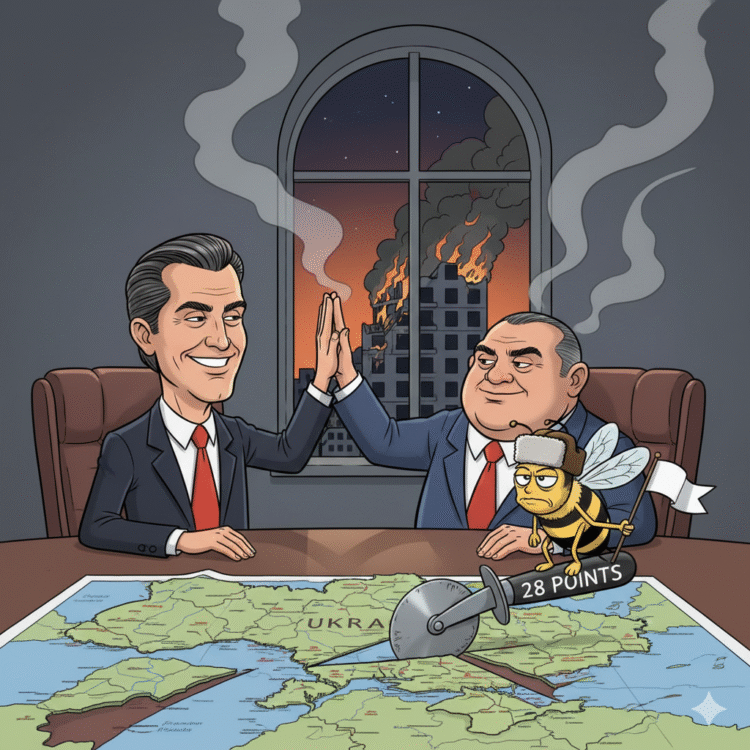
The modern history of diplomacy is usually written in treaties, summits, and carefully worded communiqués. But the history of the Trump administration is written in term sheets. On November 19, 2025, the world learned exactly what happens when you outsource geopolitics to a real estate developer and a sovereign wealth fund manager. The Guardian revealed that Steve Witkoff, Trump’s special envoy and golf buddy, and Kirill Dmitriev, a Kremlin adviser who treats state sovereignty like a distressed asset, have quietly drafted a twenty-eight point “peace plan” for Ukraine. The document was delivered to Kyiv with the subtle grace of an eviction notice taped to a burning door.
The proposal is not a peace treaty. It is a liquidation sale. The plan demands Ukraine’s total capitulation, including ceding the entire Donbas region, halving its military personnel to 400,000, and enshrining Russian as a state language. It reads less like a negotiation and more like the terms you accept when you have a gun to your head and a pen in your hand. The timing was cinematic in its cruelty. The proposal arrived in Kyiv on the exact same day a Russian missile strike slammed into a residential building in Ternopil, killing twenty-six civilians. The ink on the surrender document was still wet while the smoke was rising from the apartment block.
To the Trump administration, this juxtaposition is not a tragedy. It is leverage.
The absurdity of Steve Witkoff, a man whose expertise lies in luxury condos and tax incentives, redrawing the map of Eastern Europe cannot be overstated. One can almost hear the boardroom banter as he and Dmitriev huddled over the draft. “If we give Putin the Donbas, can we get a variance on the NATO zoning?” It is the logic of the deal, applied to the lives of forty million people. The demand to shrink the Ukrainian military is particularly galling. It is the geopolitical equivalent of telling a homeowner they can keep their house, provided they remove all the locks, fire the security guard, and leave the back door unlocked for the neighbors who keep throwing Molotov cocktails through the window.
The requirement to make Russian a state language is the final, petty flourish of the conqueror. It is not enough to take the land; you must also colonize the tongue. It forces Ukraine to institutionalize the culture of the army that is currently shelling its power grid. This is not conflict resolution. It is humiliation codified into law.
But the tragedy here is not just American cynicism. It is Ukrainian exhaustion. The proposal lands on the desk of President Volodymyr Zelenskyy at a moment when his own house is dangerously unstable. The Ukrainian leader is already battered by a domestic energy corruption scandal that reads like a bad noir novel. His top aide, Andriy Yermak—code-named “Ali Baba” in investigative files—is implicated in a scheme involving kickbacks on energy defense funds. The man responsible for protecting the grid was allegedly skimming off the top while the lights went out.
This internal rot has created a vacuum of moral authority that the sharks are eager to exploit. Zelenskyy is fighting a war on two fronts: one against Russian ballistics and another against the greed of his own inner circle. It is hard to rally the West to defend your sovereignty when your chief of staff is treating the defense budget like a personal ATM. The corruption scandal has weakened Zelenskyy’s hand, making him look less like the Churchillian hero of 2022 and more like a besieged manager trying to keep the creditors at bay.
In a desperate bid for survival, Zelenskyy spent the day of the Ternopil strike not in Washington, but frantically courting Turkish President Recep Tayyip Erdoğan. It is a grim irony that the leader of a struggling democracy must seek a lifeline from an autocrat like Erdoğan because the “Leader of the Free World” is too busy helping Putin draft the surrender terms. Zelenskyy knows that Ankara might offer a better deal than the Mar-a-Lago annex. At least Erdoğan understands the value of a buffer state; Trump only understands the value of a closed deal.
The Trump-Putin-Witkoff plan is framed as “peace,” but it is actually a permission structure for conquest. By calling demands “maximalist,” we sanitize them. These are not demands; they are erasures. The demand to cut the army in half is a guarantee that the next invasion will be shorter. The demand to cede the Donbas is an invitation to come back for Odesa. The administration is treating the invasion of a sovereign nation as a zoning dispute that can be settled if everyone just agrees to be reasonable and give the guy with the tank what he wants.
The “peace plan” exposes the hollow core of the Trump foreign policy doctrine. It is not “America First.” It is “Authoritarians First.” The worldview is simple: strongmen should not be inconvenienced by the messy aspirations of smaller nations. If Putin wants the Donbas, he should have it, because fighting him is expensive and boring. The twenty-six dead in Ternopil are just overhead costs, regrettable but irrelevant to the final valuation.
The “28 Points” are a testament to a world where might makes right, and where the victim is blamed for bleeding on the carpet. Witkoff and Dmitriev have produced a document that will go down in history alongside the Munich Agreement, a piece of paper that bought “peace” by selling out a people. The only difference is that in 1938, they at least pretended to feel bad about it. In 2025, they just call it the Art of the Deal.
The Fine Print of Extinction
The most chilling aspect of this “peace plan” is what it implies about the future. If this is the template for resolving conflicts, then every border in the world is up for negotiation. It signals to every dictator that if you bomb your neighbor hard enough and wait for a sympathetic administration in Washington, you can rewrite the map. The twenty-six civilians in Ternopil died waiting for air defense systems that were delayed by politics; their memory is now being insulted by a “peace” that validates the man who killed them. The document is not a roadmap to stability. It is a receipt for a country sold for parts.