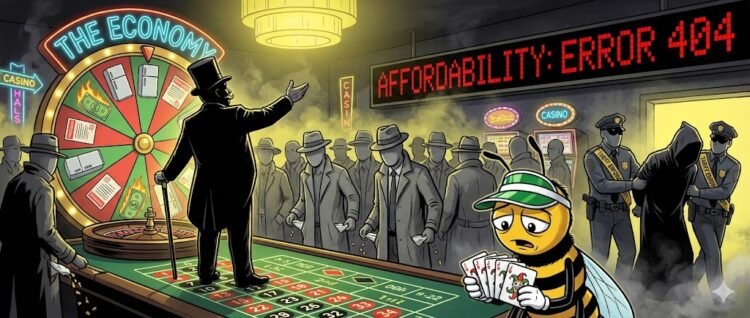
When the President tells you the price of eggs is down, but your receipt says you just took out a second mortgage for an omelet, you are living in the Golden Age of the Grift.
On Tuesday night, the traveling circus of the forty-seventh presidency descended upon Mount Pocono, Pennsylvania, bringing with it the familiar scent of spray tan, desperate ambition, and the faint, lingering odor of a reality that has been dead for three days. President Donald Trump arrived at the Mount Airy Resort and Casino for what was billed, with a straight face that surely required botox to maintain, as a serious, policy-heavy address on the affordability crisis crushing American families. The setting was perfect. It had to be a casino. Because that is exactly what the modern American economy feels like for the average worker. It is a rigged game where the house always wins, the slots are tight, the carpets are designed to keep you disoriented, and the guy running the floor is telling you that losing your rent money is actually a form of winning.
The stage was set with the subtlety of a monster truck rally held inside a library. Giant banners screamed “LOWER PRICES, BIGGER PAYCHECKS,” a slogan that feels less like a campaign promise and more like a cruel taunt to anyone who has visited a grocery store in the last twelve months. It is the kind of slogan you write when you assume your audience has lost the ability to do basic math or has perhaps suffered a collective blow to the head that erased the memory of what a gallon of milk cost in 2019. The President, ostensibly there to soothe the economic anxieties of a swing state that is currently deciding whether to heat its homes or feed its children this winter, instead treated the concept of “affordability” with the same disdain he usually reserves for wind turbines or people who don’t clap loud enough.
Fifteen minutes into the speech, he said the quiet part out loud. He called the affordability crisis a “hoax.” He later tried to walk it back, claiming he couldn’t call it a hoax because prices were too high, but the damage was done. The Freudian slip had revealed the underwear of the administration’s philosophy. In the Trumpian economic model, your struggle to pay for heat and meat is not a reality; it is a Democratic talking point. It is a scam invented by the fake news to make you feel poor, when in fact, you are rich. You just don’t know it yet because you are looking at your bank account instead of his charts. You are failing to see the invisible gold that is trickling down from the penthouse.
The Economic Fairy Tales of Mount Airy
The core claims of the night were a masterclass in alternative facts, a symphony of statistical hallucinations played for an audience desperate for a tune they could hum along to. Trump asserted that inflation is “crushed,” that “prices are way down,” and that his tariffs are generating “hundreds of billions” of dollars for the treasury. He rated his own economic performance as an “A-plus-plus-plus-plus-plus,” a grade that does not exist in any accredited institution but makes perfect sense in the university of narcissism where the only subject is the self.
Let’s fact-check this by performing a radical act of journalism. Let’s look at a receipt. Consumer price data shows that prices are not “way down.” They are up. The overall Consumer Price Index is higher than it was a year ago. Food prices are up. Housing costs are up. Insurance is up. When the President says prices are “coming down tremendously,” he is gaslighting you. He is telling you that the water isn’t rising while you are bailing out your basement with a bucket that has a hole in it. He is standing in the middle of a burning building holding a snowball and telling you that the temperature is dropping.
The claim about tariffs is perhaps the most pernicious lie in the deck. He insists, with the confidence of a man selling a monorail to Springfield, that foreign countries pay these tariffs. This is economically illiterate. It is the kind of thing you fail Econ 101 for saying. Tariffs are taxes on imports. They are paid by the importer, who then passes the cost on to you, the consumer. When he brags about the billions pouring into the treasury, he is bragging about taxing American families on their clothes, their electronics, and their food. He is picking your pocket and asking you to thank him for finding your wallet. He is the arsonist taking credit for the fire insurance payout, while you are the one standing in the ashes.
The absurdity is heightened by the visual aids. The charts behind him, glowing with cherry-picked data, showed lines going up that were supposed to go down and lines going down that were supposed to go up. It didn’t matter. The visual was the point. The aesthetic of success is more important than the reality of survival. To the man on the stage, the economy is not a system of exchange that allows human beings to live with dignity; it is a ratings game. And as long as the stock market is high, the ratings are good. Never mind that the bottom fifty percent of Americans own almost zero stock. Never mind that the “booming” market is being driven by AI speculation and defense contracts, not by the purchasing power of the middle class. In the carnival tent of Mount Airy, the only ticker that matters is the one on the screen, not the one at the gas pump.
The Tariff Trap and the Orwellian Pivot
The policy contradictions on display were dizzying, enough to give a logical positivist a migraine. In the same breath that he touted tariffs as a “beautiful word” and a money-printing machine, he acknowledged that he has had to roll some of them back on food and consumer items to lower prices.
Think about that for a second. Let the cognitive dissonance wash over you like a cold shower. If tariffs are paid by China, as he claims, why would rolling them back lower prices for Americans? If the foreigner pays the tax, why does removing the tax help the domestic consumer? The admission destroys the argument. He knows that tariffs raise prices. He knows they are a tax on the working class. But he sells them as patriotic protectionism because it sounds tough. He is playing a shell game with your grocery bill, moving the cost around while promising you that the other guy is paying for it.
We are living in a world where the government sells AI chips to foreign powers one day, touts tariffs the next, and then holds rallies claiming they are lowering costs. It is policy theater designed to keep the base loyal while shifting the economic burden onto ordinary people. It is a strategy that relies on the audience not reading the fine print, or the price tag. It relies on the belief that if you say “America First” loud enough, nobody will notice that they are finishing last.
This is Orwellian economic theater. “Lower Prices” becomes the slogan for a policy of inflation. “Bigger Paychecks” becomes the slogan for a policy of wage stagnation. The words have been stripped of their meaning and refilled with political corn syrup. The President is the MC of a carnival tent show, barking about the wonders inside, while the people outside are counting their pennies to see if they can afford admission.
The Xenophobic Pivot: When in Doubt, Blame the Other
Because no Trump speech on economics can sustain itself on math alone—mostly because the math doesn’t work—the event inevitably devolved into the uglier, more familiar territory of racial grievance. The President veered sharply from the price of bacon to attacks on Representative Ilhan Omar. He used demeaning language about her heritage. He falsely claimed she is here illegally. He stoked the crowd into chants of “send her back.”
This is the transactional cynicism at the heart of the MAGA appeal. Inflation is boring. Housing policy is hard. But hatred? Hatred is easy. Hatred is free. Hatred is the renewable energy source of the populist right. By pivoting to xenophobia, he changes the subject. He tells the crowd that the reason they can’t afford a house isn’t because of corporate price-gouging or his own tariff wars or the fact that hedge funds are buying up the neighborhoods; it’s because of them. It is because of the immigrants. It is because of the refugees. It is because of the woman in the headscarf who had the audacity to get elected to Congress.
It is a magic trick that turns economic anxiety into racial resentment, allowing the base to feel angry at the vulnerable rather than the powerful. It channels the rage of the checkout line into the rage of the lynch mob. He resurrected the “shithole countries” rhetoric of his first term, asking why we can’t have more immigrants from Norway or Denmark. It was a greatest hits tour of bigotry, played to a crowd that cheered for the insults because the economic solutions were nonexistent.
The collision of economics talk and racial dog whistles serves a strategic purpose. It suggests that “affordability” is a zero-sum game. If “they” have resources, “you” do not. If “they” are here, “you” are paying for it. It erases the complex reality of global supply chains and monetary policy and replaces it with a simple, brutal tribalism. The price of eggs isn’t up because of avian flu or corporate consolidation; it’s up because the country is “full.” It is a lie, but it is a lie that feels true to people who are looking for someone to blame.
The Social and Political Backdrop: The Desperation of the Brand
We must contextualize this speech. It did not happen in a vacuum. It comes on the heels of Republican losses in off-year elections in New Jersey, Virginia, and New York City, where voters punished GOP parties over the cost-of-living crisis. The suburban voters, the working-class moms, the people who actually balance the family checkbook—they looked at the “culture war” and then they looked at their bills, and they voted for the people who weren’t screaming about library books.
The White House is terrified. They know that “affordability” is the Achilles heel of the regime. They know that you can’t tweet your way out of a recession (or a “vibecession,” or whatever we are calling the misery this week). They are desperately trying to rebrand “affordability” in time for the 2026 midterms. They are trying to convince the public that the pain they feel is actually pleasure, or at least that it’s someone else’s fault.
This is why the rally felt so frantic. It was a rebranding exercise for a product that is visibly defective. It was “New Coke” with a side of racism. The administration is trying to pivot from “The Economy is Great” to “The Economy is Bad But It’s Not My Fault And Also I Fixed It.” It is a incoherent message, delivered by a messenger who has never admitted a mistake in his life.
The Human Cost: A Vignette from the Keystone State
While the pundits analyze the speech and the investors cheer the stock market highs, the reality on the ground in Pennsylvania is grim. Let’s imagine a family in Mount Pocono tonight. Let’s call them the Millers. They are not at the rally. They are at the kitchen table.
The heater is set to 62 degrees because heating oil is up thirty percent. The fridge is half empty because the grocery run cost $200 and resulted in three bags of food. Mrs. Miller is looking at the electric bill, which has a new surcharge for “grid modernization” that seems to only modernize the CEO’s bonus package. Mr. Miller is looking at his pay stub, which hasn’t moved in three years, despite the President’s promise of “bigger paychecks.”
They are watching the clips on the news. They see the President in the casino ballroom, surrounded by cheering fans, saying that prices are “way down.” They look at each other. They look at the bills. They don’t feel anger, exactly. They feel exhaustion. They feel the heavy, crushing weight of being lied to by the most powerful man in the world.
For the Millers, the “booming” stock market is a screensaver on a computer they can’t afford to replace. The “record” investments in chips and energy are headlines from a different planet. They are living in the economy of the kitchen table, where the math doesn’t work. They are the casualties of the “hoax.” They are the people who are told that their suffering is imaginary, that their hunger is a data error.
Meanwhile, in boardrooms and investment firms in New York and D.C., the tickers are flashing green. The investors are cheering. The tariffs are subsidies for their industries. The defense contractors are popping champagne. The disconnect becomes grotesque. It is cartoonishly stark. The economy is working perfectly for the people who own the economy. It is failing perfectly for the people who work in it.
The Darwinian Circus
If “affordability” is this grotesque, Darwinian circus of tariffs, bailouts for certain industries, political bullying, and economic spin, then whose affordability are we even talking about?
We are talking about the affordability of the donor class. We are talking about the affordability of the corporations that got tax cuts. We are talking about the affordability of the political machine that runs on grievance and grift. The President’s definition of “affordable” is “I can afford it.”
For the rest of us, “affordability” has become a punchline. It is a slogan on a banner that hangs over a room full of people who are being sold a bill of goods. It is the promise that never arrives. It is the check that is always in the mail.
The absurdity of “inflation conquered by tariffs” should sink in. It is like saying “fire conquered by gasoline.” It is a contradiction in terms that only makes sense if you accept that words have no meaning. And in the Trump era, words are just noises you make to get applause.
Conclusion: The Punchline Is You
The speech in Mount Pocono was not a policy address. It was a performance. It was a man playing the role of a President fixing an economy, while the actual economy burned around him. It was a magic show where the magician pulls a rabbit out of a hat, but the rabbit is dead and the hat is on fire.
The warning is clear. When political shows replace real policy, even the notion of home heating versus grocery food becomes a joke. We are the audience for a performance that is costing us everything. We are paying the ticket price every time we go to the store. We are paying it every time we pay the rent. We are paying it every time we see a doctor.
And until we stop clapping and start checking the receipt, the show will go on. The carnival will travel to the next town. The banners will go up. The lies will be told. And the prices will stay up.
The President is a pitchman. The economy is a prop. And you, the American citizen, are the mark. You are the casualty of the cost-of-living war that was declared over by the man who started it.
The rally ended. The President got back on his plane. The crowd dispersed, driving home in cars that cost too much to fill with gas, to houses that cost too much to heat, to eat food that costs too much to buy. And as they drove, perhaps some of them wondered, in the quiet of the Pennsylvania night, why the victory felt so much like defeat.
But the banners were folded. The cameras were packed. The show was over. The reality, however, was just beginning. And the reality has a bill that is coming due, and it is a bill that cannot be paid with applause.
Receipt Time
The invoice for this evening of economic theater is sitting on your kitchen table, right next to the late notice from the electric company. We are paying for the illusion of prosperity with the reality of our debt. We are paying for the “tariff windfall” with the cash from our pockets. The receipt shows a charge for “Gaslighting,” a surcharge for “Xenophobia,” and a massive, compounding interest rate on “The Truth.” The total is your future. And the fine print says: No refunds. The house always wins.