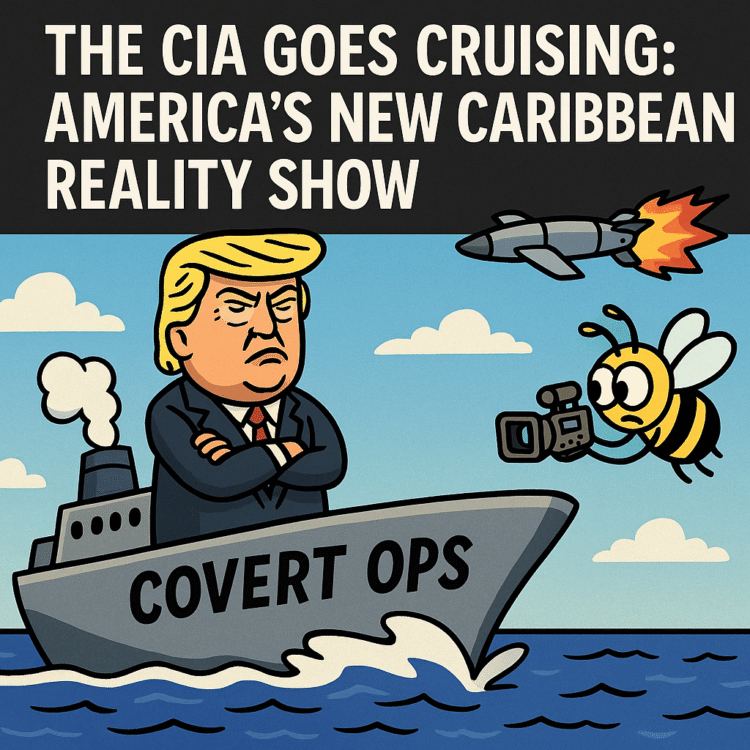
Some presidents get monuments. Some get wars. Donald Trump just got a franchise — Operation Sea Control, the world’s first state-sponsored reality series starring the CIA, the Caribbean, and a flotilla of very confused smugglers. The premise: Washington authorizes covert operations in Venezuela, calls it “freedom,” and then releases clips of blown-up boats to prove the sea is “under control.” You know, like a cruise line commercial with more corpses.
According to Reuters, AP, and anyone still brave enough to print “according to the CIA” in a headline, Trump personally admitted to authorizing these covert missions — the kind that presidents are supposed to deny while looking solemn. Instead, he bragged. Because in 2025, American secrecy has been replaced by brand management.
1. The Reality Show Presidency Returns to Syndication
Picture it: the Oval Office, gold drapes, a camera crew from Newsmax. The President leans in and says, “We’re in Venezuela now. Big operation. Very successful. We blew up the bad boats. Nobody’s ever controlled the sea like we do. Tremendous control.”
It’s not so much a briefing as a promo reel for authoritarian chic. The administration doesn’t even bother with plausible deniability anymore; covert action is just content. Instead of Top Gun: Maverick, we get Top Gun: Narcotics Unit, directed by an algorithm and scored by Kid Rock.
And the CIA — bless them — are apparently back in the role they play best: unsupervised, under the radar, and over budget. But don’t worry, they have “lethal authorities” now. Which is Beltway-speak for “we’ll handle it in post.”
2. Venezuela: The Eternal Scapegoat Revival Tour
The country that once hosted the world’s largest oil reserves now gets to host America’s latest foreign policy projection. Every few years, Washington remembers Caracas exists and decides to “save it.” Usually, this ends with sanctions, scarcity, and at least one Florida senator pretending to speak fluent Spanish for the cameras.
But this time, the White House decided to skip the usual diplomacy foreplay. Why waste time on State Department memos when you can just give the CIA live ammunition and tell them to fix socialism?
Trump says the campaign is about “fentanyl,” a substance whose primary source — according to the U.S. government’s own data — is Mexico. But geography, like ethics, has never been this administration’s strong suit. If a problem exists, the solution must be an airstrike. And if you question it, you must love communism.
3. The Gospel of Strategic Ambiguity
In the old days, covert operations were whispered about in dark corridors. Now, they’re shouted from podiums between merch drops.
The White House insists that the missions are “targeted” and “precision-guided.” What that actually means is: “We’re not sure who we hit, but the footage looks great on Truth Social.”
The administration’s narrative is a familiar one: blame a foreign boogeyman, redefine legality as “leadership,” and call anyone who objects a traitor. It’s the same three-act structure that got us Iraq, Libya, and a lifetime supply of geopolitical hangovers.
Only now, the stakes are even higher, because no one’s steering the ship — literally or metaphorically. The Pentagon’s too busy fighting with the State Department. Congress is screaming about oversight. And the CIA just got the green light to act like the world’s most violent startup.
4. Mission Creep Is America’s Love Language
Every time a U.S. president says “limited operation,” an entire region should start building bunkers.
Today it’s “covert maritime interdictions.” Tomorrow it’s drone strikes “just over the border.” By the weekend, it’s a full-blown proxy war that no one can legally define.
The euphemism of choice this time is “kinetic enforcement.” Translation: we’re bombing boats now. But not officially. And because these are “covert” operations, Congress can’t see the receipts.
The CIA gets plausible deniability. The President gets a headline about “tough action.” And the families of Venezuelan fishermen get to wonder what their loved ones did to earn a cameo in this geopolitical snuff film.
5. The Fentanyl Excuse (Now With Extra Lies)
The White House keeps repeating that these operations are about fentanyl. It’s a brilliant strategy, really: pick a universally despised drug, then tie it to whatever country you want to destabilize. It’s the foreign policy equivalent of yelling “9/11” in a crowded theater.
Never mind that the DEA and CDC both trace the vast majority of fentanyl to Mexican labs and American demand. Why let facts interfere with a perfectly good narrative? Venezuela is an easier villain — darker skin, socialist government, and fewer lobbyists in D.C.
And so, we get the absurd logic that blowing up boats in the Caribbean somehow keeps middle America safe from opioids. It’s as if someone told Trump that geography was a conspiracy theory.
6. International Law: Optional, Like Tipping at Mar-a-Lago
Venezuela’s foreign ministry called it what it is: a violation of sovereignty. They’re taking it to the U.N. Security Council, which means we’ll soon be treated to another episode of Diplomatic Idol, where America pretends to care about international norms while vetoing its own prosecution.
The administration’s defense? “The sea is under control.” Which might be the most hauntingly stupid sentence ever uttered about foreign policy. You can’t control the sea. You can’t even control Congress. But in the Trump Doctrine, control isn’t about reality—it’s about vibes.
Meanwhile, allies are privately panicking, lawyers are Googling “War Powers Resolution,” and the Pentagon is drafting contingency plans titled “In Case the President Gets Bored.”
7. Covert, Overt, Whatever—Just Film It
The line between covert and overt operations used to matter. It was the difference between plausible deniability and international incident. Now it’s the difference between a leak and a livestream.
Trump’s public acknowledgment of CIA missions isn’t just reckless—it’s revolutionary. He’s turned classified warfare into campaign messaging. Why wait for historians when you can get engagement now?
It’s only a matter of time before the White House releases a promo titled Tomahawks for Freedom! featuring drone footage set to Lee Greenwood. The military-industrial complex finally has its influencer-in-chief.
8. Oversight, Meet Under-Sight
Senator Jeanne Shaheen is calling for answers. Congress wants to know the scope, the cost, the casualties. But good luck getting details from an administration that thinks “oversight” means better camera angles.
By the time the paperwork arrives, the operation will have expanded into a dozen new theaters. Venezuela today, Colombia tomorrow, Cuba for dessert. The logic of endless war is that it’s always one success away from ending.
And every strike, every covert kill, every “rogue” decision reinforces the same central myth: that America can bomb its way to moral clarity.
9. Blowback Is a Feature, Not a Bug
History is a wheel, and the CIA is the hamster that never learns. Every time Washington meddles in Latin America, it ends the same way: unintended consequences and very expensive regret.
We armed contras. We trained juntas. We installed dictators. And now, we’re at it again—only this time, the soundtrack is country-pop, and the justification is opioids.
Experts warn that clandestine assassinations and maritime kills could strengthen Nicolás Maduro instead of toppling him. Because nothing rallies a nation like foreign aggression. But to Trump, that’s fine—every villain needs a comeback season.
10. The Caribbean as Catwalk
Off the coast, the U.S. military is already flexing—bombers in formation, destroyers at parade rest, and a whole new lexicon of “deterrence” that sounds suspiciously like “occupation.”
It’s theater on a global scale. You can almost imagine the press photos: Trump in aviators, pointing at the horizon, declaring victory over an ocean. The sea is under control, remember? Never mind the civilians, the oil slicks, the diplomatic protests. Control is the illusion. And America is addicted to the high.
11. The Human Cost, Briefly Mentioned Between Commercial Breaks
Behind all the spectacle are real people—fishermen mistaken for traffickers, coastal families whose homes shake from sonic booms, refugees whose boats now risk being “neutralized.” But these stories don’t trend.
In the American narrative, they’re background noise, collateral color for the main event. We’ve seen this before in Iraq, Afghanistan, Libya—each time with better branding and worse outcomes.
Every bomb we drop to prove a point becomes another reason for resentment. Every covert operation becomes the next crisis headline. The only constant is the delusion that we’re helping.
12. The New Definition of Peace
When Trump stood beside Netanyahu and declared, “If Hamas won’t disarm, we will disarm them,” the message was clear: peace, in this new world order, means compliance at gunpoint.
Now that same philosophy is sailing south. If Venezuela won’t cooperate, we’ll make them. If international law objects, we’ll redefine it. If allies complain, we’ll accuse them of weakness.
This is peace as performance art—loud, photogenic, and utterly unsustainable.
13. The Next Crisis Is Already Scheduled
The White House insists this is about “stability.” But stability has never been America’s export. What we export are crises—prepackaged, pre-spun, and conveniently profitable.
By next quarter, the same officials who greenlit this covert campaign will be on television warning of “escalation” and calling for new authorizations to “protect our interests.” The loop is endless. The budget expands. The accountability evaporates.
And somewhere, a CIA officer is already updating the PowerPoint: Mission Accomplished (Tentative).
14. The Moral of the Mission
Every empire has its rituals. Ours just happens to involve self-congratulation and plausible deniability. We call it democracy. We call it freedom. But what it really is—what it’s always been—is a story we tell ourselves to sleep at night.
Because nothing says liberty like a drone strike you don’t remember authorizing. Nothing says peace like a body count wrapped in patriotism. And nothing says control like pretending the sea obeys orders.
AFTERWORD: WHEN THE TIDE TURNS
When the smoke clears and the headlines fade, we’ll realize that the real “covert operation” wasn’t in Venezuela—it was here, in the American mind.
We’ve been conditioned to accept war as background noise, to cheer explosions as policy, to confuse dominance with direction.
And maybe one day, when the next president stumbles onto another gilded podium and declares a new mission against a new villain, we’ll remember that this was the moment we lost the plot—not because we intervened, but because we mistook chaos for control.
The sea, after all, doesn’t care who claims it’s “under control.” It just keeps swallowing ships.