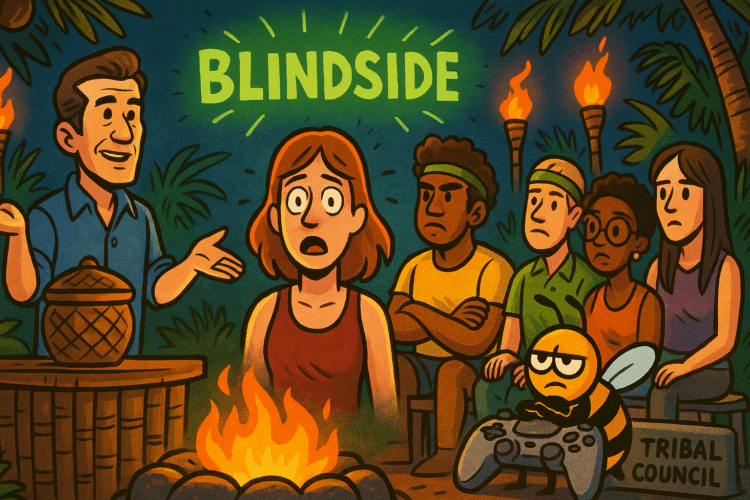
The two-hour premiere of Survivor’s latest season dropped us straight into the tropics: Fiji. Sand, sweat, whispered alignments, and the familiar tension that says, “You’re not safe.” But what struck me most was not the immunity challenges or the plundered rice rations — it was the spectacle of alliances forming and betrayal already baked in. From the sudden ejection of two contestants before filming even began to a unanimous blindsiding of Nicole Mazullo, the machinery of Survivor is functioning at full dramatic throttle.
Let’s reconstruct the who / what / where / why / stakes, and then step back and scold the illusion of integrity this show traffics in. Because if Survivor markets itself as a game of social merit, the premiere suggests it’s a morality play in broken mirrors.
Who’s Who, What Happened, and the Fiery Stage
Cast shake-ups before the game
Even before the opening challenge, drama was in the wings. Two contestants were dismissed for rule violations, their identities withheld until replaced by alternates. Into the fray jumped Jason Treul and Michelle “MC” Chukwujekwu, the “emergency reserves” inserted to keep numbers even. Their arrival, unannounced in advance of filming, already tilts the deck: newcomers who never went through the audition stress now step straight into a populated alliance field.
This kind of “surprise entry” is hardly new in reality TV, but it undercuts the idea that the season begins with everyone on equal footing. Some players have already watched the show, studied behavior, or observed casting trends — these alternates could have unseen informational advantages. Their sudden inclusion also whispers: you might be voted out before you even know who you’re playing against.
The Kele tribe’s unanimous blow
The chosen tribe, Kele, fast became the locus of the premiere drama. They isolated Nicole Mazullo, a young financial crime consultant from Long Island, as the only true outsider to the core alliance. She failed to bend or blend, unable to secure trust or votes, and at tribal council, she was voted off unanimously. She was left speechless — no last-ditch pitch, no tearful plea, just an exiled silence in the flicker of torchlight.
There’s symbolic weight in that: the one outsider, the one who didn’t yet warm to the fire, is excised without wavering. That unanimity says more about groupthink than about clever gameplay. To build trust alliances in two hours? A social experiment wrapped in a contest. To cut someone out without crossfire? A ritual.
Other players in the cast mosaic
The cast includes 18 total competitors — among them Alex Moore, a political communications director; Sophi Balerdi, entrepreneur; Kimberly “Annie” Davis, musician; plus MC and Jason as the surprise entrants. Early alliances are taking shape: whispered confidences, shared meals, wary glances. It’s always in the first few episodes that the skeleton of the social structure emerges: who is a number, who is a swing vote, who is disposable.
And that million-dollar prize looms. Prize money is the gravity well pulling every emotional solar body toward betrayals, Vindications, and confessions. But Survivor’s real high gear is not the money — it’s the narrative liturgy of loyalty, betrayal, sincerity, and survival under fire. The promise is that your merits, alliances, and social acuity deliver you to the end. But as the premiere suggests, that narrative is always mediated, predestined, and telescoped.
Why This Premiere Matters: Values, Illusions, and Social Theater
1. The appearance of fairness, subverted
Survivor sells us the drama of social competition, the idea that clever alliances can overcome brute physicality. But right out of the gate, the removal of two contestants for undisclosed violations and the insertion of alternates is the sort of backstage decree that undermines the veneer of fairness. Those hidden decisions are invisible levers. It means the game is not entirely yours — producers, editors, and rule enforcers have already shaped outcomes you don’t see.
To cast new entrants after casting is complete is especially suspect: those alternates can be cast and conditioned with the knowledge of what works in previous seasons. They are late-stage implants. Meanwhile, the established cast must gamble trust, alliances, and first moves in ignorance. That asymmetry is baked into the narrative.
2. Unanimous blindsides as social proof
The unanimous vote against Nicole gives us the illusion of a moral clarity: everyone agreed she was the outsider. But unanimity in group votes rarely emerges without subtle coercion, rehearsal, or shared momentum. It signals strongest not a rational decision but a ritual purge. The first vote becomes baptism: to join the tribe’s moral circle, you must participate in the exclusion. Trust becomes less something earned and more a ceremony you’re compelled to rehearse.
Moreover, Nicole’s silence at tribal council becomes symbolic: the outsider who fails to persuade gets cast out without protest. It reinforces the message: if you can’t speak the script, you vanish. Survivor isn’t just a game of persuasion — it is a staged morality for those who know how to perform within it.
3. Stakes beyond the million dollars
The million-dollar prize is the ostensible goal, but the real stakes are narrative: legacy, Instagram clout, social capital, casting allure. Being blind-sided, especially in the premiere, becomes part of your story arc. A humiliating early exit can become a cautionary legend, repeated by casting directors, blogs, superfans—not as shame, but as proof that you were dangerous, unaligned, miscast.
And for the rest of the cast, the memory of Nicole’s defeat lingers. In cocktail whispers, they will forever reference “what happened to her.” It sets a precedent: cling to alliances early or get exiled quietly.
Structural Irony: The Game of Illusions
What always fascinates me about reality TV like Survivor is the structural irony: the show claims to reveal authentic human drama, when in fact it choreographs it.
- We watch alliances form in montage and then collapse in real time, all while editing controls what we see.
- We see blindsides as proof of social cunning, even though by episode three they become narrative staples.
- We root for sincerity and authenticity in a world built on staging, confessionals, and redemption arcs.
This premiere leans into that. The two alternates, the swift unanimous vote, the silence of Nicole — these are not glitches. They are deliberate beats. The show wants big moments, not slow stew. It wants clarity early, not confusion. It wants you to suspect betrayal, to fear exclusion, to lean in.
And to an audience, that feels electric. But it’s a cynical trick: the illusion that what you see is raw, unfiltered tribal politics, when what you get is narrative engineering with human players.
What to Watch as the Season Unfolds
- The alternates’ arcs: MC and Jason start behind by definition. Do they catch up? Do their presences unsettle early alliances? Do they carry meta-trauma from being “on stand-by”?
- Alliance fracturing: The core Kele alliance may get too tight. One slip, one misstep, one contestant pissed—those fractures will be the drama accelerants.
- Vote swings & tribal surprise: Will unanimous votes persist? Or will cracks show? The first split vote is always a show of power.
- Emotional authenticity vs performative loyalty: Who really plays to be liked, who plays to survive? Cold sincerity or practiced persona?
- Narrative survivors: Who gets to the merge? Who becomes fodder for redemption arcs? Watch who survives the first few tribal councils—those are future story anchors.
And I’ll be paying attention to how the show frames the blindsides—heroic betrayal or evil deception—and how it casts Nicole’s silence. Is she portrayed sympathetically, foolishly, or mythically?
Penultimate Reflection: The Tribal Masquerade
Survivor is reality TV’s most persistent illusion: part social experiment, part staged drama, part mythmaking. In the premiere, we saw how early the show scripts betrayal, how quickly the social ritual demands exclusion. The insertion of alternates reminds us: the stagehands are always working behind the curtains. The unanimous vote reminds us: when you enter the arena, you already accept the terms of exclusion. And Nicole’s silenced exit becomes a symbol of how easy it is to speak the wrong words in a game that values alignment over authenticity.
If you came for competition, you got competition. But if you came for a pure social laboratory, you glimpsed the artifice. The real game begins when alliances tremble, when trust fractures, when someone dares to defy the script. That’s when you see whether Survivor is about survival, or about survival of illusion.
The First Vote as Oath
This premiere put the tribal contract on full display: outsiders are vulnerable, alternates fold in, and unanimous votes set the norms. Reality blurs with narrative, and the stagehands of casting and editing quietly steer the drama. The million-dollar prize may glimmer, but the real currency is story, allegiance, and who gets to be remembered. Survivor’s greatest trick? Making you believe that every twist is genuine, even as every move is choreographed.