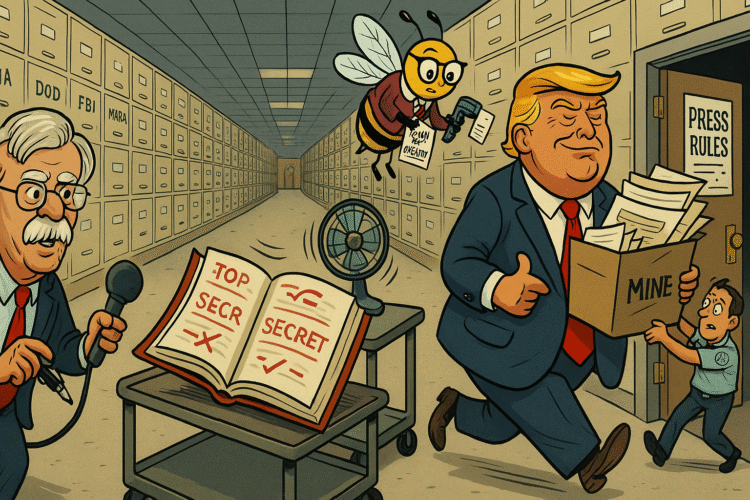
The federal government has finally located the one man in Washington who can make Donald Trump’s document crimes look like a Marie Kondo project. His name, once again, is John R. Bolton—a man whose mustache has seen more classified briefings than most senators. According to a newly unsealed federal indictment in Maryland, Bolton, the hawkish former National Security Adviser and self-styled conscience of conservative interventionism, managed to turn over a thousand pages of national defense material into what prosecutors politely describe as “diary-like notes.”
That’s the government’s way of saying the man was journaling nuclear secrets like a teenage girl processing prom night trauma.
The Diary of John R. Bolton, Aged 69¾
The 18-count indictment reads like a cross between a Tom Clancy novel and a therapy workbook. Eight counts of unlawful transmission. Ten counts of unlawful retention. Over a thousand classified entries allegedly kept in his Bethesda home, some marked “Top Secret,” others forwarded to family members via personal email and messaging apps. The Justice Department claims his “personal account” was even compromised by Iran-linked hackers, which is what happens when your password is probably “regimechange1983!”
The prosecution’s story is simple: Bolton treated national security like a scrapbook hobby. He took briefings home, mixed them with reflections about staff meetings, and stored them in a filing system so secure that foreign adversaries could apparently stroll in and help themselves. The FBI retrieved the materials from his home and D.C. office, though one suspects they could have just checked Amazon for “John Bolton’s Unredacted Thoughts: A Memoir.”
It’s the national security equivalent of someone leaving their tax returns on the windshield of their car—except these documents involved real lives, operations, and foreign agents whose work might now be jeopardized because one man couldn’t separate self-promotion from statecraft.
Equal Justice for All, Except When It’s Not
Attorney General Pamela Bondi, still busy reinventing herself as the patron saint of “neutral enforcement,” called the indictment proof that “no one is above the law.” FBI Director Kash Patel—yes, the same one who once described himself as Trump’s “bulldog”—echoed her. It’s a surreal tableau: Trump’s most loyal lieutenants prosecuting one of his loudest critics.
To Bolton, this is all political payback. He insists the case is retaliation for his public opposition to Trump, his refusal to back post-election conspiracy theories, and his now-infamous memoir, The Room Where It Happened, which portrayed the former president as both reckless and allergic to reading. In a deliciously ironic twist, the Justice Department’s evidence apparently includes passages written while Bolton was drafting that very memoir, which means his own tell-all may have told on him.
There’s poetic symmetry in it: Trump hoards secrets for vanity; Bolton leaks them for legacy. Two sides of the same narcissistic coin, spinning endlessly through the national security establishment.
The Espionage Act: America’s Most Selective Hammer
Bolton’s indictment is another act in the ongoing tragicomedy that is the Espionage Act. Passed in 1917 to prosecute spies and dissenters, it has since become the government’s favorite catchall for everyone from whistleblowers to presidents. Chelsea Manning, Edward Snowden, Reality Winner—they all learned what happens when classified information leaves the vault.
But when high officials mishandle secrets, the Espionage Act transforms from hammer to feather. It’s invoked with solemnity and applied with surgical caution. Bolton’s case will almost certainly hinge on “intent,” that mystical concept that has saved more Washington insiders than any lawyer ever could. Did he mean to mishandle state secrets? Or did he simply confuse his daily brief with his daily affirmations?
Either way, the indictment is a stress test for the idea of equal justice. When a career national security bureaucrat treats his job like LiveJournal, the question isn’t just whether he’s guilty—it’s whether the system that protects intelligence can survive its own caretakers.
Trump’s Great Classified Comedy Tour
Let’s be honest: in any other era, Bolton’s indictment would have been headline Armageddon. But in Trump’s second term, it’s merely Tuesday. We live in a country where the former president stored nuclear war plans in his bathroom, showed Kim Jong-un’s love letters to dinner guests, and once called national defense documents “beautiful mementos.”
And then there’s Pete Hegseth—the Trump administration’s designated haircut—who reportedly added to this farce by accidentally inviting a reporter into a private Signal group where administration officials discussed Yemen war plans. The conversation, meant for “eyes only,” became one of those accidental transparency moments that make you wonder whether the next world war will be declared via group chat.
This, it should be noted, was not on an approved government system. It was on Signal, the same app college kids use to coordinate beer pong tournaments. Somewhere, the ghost of George Kennan is begging for a reboot.
If Bolton’s sin was hubris, Trump’s orbit specializes in chaos—the sort that leaks not because of ideology but because of incompetence. It’s as if the entire national security apparatus has been outsourced to a team-building retreat run by Reddit moderators.
Bolton’s Moral Math
Bolton’s defense is that he was documenting history. He claims his notes were part of a process to ensure an accurate public record, to counter the distortions of the administration he once served. It’s a noble-sounding argument until you realize that “accurate public record” apparently includes classified intelligence about foreign operations and internal deliberations.
He may try to argue that much of what he recorded was already public or “effectively declassified” by virtue of public briefings. That’s a familiar tune—Trump himself claimed he could declassify documents “by thinking about it.” The problem with that logic is that national security classification isn’t telepathic. It’s procedural. If everyone who touched a secret could redefine its status through sheer self-regard, we wouldn’t have secrecy at all—just ego management with clearance levels.
Bolton’s real calculation seems to be that the American public’s tolerance for elite impunity has grown infinite. After all, Trump was caught on tape admitting to waving around war plans. Biden’s aides discovered classified documents in a garage near a Corvette. The system keeps finding new ways to tell us that confidentiality is for the little people.
The Ghost of Prepublication Review
There’s a tragicomic footnote to this story. Bolton’s fight with the National Security Council’s prepublication review office in 2020 became a cause célèbre among free speech defenders. He accused the government of trying to censor him; the government accused him of rushing to print for profit. The result was a stalemate so bitter that it now looks prophetic.
If the indictment holds, Bolton’s “rough notes” from that period might not just be unapproved drafts—they might be the classified material he was never supposed to take home in the first place. It’s the bureaucratic equivalent of a man trying to win a libel suit with stolen evidence.
The larger question is what happens to prepublication review now. If it’s a tool to suppress dissent, it’s intolerable. But if it’s a safeguard against self-serving leaks that compromise security, Bolton just turned it into Exhibit A for why the rules exist.
Iran Enters the Chat
The indictment’s most chilling detail isn’t Bolton’s ego or his prose—it’s the allegation that his personal account, containing some of these documents, was compromised by hackers linked to Iran. That makes this not just a scandal of vanity but of potential espionage exposure.
For a man who has spent his career advocating regime change in Tehran, the irony is Biblical. Bolton has long positioned himself as Iran’s loudest American adversary, pushing for strikes, sanctions, and saber-rattling. Now, his carelessness may have handed those same adversaries a classified buffet.
Somewhere in a cyber unit outside Qom, an Iranian officer is probably scrolling through Bolton’s diary entries, learning more about U.S. intelligence assessments than Congress ever will. It’s a level of poetic justice even Kafka might have found too on-the-nose.
The Political Backdrop: Retaliation or Restoration
Bolton claims persecution. The Justice Department insists due process. The truth probably lives somewhere in the gray fog that always accompanies national security prosecutions.
It’s true that the optics are radioactive. Bolton is a high-profile Trump critic. The prosecutors—Bondi and Patel—are avowed Trump loyalists. But the file reportedly originated with career national security lawyers, not political appointees, and the classified evidence is being handled under the strictest procedural safeguards. The politics are messy, but the paperwork is meticulous.
This dynamic—the appearance of retaliation overlaying legitimate enforcement—isn’t new. It’s what happens when a government that has blurred every institutional line suddenly remembers that lines exist. The same White House that mocked the rule of law now claims to champion it, provided it only applies to its enemies.
If the Bolton case collapses, it won’t be because he’s innocent. It’ll be because the machinery of accountability was already dismantled by the very people now pretending to operate it.
From Signal Chats to Secret Diaries: The Normalization of Breach
This is the era of accidental espionage. It’s not about ideology anymore—it’s about carelessness scaled to power. The Trump administration normalized leaks, redefined secrecy, and made classification a punchline. Officials treat encryption apps like private diaries, forgetting that private doesn’t mean secure.
Pete Hegseth’s accidental Signal invitation wasn’t an isolated glitch. It was symptomatic. It showed how national security has become a political hobby, managed by influencers instead of professionals. A reporter in a Signal chat about Yemen war plans isn’t just a breach—it’s a metaphor for how the government’s firewall between politics and warfare has dissolved into noise.
This is how institutions die: not in dramatic explosions of malice, but in the quiet, stupid hum of group notifications no one meant to send.
The Legal Labyrinth Ahead
Bolton’s trial will be a procedural minefield. The Classified Information Procedures Act (CIPA) will dictate how evidence is handled, what the defense can see, and how much of the case will be redacted from public view. Expect months of sealed filings, coded references, and outraged cable-news speculation.
The irony is that Bolton himself helped create the culture of secrecy that now ensnares him. He spent decades arguing for harsher penalties for leaks, tighter control of intelligence, and maximum deference to the executive branch. Now that those rules apply to him, the former hawk finds himself in a legal aviary built from his own feathers.
If convicted on all 18 counts, he faces potentially decades in prison. But Washington insiders rarely serve real time. The likelier outcome is a plea deal, a suspended sentence, and another memoir—this one titled The Diary Where It Happened: My Battle for Transparency.
The Espionage Economy
There’s money in mismanagement. Every high-profile leak becomes a Netflix pitch; every indictment, a TED Talk on “truth-telling.” The postmodern security state doesn’t produce spies so much as content creators. Trump sold secrets for ego. Bolton mishandled them for legacy. Even the leakers become brands, selling their “sacrifice” to podcast audiences who mistake narcissism for heroism.
This is the market economy of treason-adjacent celebrity. You can break the law as long as you break it with conviction—and a good book deal.
The Myth of Teeth
The Hatch Act, the Espionage Act, the Emoluments Clause—all the supposed safeguards of democracy—now function more like commemorative plaques. They exist to remind us what used to matter. Bolton’s prosecution might appear like proof the system still works, but history suggests otherwise. The machinery of consequence moves just enough to create headlines, not enough to create deterrence.
Every new scandal becomes a case study in selective enforcement. Presidents declassify secrets by whim. Cabinet members campaign from the podium. National security officials hoard diaries of classified intel. And when accountability finally arrives, it arrives late, watered down, and available for preorder.
Bolton’s Last Stand
Bolton has always believed himself the protagonist of American righteousness, a man born to save democracy through force of will. Now, his legacy risks becoming that of a bureaucratic Icarus, undone not by hubris alone but by his compulsion to narrate it.
He’ll fight this case with all the vigor of a man who believes history owes him vindication. His defenders will paint him as a victim of political persecution; his critics will see poetic justice. Both will be right, and neither will matter.
Because the real story isn’t about Bolton—it’s about a government so comfortable breaking its own rules that even its disciplinarians become delinquents.
Conclusion: The Security State Eats Its Own
This is what institutional decay looks like in real time: a parade of insiders devouring one another under the banner of accountability. Bolton, Trump, Hegseth—they’re not exceptions. They’re symptoms. When power becomes synonymous with impunity, every scandal becomes a sequel.
The Bolton indictment is a warning written in bureaucratic language: that the walls separating secrecy, self-interest, and stupidity have collapsed. The national security state, once obsessed with guarding information, now leaks from every ego.
We used to imagine espionage as shadowy men trading microfilm under streetlights. Now it’s group chats, diaries, and podcasts. The apocalypse won’t come from spies in trench coats—it’ll come from mid-level functionaries with memoir deadlines.
And in the end, the classified material will survive everyone. It always does.
Summary Section: “The Diary Where It All Fell Apart”
The Bolton indictment is less about one man’s misconduct and more about a culture that treats security as a suggestion. It proves that the line between arrogance and espionage is as thin as a Wi-Fi signal and as subjective as a declassification memo. The same government that once crucified whistleblowers now shrugs at its own leaks, turning accountability into a spectator sport.
If Bolton’s guilty, the law may finally bite. If he walks, it’ll confirm what everyone already suspects—that national security, like everything else in this era, has become just another political franchise.