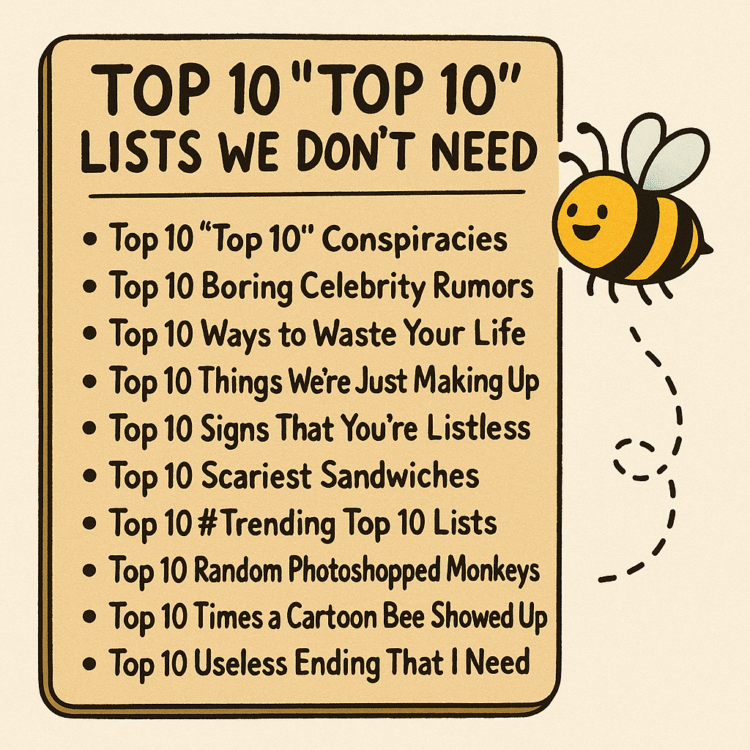
There was a time—not that long ago—when journalism meant something. People risked their lives reporting from war zones, uncovering corruption, and writing scathing exposés that brought entire institutions to their knees. Now? Now we’ve got 27 interns fighting over who gets to write “14 Times a Celebrity Sneezed and It Changed Our Lives” for pageviews.
Congratulations, Woodward and Bernstein. We’ve replaced Watergate with “Which Type of Bread Are You Based on Your Zodiac Sign?”
Let’s break it down—of course, in list form. Because that’s how our brains work now: line breaks, memes, and dopamine hits. Here’s why listicles are slowly swallowing society whole like a gluten-free snake eating its own tail.
1. The Algorithm Made Them Do It
Outlets once known for Pulitzers and global analysis now survive by pleasing the SEO gods. You think The Atlantic wanted to publish “10 Types of Guys Who Still Wear Puka Shells and What That Says About Their Father Wounds”? No. But Google said jump, and we clicked.
2. There’s No Time to Think—Only to Rank
Critical thought takes nuance. Lists take 11 minutes, Canva, and a therapist’s unpaid labor. Why wrestle with the complexity of income inequality when you can just rate “Top 10 Billionaires Who Look Like Sentient Lunch Meat”?
3. They’re Made for Skimming, Not Reading
We don’t even read them. We scan them like we’re disarming a bomb. “Okay, number 3 was relatable, 5 had a gif, 7 said ‘late-stage capitalism’—I’m done.” And just like that, you’ve consumed news. Pulitzer, please.
4. They Turn Trauma Into Clickbait
“Top 5 School Shootings That Shocked a Nation” should not be on the same homepage as “Top 10 Celebrity Wardrobe Malfunctions That Broke the Internet.” But here we are, trauma-surfing between sponsored ads for probiotic lube.
5. They Replace Expertise With Vibes
Used to be you had to know something to get published. Now it’s just: “Top 10 Ways to Lower Your Anxiety According to My Barista’s Moon Journal.” And we eat it up like oat milk pudding for the soul.
6. Every Topic Can Be a List—And That’s the Problem
War crimes? Top 10. Climate collapse? Top 10. Emotional abuse? “13 Red Flags That Say He’s More Toxic Than the Ohio River.” The stakes don’t matter when everything’s clickable.
7. News Is Now a Buzzfeed Quiz With Worse Fonts
Imagine pitching “Why Poverty Is Still a Crisis in America” and being told, “Can you turn it into ‘10 Budget-Friendly Meals That Scream ‘I Have Student Loans’?” We’ve taken real problems and filtered them through meme-speak until they taste like LaCroix: barely there, vaguely sad, and best served cold.
8. They Give the Illusion of Control
Ranking things makes chaos feel manageable. But just because you know the “Top 9 Serial Killer Documentaries” doesn’t mean you’re informed. It just means your dinner parties are worse.
9. We Don’t Know How to Read Without Numbers Now
Give us a paragraph and we panic. “Where are the bullet points?” we scream, scrolling like it’s a hostage situation. Reading comprehension? That’s for people with pensions.
10. You’re Reading This Right Now
The final proof that listicles have won? This article is one. And you’re still here. Which means I’m part of the problem. But also: you’re welcome.
In Conclusion:
We’ve traded journalism for dopamine. We used to fear Big Brother. Now we fear missing “12 Reasons Why Big Brother Was Actually Feminist.” We used to beg for facts. Now we beg for content that won’t hurt to consume while we poop.
So the next time you see “Top 10 Ways To Tell If Your Cat Hates You (Or Is Just A Republican),” ask yourself: Is this news? Or is this noise with a numbered index?