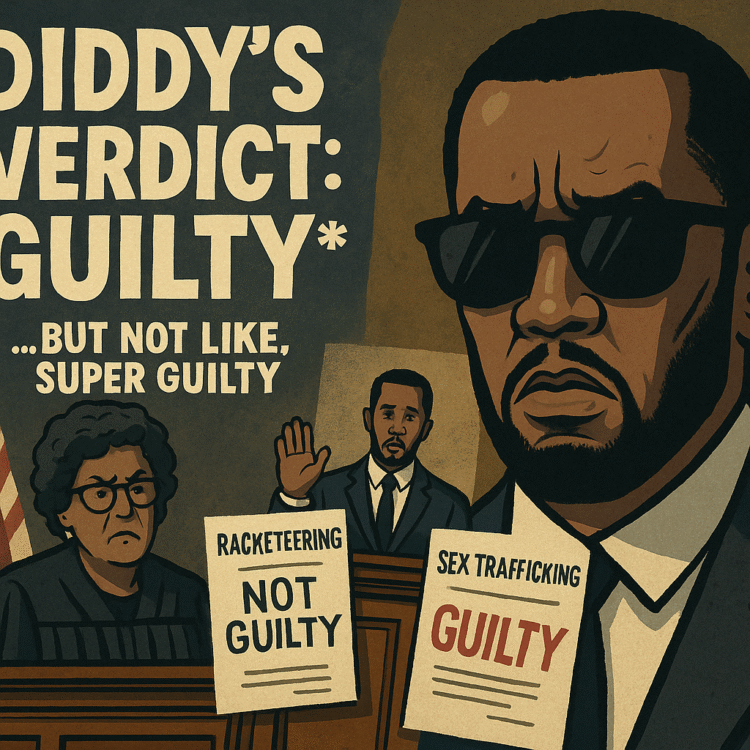
In a stunning turn of events that will surprise absolutely no one who’s been paying attention to the American legal system since, oh, forever, Sean “Diddy” Combs has emerged from his latest legal firestorm with his reputation slightly singed, his wallet marginally lighter, and his Instagram following entirely unbothered.
That’s right: despite a tornado of allegations ranging from sex trafficking to assault to “just being the worst kind of rich,” the hip-hop mogul has managed to wriggle through the system like a greased-up remix of Law & Order: SVU. And somehow, we’re all supposed to believe that justice has been served.
Let’s rewind. Remember that video? The one where he assaulted Cassie in a hotel hallway and the whole internet collectively gasped before immediately forgetting because the new Drake album dropped? That was just the tip of the iceberg. Over the last few years, multiple lawsuits have surfaced alleging horrific abuse, manipulation, and violence. Diddy responded the way any innocent man would: with multimillion-dollar settlements, silence, and a few spiritual Instagram posts about personal growth.
But now, the legal process—if you can even call it that—has come to its inevitable conclusion. And while Diddy’s team of lawyers high-fived their way back to their Range Rovers, the survivors of his alleged abuse are left to piece themselves back together with nothing but NDAs and disbelief.
The court didn’t say he was innocent. They said he was untouchable.
This isn’t just about Diddy. It’s about power, celebrity, and the American obsession with redemption arcs for rich men. Diddy doesn’t need to be good. He just needs to be good enough to get booked at Coachella. He doesn’t need to be held accountable. He just needs to drop another Cîroc flavor and a half-assed apology to Oprah.
And we’ll let him. Because in the United States of Brand Management, apologies are currency and consequences are for the poor.
Let’s be real: if a woman accused your middle-aged neighbor of even one of the things Diddy’s been linked to, he’d be in a jail cell so fast his ankle monitor would melt. But when it’s a man with a yacht and a legacy, we pause. We ask for context. We wonder if the accusers are just bitter. We wait for the Netflix documentary to tell us how “tortured” he is.
But make no mistake: the system worked exactly as it was designed to. Not to protect the vulnerable. Not to investigate the powerful. But to funnel attention into a circus of denial, delay, and deflection until the public gets bored and clicks away.
There will be no justice here. There will be no catharsis. There will only be another Diddy remix, another red carpet appearance, another carefully crafted PR spin about “healing.”
Meanwhile, the people who were hurt—who lived through trauma, gaslighting, and violence—get nothing but the knowledge that their abuser is still on every playlist.
So go ahead. Play I’ll Be Missing You. Sip the vodka. Celebrate the myth.
Just don’t call it justice.
Because justice doesn’t wear mink and fly private. And it sure as hell doesn’t settle out of court.