An atheist’s field guide to keeping the pulpit off the payroll and the state out of your soul
I’m an atheist. Not the hat-throwing, slogan-on-a-bumper kind—more the “coffee, quiet, and a stubborn allergy to being preached at by anyone with a lanyard” variety. I have no congregation, no creed, and no appetite for a government-approved path to eternity. And that is precisely why I fight—without irony—for your freedom of religion: so I can keep my freedom from religion. My liberty depends on yours, and yours is safest when mine is untouchable. The Constitution understood this before any of us were born, and it wrote the plan in black letters a child could read.
Start with the operating system. The First Amendment opens the gates and posts a guard: “Congress shall make no law respecting an establishment of religion” (that’s the Establishment Clause) “or prohibiting the free exercise thereof” (the Free Exercise Clause). Two rails, one track. Article VI, Clause 3 adds, for the people in the cheap seats: “no religious Test shall ever be required as a Qualification to any Office or public Trust under the United States.” Then the Fourteenth Amendment’s Due Process Clause brings the whole bundle to every state and school board that thinks the drumline would sound better with a hymn. Translation: no state church, no state penalties for belief or unbelief, and no loyalty oath to heaven in exchange for a paycheck.
I back those words because I’ve seen what happens when the state borrows a pulpit. You can call it history; I call it a recurring fever. In medieval and early-modern Europe, the church key also opened the armory: Crusades, Inquisitions, confessional wars where “wrong” worship made you an open target. Puritan England under Cromwell tried holiness by decree and ended up policing joy. In parts of today’s world, blasphemy laws and morality police flatten conscience into compliance and women into case files. Even the twentieth century’s secular cults—blood-and-soil nationalisms—wrapped power in sacred robes. Whether the altar is marble or marbleized rhetoric, when the state chooses a creed, dissent becomes treason and orthodoxy becomes rent.
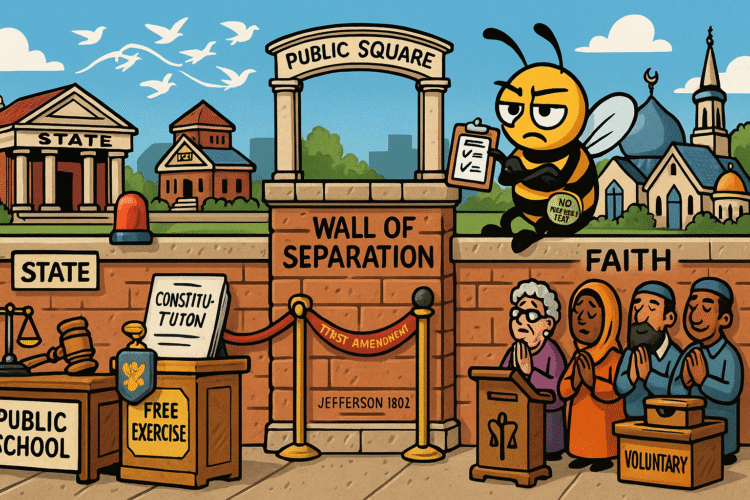
America’s founders—some pious, some Deist, some skeptically devout—had the good sense to put the matches far from the gasoline. Jefferson’s 1802 letter to the Danbury Baptists promised a “wall of separation” between church and state. Madison’s “Memorial and Remonstrance” argued that religion is the last territory where majority rule should fear to tread; subsidies, he warned, corrupt religion. Washington wrote in 1790 to the Newport synagogue that this country gives “to bigotry no sanction, to persecution no assistance.” Virginia’s 1786 Statute for Religious Freedom cut the state tithe cord to churches and declared that no person would suffer on account of beliefs. And the 1797 Treaty of Tripoli, Article 11, spoke plainly that the U.S. government is “not, in any sense, founded on the Christian religion.” You can quibble over drafts and printers’ marks; you cannot miss the throughline: the Republic would neither install a pulpit nor shut a door to private faith.
If parchment feels abstract, the Supreme Court has spent a century playing hall monitor. In Everson v. Board of Education (1947), the Court said the Establishment Clause binds states too—the wall doesn’t stop at the Potomac. McCollum (1948) told public schools to stop renting classrooms to sectarian classes. Engel v. Vitale (1962) forbade state-written school prayers; Abington v. Schempp (1963) barred school-sponsored Bible readings. I don’t need my kid’s homeroom to double as Sunday school, and neither do you. Torcaso v. Watkins (1961) crushed state-level religious tests for office. If you are qualified to file budgets and plow snow, your theology—or lack of it—is none of the registrar’s business.
Then came Lemon v. Kurtzman (1971), a clumsy but useful seatbelt: government action touching religion must have a secular purpose, its primary effect can’t advance or inhibit religion, and it must avoid excessive entanglement. Unsexy? Yes. Helpful? Also yes. Stone v. Graham (1980) said public classrooms aren’t bulletin boards for the Ten Commandments. Edwards v. Aguillard (1987) told Louisiana that creationism in science class is theology in a lab coat. Lee v. Weisman (1992) blocked clergy-led graduation prayers—coercion in a cap and gown is still coercion. Santa Fe ISD v. Doe (2000) nixed the “student-led” prayer over the football PA system. If the school writes the script and the microphone, it’s the state talking, not a kid.
Do the edges get messy? Always. Town of Greece v. Galloway (2014) allowed ceremonial prayers before town meetings under an inclusive tradition rationale. Kennedy v. Bremerton (2022) found room for a coach’s personal prayer at midfield—private expression, the Court said—while warning about overt pressure. These decisions complicate line-drawing, but they don’t dynamite the foundation. The state still doesn’t get to pick a faith, fund a faith because it’s a faith, or cajole worship. Individuals keep their speech; institutions keep their neutrality. That equilibrium is the only reason your liberty and my atheism can share a sidewalk without lawyers.
Let me be blunt about my self-interest. I don’t want your church money. I don’t want my property taxes underwriting anyone’s altar. I don’t want to pretend amen to keep a job, a grade, or a friend. I won’t make you whisper your prayers—they’re yours. The deal is simple: the state keeps its hands off your conscience, and your conscience keeps its hands off the state. That’s not hostility. That’s hygiene.
Because state-backed piety doesn’t just choke dissent; it hollows faith. Subsidy turns prophets into grant writers. Regulatory favors tempt pulpits to trade truth for zoning. Once Caesar pays the choir, the choir’s first hymn is “Thank you, Caesar.” Madison warned exactly about this: government money deforms religion. If faith needs a badge to survive, it isn’t faith; it’s a franchise.
People love to say, “But we’re a majority-Christian nation—shouldn’t laws reflect that?” Here’s where my atheist spine and your religious liberty shake hands: state-sponsored religion feels great when you’re the majority, and terrifying when you’re not. Majorities rotate. Doctrines drift. The apparatus you erect for your creed will be wielded by someone else for theirs—against you. Today’s doxology is tomorrow’s orthodoxy test. The Constitution anticipates that cycle and breaks it on purpose. It keeps government in the business of rights, not rites.
If you want a cultural parable: Margaret Atwood’s The Handmaid’s Tale. Call it fiction if that helps you sleep. Its warning is empirical: when scripture becomes statute, women’s bodies become jurisprudence; when “blessed be the fruit” becomes policy, consent becomes a rumor. The lesson isn’t “religion equals Gilead.” The lesson is that law turns private conviction into public compulsion, and compulsion is always eager to find a uterus to manage. Separation keeps scripture as scripture and the law as law.
Now, because I promised mock seriousness and surgical observation, let’s calibrate the common objections.
“What’s the harm in a little school prayer?” The harm is the kid learning to fake belief to dodge social frostbite. The harm is the teacher who reads the room and reads the Bible to keep the principal happy. The harm is the Hindu, Muslim, Jew, Catholic kid in a Protestant town, or the atheist anywhere, who learns early that belonging requires a performance. We have other words for coerced performances. None of them mean freedom.
“But a coach kneeling privately isn’t the same as a school sponsoring religion.” Correct. That’s why the case law strains to protect private devotion while forbidding institutional promotion. I can live with that tension; it beats the alternative, where we pretend the government has a heart and a pew.
“Separation drives faith out of public life.” Backwards. Separation invites faith into public life as persuasion, not policy. You can argue from your scripture; I’ll argue from my ethics. If you win the vote, you win by consent, not by establishing a sacred brand. That preserves your witness as testimony, not as ordinance.
A quick tour of the Founders again, this time through an atheist’s eyes. Jefferson’s wall is my shelter. Madison’s warning about subsidies corrupting religion resonates the way a weather report resonates with a farmer. Washington’s bigotry line—“no sanction, no assistance”—isn’t poetry; it’s the thermostat that keeps pluralism livable. The No Religious Test Clause is a handshake across centuries: I won’t be disqualified for unbelief; you won’t be disqualified for belief. We’ll judge each other by competence and character, not catechism. Fair trade.
And yes, the Treaty of Tripoli’s line that America’s government is “not, in any sense, founded on the Christian religion” still matters—not because it exiles Christianity, but because it frees it. Christianity, Islam, Judaism, Buddhism, humanism—you flourish because the state refuses to crown a theology. The Preamble’s creed is secular and sufficient: We the People. That’s the only prayer the paperwork requires.
Let’s talk schools, because this is where the rubber meets the backpack. I want classrooms where a kid can learn Mendel without getting ambushed by Genesis, where the Ten Commandments are studied as history or literature when relevant, not tacked like warding charms above the whiteboard. I want graduations that honor accomplishment, not compliance. I want football games where the loudest call is the play, not the prayer. If you want devotion, you have evenings, weekends, homes, and houses of worship—vast, voluntary spaces where coercion isn’t disguised as tradition.
“But why so rigid?” Because erosion is patient. We don’t lose rights in bonfires; we lose them in drafts. I’ve lived long enough to recognize the soft sell: it’s just a blessing, just a poster, just a moment of silence, just a little creationism for “balance,” just a nativity scene on public steps because it’s pretty, just one hiring preference because “mission fit,” just one contractor exemption, just one more prayer “voluntarily” led by the person who decides playing time. Before you know it, the “voluntary” part is doing a lot of lying.
If this sounds cynical, good—it’s the kind that’s learned the hard way to trust systems over saints. Everson through Santa Fe didn’t criminalize religion; they quarantined government. Lemon didn’t make judges high priests of secularism; it gave them a tape measure for foggy rooms. Town of Greece and Kennedy reopened debate at the edges; they didn’t crown a faith. The core remains: the state may not favor a religion or force a citizen to perform belief. That protects you when your creed is unpopular. It protects me when any creed tries to rent the police.
I’ll confess a pragmatic motive. I don’t want to spend my life staging counter-rituals. I don’t want to sue my way through every meeting agenda. I want a government that runs on neutral fuel: roads, rights, rules. Let the sanctuary run on testimony, not taxes. Let the heart decide, not the statute.
If we need reform, I’d sharpen the tools, not dull them. Keep the No Religious Test Clause sacred; put it in every civics classroom and county HR manual. Clarify that public money touching religious institutions must be for universally accessible, secular services—and rigorously audited. Require that public schools train staff on the difference between private expression and institutional endorsement. Enforce anti-coercion norms with teeth: power gradients matter; a principal’s “suggestion” is a command with a smile. And for the love of everyone’s sanity, stop pretending the answer to every hard edge is to erase the line. Draw it, argue it, defend it.
Here’s where my atheism and your devotion walk out of the building together. I don’t need the state to validate my unbelief. You don’t need it to validate your belief. We both need it to stay neutral, so neither of us has to fake fealty to keep our jobs or our neighbors. When I stand next to you at a school concert, I want to hear music, not a loyalty oath. When I serve on a jury, I want justice, not a catechism. When I vote, I want a ballot, not a pew.
Separation of church and state is not a plot to erase faith. It’s a truce that protects conscience for believers and nonbelievers alike. It prevents the government from picking winners in the marketplace of souls and prevents tomorrow’s majority from weaponizing yesterday’s creed. It keeps law from turning scripture into shackles and keeps religion from becoming a public utility with a cross on the letterhead. It’s the quiet genius of “no establishment + free exercise + no religious test”: a floor sturdy enough for a wildly plural nation to argue, worship, doubt, convert, deconvert, and coexist without a knock at the door.
So yes, I’m an atheist. I defend your right to bow your head because I refuse to be told when to bow mine. I will stand up for your Sabbath, your mosque, your synagogue, your church, your meeting house, your meditation cushion—because I want my Sunday morning to remain mine. If you ever find me on a courthouse step arguing against your freedom to pray, know I’ve lost the plot. If you ever find me on a school board arguing for state prayer, know I’ve sold my own freedom for the cheap thrill of control.
The wall Jefferson sketched isn’t ornamental; it’s load-bearing. It holds up a roof wide enough for saints and skeptics, for the devout and the deliriously unconvinced. I fight for that wall not to keep you out, but to keep government out of both our sanctuaries—yours with stained glass, mine with coffee and a book. Keep the pulpit off the payroll. Keep the sirens out of the sermon. Keep conscience free enough to say amen, or not, without asking permission from a clerk. That’s not a bug. That’s the feature that lets us live together—each stubborn soul sovereign within, all of us citizens without.