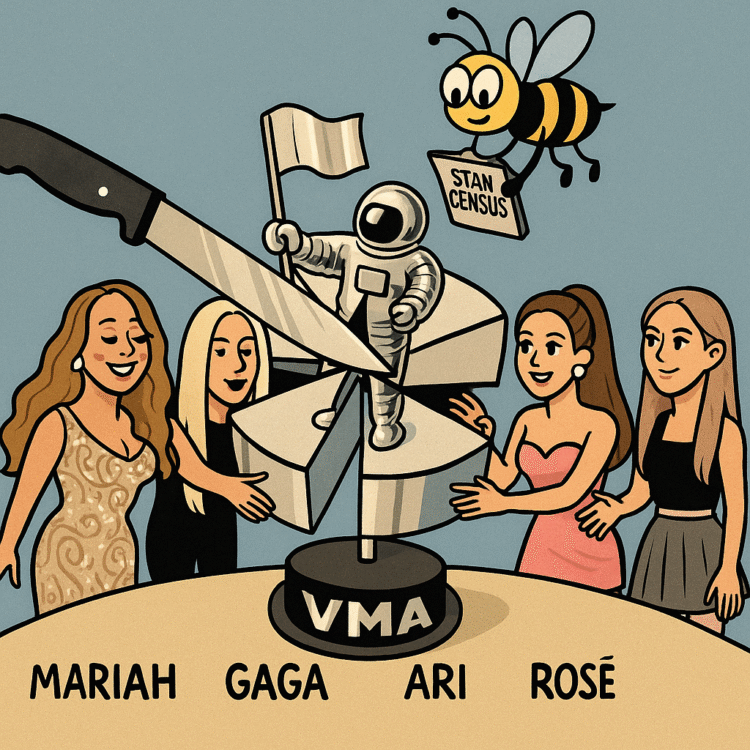
The MTV Video Music Awards are not an award show so much as an annual group therapy session where pop culture confronts its contradictions under a disco ball. For decades, it was a cable-era ritual: eyeliner, explosions, maybe a snake or two. But on September 7, 2025, the VMAs tried on broadcast television for the first time, and the result felt less like a telecast and more like a census. Not the kind the government mails you every ten years. More like a pop-industrial reckoning with stan armies, Spotify algorithms, and the unshakable suspicion that CBS executives secretly fantasize about Mariah Carey running HR.
It was a night where everyone got just enough: Mariah finally got her overdue flowers, Gaga got her trophy-hoard and her Madison Square Garden flex, Ariana got therapy shoutouts, Rosé got a Bruno duet immortalized, and Sabrina got her F-bomb slipped past the censors. The VMAs distributed their Moonpersons with surgical precision, and for once the precision didn’t feel like rigging. It felt like a truce.
Act I: Legacy and Lore
Let’s start with the coronation that should have happened in the ‘90s, in the aughts, in any of the decades MTV spent airbrushing its own history. Mariah Carey, finally, received the Michael Jackson Video Vanguard Award—and, just to rub salt into thirty-five years of delay, also her first competitive VMA ever for Best R&B with “Type Dangerous.”
Mariah’s medley was glitter, sequins, whistle tones, and the gentle passive aggression of a woman who’s been kept waiting far too long. She winked as she thanked MTV for finally noticing she existed, which is the polite pop-diva version of “about damn time.” Ariana Grande introduced her, bridging generations with the kind of respect that only happens when you know your own high notes stand on someone else’s shoulders.
Elsewhere in the legacy lane, Ricky Martin received the inaugural Latin Icon Award, dancing across the stage like it was still 1999. Busta Rhymes collected the Rock the Bells Visionary Award, then reminded everyone that half of TikTok’s flow patterns were stolen from him. And because the VMAs still crave their credibility as a rock show, an Ozzy Osbourne tribute landed like thunder. Steven Tyler, Joe Perry, Yungblud, and Nuno Bettencourt brought the metal, while Ozzy’s grandkids introduced the segment via video. It was the rare VMA tribute that felt like memorial and mosh pit at once.
If you squinted, Act I resembled a pop museum opening its new wing. The exhibits were still alive, still strutting, but the plaques were being mounted.
Act II: Mayhem and Metrics
If Act I was the Smithsonian, Act II was Times Square. Lady Gaga dominated the night, taking Artist of the Year, Best Collaboration with Bruno Mars (“Die With a Smile”), and craft trophies for Best Direction and Best Art Direction on “Abracadabra.” She technically performed at the VMAs but also technically didn’t, beaming in a pre-taped Madison Square Garden mashup like a time traveler sending back receipts.
“Gotta get back to MSG,” she quipped onstage before vanishing, leaving behind more trophies than any other artist that night. Gaga treated the VMAs like a pit stop. CBS treated her like a ratings guarantee. Both were right.
Rosé and Bruno Mars’ “Apt.” was crowned Song of the Year, cementing her first solo Moonperson moment and proving that pop hooks now require international joint custody agreements. Sabrina Carpenter took Best Album for Short n’ Sweet and Best Visual Effects for “Manchild,” punctuating her speech with an F-bomb that CBS censors either missed or strategically allowed for “authenticity.”
Alex Warren was knighted as Best New Artist, KATSEYE took PUSH Performance of the Year, and Tate McRae won Song of Summer for the soundtrack-adjacent “Just Keep Watching (From F1 The Movie).”
The middle act of the night wasn’t about shock value. It was about metrics. Who won enough to trend? Who lost gracefully enough to stay booked? Who got just enough camera time to guarantee stan approval? The VMAs functioned less like an award show and more like a spreadsheet disguised as a concert.
Act III: Global Pop Reality
The third act belonged to globalization, the category MTV resisted for years until streaming made denial impossible. Lisa, flanked by Doja Cat and Raye, won Best K-pop. Tyla collected Best Afrobeats. Shakira, still defying time itself, took Best Latin. Coldplay lumbered home with Best Rock like a reliable insurance payout.
Sombr claimed Best Alternative, Doechii picked up Hip-Hop and Choreography, Kendrick Lamar secured Best Cinematography, and Ariana won Best Longform Video for proving you can stretch a pop narrative past the three-minute mark without collapse. Megan Moroney took the inaugural Best Country, reminding Nashville that yes, the VMAs exist outside of karaoke bars.
The effect was startling. The winners’ board looked like the Spotify Top 50 in multiple languages. For once, MTV acknowledged that pop is global, fractured, and multilingual—and that American teens no longer own the monopoly on screaming.
Red Carpet Theater
Of course, it wouldn’t be the VMAs without chaos on the carpet. Doja Cat applied bright red lipstick on camera, then ate it, because subtlety has never been her lane. Taylor Swift didn’t show up at all, which became its own subplot: her absence was trending harder than some winners.
Mariah’s arrival was treated like the Second Coming of Sequins. Gaga never bothered with the carpet, because Gaga has transcended fabric. Sabrina Carpenter practically sprinted, delivering TikTok-ready soundbites as if she had rehearsed them with Paramount’s PR interns.
Even the seating chart became a subplot. Fans tracked who stood first when Sabrina clinched Best Album. Rosé’s win came with a promise to call Bruno later, a parasocial Easter egg disguised as sincerity.
The VMAs have always been a circus. This year, the carpet was the sideshow.
CBS: Broadcast or Bust
The VMAs airing on CBS for the first time should have been the elephant in the room. Instead, it became the stage itself. MTV didn’t just simulcast; it widened the tent. For a night, the VMAs weren’t a cable relic. They were a broadcast tentpole trying to cosplay as cultural glue.
CBS treated it like Survivor but with sequins. Paramount+ streamed it like a millennial life raft. MTV pretended it was still 2002. The triangulation was absurd and effective: every demo had a way in. The VMAs reinvented themselves not by shocking audiences but by distributing visibility like a federal grant.
The Winners List, a.k.a. The Gospel According to Moonpersons
If you’re keeping score (and you are, otherwise what’s the point):
- Ariana Grande = Video of the Year, Best Pop, Best Longform.
- Lady Gaga = Artist of the Year, Best Collaboration, Best Direction, Best Art Direction (and most awards overall).
- Rosé & Bruno = Song of the Year.
- Sabrina Carpenter = Best Album, Best Visual Effects.
- Alex Warren = Best New Artist.
- Tate McRae = Song of Summer.
- KATSEYE = PUSH.
- Megan Moroney = Best Country.
- Coldplay = Best Rock.
- Shakira = Best Latin.
- Tyla = Best Afrobeats.
- Lisa ft. Doja Cat & Raye = Best K-pop.
- Sombr = Best Alternative.
- Doechii = Best Hip-Hop, Best Choreography.
- Kendrick Lamar = Best Cinematography.
Legacy awards: Mariah Carey (Vanguard), Busta Rhymes (Rock the Bells Visionary), Ricky Martin (Latin Icon). Tribute: Ozzy Osbourne.
That’s the lore pack. Screenshot it for stan warfare later.
The Irony of Equality
What’s fascinating is how evenly MTV spread the wealth. Nobody dominated too much, except Gaga, but even her sweep was carefully insulated by craft categories so Ariana could still claim a headline. Sabrina got her wins without overshadowing Rosé, who was paired with Bruno, who was paired with Gaga. Mariah got her flowers without threatening Ariana’s present tense.
It was equity disguised as chaos, fairness cosplaying as mayhem. Everyone left with something. The stan armies had no choice but to call it a draw. The VMAs became a pop version of Switzerland: neutral, strategic, and slightly smug.
Satire in Sequins
The satirical heart of the night is that the VMAs finally admitted what they’ve been pretending wasn’t true: pop is no longer centralized. The monoculture died, the internet balkanized fandoms, and MTV spent years chasing shock moments that no longer landed. So instead, they leaned into spreadsheets. They became a human resources department for stans, distributing recognition to avoid lawsuits.
Mariah, finally validated. Gaga, crowned again. Ariana, trending. Rosé, globalized. Sabrina, minted. Alex Warren, launched. Megan Moroney, tokened. Coldplay, placated. Shakira, eternal.
It wasn’t chaos. It was choreography.
The VMAs proved one thing: pop music is still capable of collective spectacle, but only when curated like a census. The show wasn’t about crowning the best. It was about maintaining a fragile coalition of fans, demographics, and global markets. It was less “award show” and more “UN summit with pyro.”
And yet—for all the precision, all the spreadsheets, all the choreography—the truth was still there in the screams. Pop culture remains fragmented, tribal, digital. But for one night, Mariah sang, Gaga flexed, Ariana confessed, and the rest of us remembered what it felt like to share the same chorus.
The haunting truth is that the VMAs aren’t just about music videos anymore. They’re about proving the monoculture can still fake a heartbeat. And maybe that’s enough. For a night.