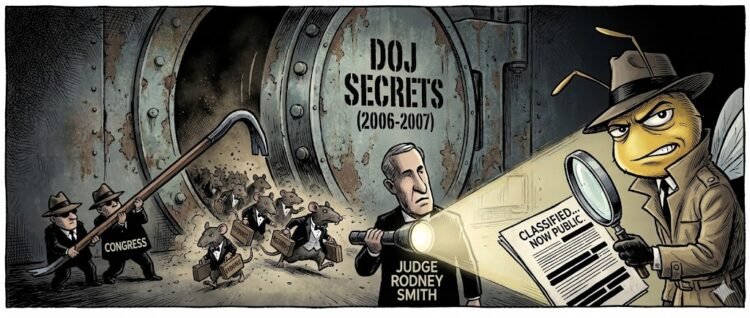
On December 19, the United States government will attempt a new experiment: telling the truth about how it let a monster run a catering service for predators.
There is a specific kind of silence that descends upon a room when the lights are suddenly turned on at a party that has gone on far too long and involved far too many illegal substances. It is the silence of realization. It is the silence of panic. It is the silence of people frantically looking for their shoes while trying to delete their text history. That is the sound currently echoing through the gated communities of Palm Beach, the penthouses of Manhattan, and the darker corridors of Washington D.C. because a federal judge has just decided to do the unthinkable. He reached for the light switch.
U.S. District Judge Rodney Smith, acting with the kind of decisive clarity that usually gets a jurist removed from the holiday card list of the establishment, has ordered the unsealing of grand jury transcripts from the 2006-2007 Florida investigation into Jeffrey Epstein and Ghislaine Maxwell. This is not a drill. This is not a leak. This is the law.
The order comes in the wake of the newly enacted “Epstein Files Transparency Act,” a piece of legislation that passed with such overwhelming bipartisan support—427 to 1 in the House, unanimous in the Senate—that you have to wonder if Congress was trying to atone for something or just wanted to watch the world burn. The only dissenter was Representative Clay Higgins, a man whose voting record often suggests he is receiving signals from a radio frequency the rest of us cannot hear. But aside from the gentleman from Louisiana, the entire legislative apparatus of the United States looked at the secret history of Jeffrey Epstein and said, “Open it up.”
And then, in a twist of irony so delicious it should be served with a side of caviar, President Trump signed it. The man who once socialized in the same circles, who famously noted Epstein’s taste for women “on the younger side,” put his signature on the document that effectively lights the fuse. Whether this was an act of supreme confidence, political nihilism, or simply a desire to see his enemies squirm more than he does is a question for future historians. The result is the same. The vault is opening.
The End of the “John Doe” Era
For nearly two decades, the 2006-2007 Florida investigation has been the Rosetta Stone of the Epstein saga. It is the origin story of the failure. It is where the “deal of the century” was cut, a non-prosecution agreement so lenient it effectively granted Epstein and his unnamed co-conspirators immunity for crimes that hadn’t even been investigated yet. It was a legal hallucinogen, a document that suspended the laws of physics and justice for a man who had the right phone numbers.
Until now, the grand jury proceedings that led to that deal have been sealed behind the iron curtain of Federal Rule of Criminal Procedure 6(e). This rule is the sacred cow of the American legal system. It says that what happens in the grand jury room stays in the grand jury room. It is designed to protect the innocent and ensure witnesses can speak freely. In the Epstein case, however, it has functioned less like a shield for the innocent and more like a lead-lined casket for the truth.
But Judge Smith looked at the new law and ruled that Congress has spoken. The “Epstein Files Transparency Act” overrides the traditional secrecy. The legislative intent was clear: the public interest in understanding how the justice system failed so spectacularly outweighs the privacy of the people who benefited from that failure.
The Justice Department, which has spent years fighting tooth and nail to keep these records buried, now has a statutory deadline. December 19, 2025. That is the date. Mark it on your calendar. It is the day the Department of Justice has to stop protecting its own reputation and start producing the receipts.
The Panic in the Rolodex
Imagine the conference calls happening right now. Imagine the billable hours being racked up at white-shoe law firms as “John Does” ranging from 1 to 170 realize that their anonymity is about to expire. The unsealing covers immunity deals, prosecutorial memoranda, witness testimony, charging deliberations, and internal communications.
This is the anatomy of the fix. We are not just going to see who was accused; we are going to see how the government decided not to prosecute them. We are going to see the internal emails where prosecutors discussed “pressure” and “complexities.” We are going to see the logic, or lack thereof, that led Alexander Acosta—then the U.S. Attorney in Miami—to sign off on a deal that required Epstein to serve a mere 13 months, mostly on work release, in a private wing of a county jail where the door was presumably kept unlocked.
The “cascading litigation” predicted by legal analysts is a polite way of saying “total chaos.” Every person named in those files is going to file an emergency motion. They will argue for privacy. They will argue for safety. They will argue that the release of their name will cause “reputational harm,” ignoring the fact that the reputational harm is entirely self-inflicted by their decision to associate with a prolific sex trafficker.
The Justice Department faces a filing deadline of Monday, December 8, to respond to submissions from victims, Epstein’s estate, and Maxwell’s counsel regarding pending New York requests. The timeline is compressed. The pressure is immense. The DOJ is trapped in a pincer movement between a Congress that demands transparency and a class of powerful individuals who demand obscurity.
Redaction as an Art Form
The law does allow for narrow redactions. This is where the battle will be fought. The statute permits the withholding of personally identifiable information of victims, which is necessary and just. It also allows for the protection of materials that could jeopardize “active investigations.”
And here lies the rub. What counts as an “active investigation” in a case where the primary villain has been dead for years and his accomplice is serving twenty years in federal prison? Is there a secret, ongoing probe into the other men? Or will the DOJ use the “active investigation” excuse to hide the most embarrassing details of their own incompetence?
Critics say these files have long been shielded not to protect the integrity of the law, but to protect the integrity of the prosecutors. It is embarrassing to reveal that you let a monster walk because he hired expensive lawyers and threatened to make your life difficult. It is humiliating to admit that the justice system is a tiered service, with a premium package available for billionaires that includes “immunity for all your friends.”
We should expect the initial release to look like a classified CIA document from the Cold War—black bars covering every third word. But the judge’s order is specific. The exceptions are narrow. The burden is on the government to prove why a name should be hidden. And Judge Smith does not seem to be in the mood for games.
The Clay Higgins Mystery
We must pause for a moment to appreciate the lone “nay” vote. Representative Clay Higgins. Why? Why did the gentleman from Louisiana oppose a bill that even the most partisan hacks in Washington agreed upon? Did he think it was a trap? Did he believe the files contained the coordinates to a ghost bus? Or is he simply a contrarian who votes “no” on everything just to see if anyone notices?
In a way, Higgins’ opposition serves as the perfect satirical garnish to this dish. It highlights the absurdity of the consensus. When 427 members of the House agree on something, you usually assume they are naming a post office. For them to agree on exposing the darkest scandal of the century suggests that the pressure from the public had become insurmountable. They didn’t vote for this because they are brave. They voted for this because they were terrified of being the one person who voted to keep the secrets. Higgins, apparently, lacks that fear gene, or perhaps simply lacks the ability to read the room.
The Myth of the “Black Book”
There is a danger, of course, that we are overhyping the contents. We have been trained by Hollywood to expect a smoking gun, a single document that lists the names of every power broker who flew on the “Lolita Express” and exactly what crimes they committed.
Real life is rarely that tidy. The grand jury transcripts will likely be a mess of conflicting testimony, bureaucratic jargon, and procedural maneuvering. We will see prosecutors agonizing over jurisdiction. We will see witnesses pleading the Fifth. We will see the banality of evil in its most bureaucratic form.
But even if there is no single smoking gun, the sheer volume of the evidence will be damning. It will show the pattern. It will show the network. It will show that Jeffrey Epstein was not a lone wolf; he was a hub. He was the center of a spider web that stretched from Hollywood to Harvard, from Kensington Palace to the White House. And the flies caught in that web were teenage girls.
The Public Reckoning
The “public reckoning” promised by the pundits is an optimistic phrase. Reckoning implies consequences. Reckoning implies that people will lose their jobs, their status, their freedom.
But let’s be realists. Most of the people involved are too big to fail. They have crisis PR firms on retainer. They have lawyers who charge more per hour than most Americans make in a month. They will spin. They will deny. They will claim that “being named in a grand jury proceeding is not evidence of guilt,” which is technically true but morally irrelevant in the court of public opinion.
What we will get instead of a reckoning is a confirmation. We will get confirmation of what we have suspected all along: that the rules do not apply to them. We will see, in black and white text, that the Department of Justice looked at the evidence of mass sexual abuse and decided that a non-prosecution agreement was the “appropriate resolution.”
This confirmation is painful, but it is necessary. We cannot fix a system until we see exactly how it is broken. We need to see the gears of the corruption. We need to see the memos where a prosecutor wrote, “He has powerful friends,” or whatever euphemism they used for “We are afraid of him.”
The Privacy Paradox
The concern for victim privacy is the one legitimate argument for caution. These women have been through hell. They were abused by Epstein, then abused by the legal system that ignored them, then abused by the media that sensationalized them. The last thing they need is for their grand jury testimony—given under the promise of secrecy—to be splashed across the internet for the amusement of armchair detectives.
The Act and the Judge’s order claim to protect them. But redaction is an imperfect science. In the age of the internet, a few biographical details can be enough to identify someone. The “cascading litigation” will likely include frantic motions from victims’ attorneys trying to ensure that their clients are not re-traumatized in the name of transparency.
This is the tragedy of the situation. The secrecy that was supposed to protect the victims was weaponized to protect the perpetrators. Now, to expose the perpetrators, we risk exposing the victims again. It is a trap laid twenty years ago by Jeffrey Epstein, and we are still caught in it.
The Trump Card
The fact that President Trump signed this bill is the final layer of surrealism. Trump, who once called Epstein a “terrific guy,” is now the instrument of his exposure. It fits his chaotic style of governance. He loves to burn down the establishment, even if he is standing in the lobby.
Perhaps he believes he is insulated. Perhaps he believes the files will hurt his enemies more than they hurt him. Or perhaps he just likes the chaos. The “Epstein Files Transparency Act” is a populist grenade, and Trump has never met a grenade he didn’t want to pull the pin on.
It sets up a fascinating dynamic for the next month. The Justice Department, technically under the executive branch but fiercely protective of its independence (and its secrets), is being ordered by the President (via the law he signed) to expose its own past failures. The tension between the White House and the DOJ will be palpable.
The Statutory Deadline
December 19, 2025. It is close. It is looming. It is the deadline for the Justice Department to produce the unclassified records.
Will they comply? Or will they stall? Will they dump 10,000 pages of fully redacted black ink on a Friday afternoon at 5:00 PM? Will they file an emergency appeal to the Supreme Court arguing that the separation of powers prevents Congress from ordering the unsealing of grand jury records?
Do not underestimate the Department of Justice’s ability to delay. They are the masters of the slow walk. They can turn a 30-day deadline into a three-year litigation battle. But Judge Rodney Smith seems to have anticipated this. His order is firm. The law is clear. The legislative mandate is overwhelming.
If the DOJ tries to stonewall, they will be fighting a three-front war: against the Courts, against Congress, and against the President who signed the bill. That is a losing battle, even for the most entrenched bureaucrats.
The Architecture of Impunity
When the files finally drop, we need to be prepared for what we will see. We will not just see the names of bad men. We will see the architecture of impunity. We will see how wealth and power can bend the light of justice until it breaks.
We will see the letters of recommendation. We will see the phone logs. We will see the social calendar of a predator who was welcomed into the highest echelons of society because he threw good parties and claimed to manage money for billionaires.
The “Epstein affair” was never just about Epstein. It was about us. It was about our culture’s worship of wealth. It was about our willingness to look the other way as long as the check clears.
Epstein is dead. Maxwell is in prison. But the system that created them, protected them, and enabled them is still very much alive. The unsealing of these records is an attempt to put that system on trial.
It is an audit of the American aristocracy. And the results are going to be ugly.
The Aftermath
What happens on December 20? The sun will rise. The internet will be on fire. The cable news pundits will scream. The politicians will issue statements expressing “shock” and “outrage” at things they probably knew about for years.
But for the victims, the unsealing might bring a sliver of peace. Not justice—justice would have been Epstein facing a jury in 2007—but validation. The world will finally see the evidence they tried to present. The world will finally understand the magnitude of the betrayal.
The “Epstein Files Transparency Act” is a rare example of the government actually doing something the people want. It is a moment of clarity in a fog of war.
It is also a warning. It is a warning to every powerful predator who thinks their secrets are safe in a grand jury room. It is a warning that laws change, climates shift, and eventually, the seal gets broken.
The vampires of 2006 thought they would live forever in the dark. But the dawn is coming on December 19. And it turns out, sunlight really is the best disinfectant, even if it burns.
Receipt Time
The invoice for twenty years of silence is finally due. The cost was the safety of countless young women. The cost was the integrity of the Justice Department. The cost was the public’s faith that the law applies to everyone. The unsealing of these documents is the first installment of the repayment plan. We are about to see the itemized list of who bought what, who sold what, and who looked the other way. The receipt is long, it is dirty, and it has names on it that you recognize. And for once, the American public isn’t the only one paying the bill.