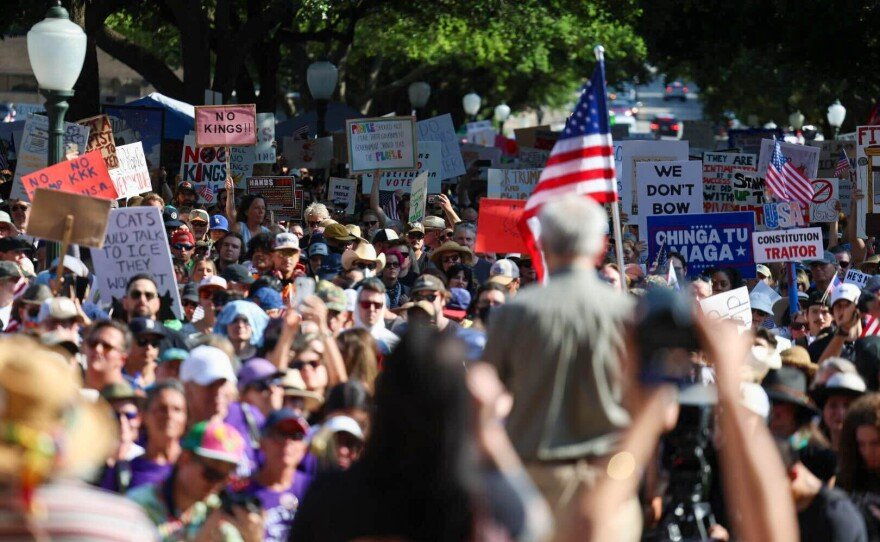
The streets rumble not with tanks, but with voices. The air, thick with the weight of civic discontent, carries a different kind of power. Across the nation, thousands of Americans recently participated in nationwide “No Kings” protests against President Trump’s policies, coinciding, quite pointedly, with a military parade celebrating the U.S. Army’s 250th birthday. For some, this juxtaposition might seem discordant, disrespectful even. But for me, as a liberal Democrat with a deep belief in democratic principles, this convergence was a powerful, essential demonstration of what it truly means to be a citizen in a republic.
This isn’t just about disagreement; it’s about the inherent, vital role of public dissent in a functioning democracy. It’s about the unyielding roar of the people, demanding to be heard when the established channels feel unresponsive, or when core values are perceived to be under threat.
The Myth of Unanimous Consent: A Democracy’s True Pulse
In any healthy democracy, there is no such thing as universal agreement. To expect it is naive; to demand it is authoritarian. The beauty of a republic lies in its capacity for diverse viewpoints, its mechanisms for debate, and its avenues for citizens to express their approval and disapproval of their government. Political protest is one of the oldest, most fundamental, and often most effective mechanisms for expressing that disapproval.
- A Check on Power: Protests serve as a vital check on governmental power. When elected officials act in ways that are perceived to be unjust, harmful, or contrary to the will of the people, public demonstrations send an undeniable signal of discontent. They force those in power to acknowledge opposition, to respond, and, ideally, to reconsider their actions. They are the constant atmospheric pressure on decision-makers.
- Giving Voice to the Unheard: For marginalized communities, or for those whose voices are often drowned out by powerful lobbies and entrenched interests, protest can be the only effective way to make their concerns heard. It provides a platform for grievances that might otherwise be ignored by mainstream media or dismissed by political elites.
- Catalyst for Change: Historically, every major stride forward in civil rights, human rights, and social justice in America has been catalyzed, or at least significantly propelled, by public protest. The Civil Rights Movement, the women’s suffrage movement, the LGBTQ+ rights movement (sparked by Stonewall, a riot against police brutality)—these were all defined by courageous individuals taking to the streets, demanding recognition and equality.
- Exercising Fundamental Rights: The right to peacefully assemble, to speak freely, and to petition the government for a redress of grievances are cornerstones of the First Amendment. Protests are not a deviation from democratic norms; they are a direct, embodied exercise of those fundamental liberties. They are the very breath of a free society.
The ‘No Kings’ Protests: A Direct Challenge to Perceived Overreach
The “No Kings” protests against President Trump’s policies were a powerful manifestation of this democratic right. The slogan itself—”No Kings”—is deeply resonant, harkening back to the foundational anti-monarchical spirit of the American Revolution. It signals a rejection of authoritarian tendencies, a demand for accountability from leadership, and a reminder that in a republic, power ultimately resides with the people, not a singular ruler.
The specific timing, coinciding with a military parade, added another layer of poignant commentary. While honoring our military is important, the decision to hold a large, expensive military parade in the nation’s capital has often been criticized as a display more akin to authoritarian regimes than a democratic republic. The protests, occurring simultaneously, served as a powerful counter-narrative, a clear statement that national pride in military strength should not overshadow the fundamental right to dissent or the civilian nature of our democracy. It highlighted the distinction between honoring service members and tacitly endorsing a particular political leader’s agenda. The clash of these two events created a palpable tension in the atmosphere.
Beyond Discomfort: Why Protest Is Necessary (Even When It’s Messy)
For those unaccustomed to it, protests can seem inconvenient, noisy, or even disruptive. They can be uncomfortable to witness. But that discomfort is often the very point.
- Disrupting Complacency: Protest is designed to disrupt the status quo, to break through indifference, and to force a confrontation with uncomfortable truths. If it’s too polite, too quiet, or too easily ignored, it loses its power to effect change.
- Drawing Attention: In a crowded media landscape, protests demand attention. They force issues onto the public agenda, compelling news coverage and sparking conversations that might otherwise be avoided.
- Reflecting Real Distress: When thousands of citizens take to the streets, sacrificing their time, energy, and sometimes risking their safety, it reflects a genuine, profound level of distress and dissatisfaction with the government or specific policies. It signals that the grievances are not merely isolated complaints, but widespread concerns.
For me, particularly as someone who has experienced the painful realities of oppressive power dynamics (from personal abuse to navigating systemic discrimination against the LGBTQ+ community), the act of public protest is a vital affirmation of agency. It’s a refusal to be silent. It’s a demand for justice. It’s a declaration that the voices of the people will not be ignored.
Political protests are not antithetical to patriotism; they are its very embodiment. They are the unyielding roar of a democratic people, challenging authority, demanding accountability, and striving to make their nation live up to its highest ideals. They are the essential oxygen that keeps the flames of liberty burning brightly.
What are your thoughts on the role of political protest in a democracy? When do you believe protest is most effective? Share your perspective below – let’s discuss the power of public dissent and the ongoing pursuit of justice.