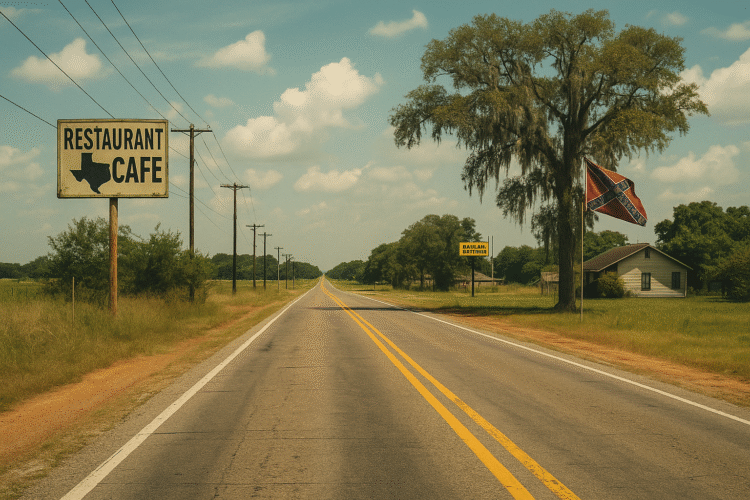
When people think of the American South, a particular image springs to mind: magnolia trees, sweet tea, wraparound porches, maybe a fiddle in the background and someone with a syrupy drawl offering you a “bless your heart.” And while those postcards aren’t exactly wrong—hell, I’ve sipped a sweet tea on a wraparound porch in Georgia while watching someone drive a riding mower shirtless with a beer in hand—they’re also only part of the story.
The South, as I’ve come to know it through my many road trips and detours, is a region in contradiction. It’s where you can stumble upon a soul-stirring gospel choir in a country church and then, five miles down the road, see a Confederate flag waving proudly like it’s the most normal Tuesday in the world. It’s BBQ smoke wafting through towns with boarded-up buildings. It’s a Cracker Barrel next to a Dollar General next to a shuttered maternity ward. It’s warm smiles and hard truths. It’s home to me—and yet I’m often struck by how little the travel brochures prepare you for the real South.
Let’s talk about what the billboards and tourism boards tend to leave out.
Poverty in Plain Sight
One thing you quickly learn driving through small-town Alabama, Mississippi, Louisiana, and my home state of Texas: poverty isn’t hidden here—it’s woven into the landscape. You’ll see it in crumbling motels turned permanent housing, in entire downtowns with more “For Lease” signs than businesses, in schools that look like time forgot them.
There’s generational poverty that can’t be scrubbed clean with charm. Some towns feel like they’ve been bypassed—by progress, by investment, by anyone who could have helped before it got this bad. It’s not uncommon to fill up at a gas station that still uses mechanical pumps, then drive past homes with blue tarps for roofs and “Jesus Saves” signs out front. People survive here, but they shouldn’t have to just survive.
And yet this poverty is often romanticized or ignored in narratives about “Southern grit” or “simple living.” It’s neither simple nor charming when families have to drive 45 minutes for healthcare or clean water.
Race, History, and Selective Amnesia
The South’s racial history isn’t behind it—it walks beside it. I’ve been in towns where historical markers proudly celebrate Civil War battles but leave out the part where the economy was built on human lives. I’ve stood in beautifully preserved squares where the only monument to Black history was a modest plaque in the shade behind the courthouse.
On one trip through Mississippi, I visited a plantation-turned-event-venue that was aggressively sanitized—no mention of slavery, but plenty of talk about “heritage” and “Southern elegance.” I didn’t see the ghosts, but I felt them. You always do.
There’s progress, of course. There are murals celebrating civil rights heroes, thriving Black-owned businesses, and communities pushing back against the whitewashing of history. But there’s also resistance—quiet, polite, sometimes violent resistance. And as a biracial, queer man driving through places where I might legally marry someone one day and be refused service the next, I don’t take my visibility lightly.
Queerness in Unexpected Places
Let’s talk about queerness in the South—a subject near and dear to my glittering little heart.
Despite what outsiders assume, there are queer folks everywhere here. In fact, some of the fiercest LGBTQ+ people I’ve met live in the heart of Bible Belt towns, throwing drag brunches in barbecue joints or running youth centers out of old VFW halls. They are bold. They are loud. They are necessary.
But it’s not easy.
I’ve felt the shift in energy when I walk into a diner in rural Arkansas holding hands with my boyfriend. I’ve watched waitresses try to figure out whether to treat us like any other couple or pretend we’re just two guys on a road trip. Sometimes the smile tightens. Sometimes it widens. You never know. That’s the dance.
Yet I’ve also had unexpected conversations in these towns—people asking kind, curious questions. People who want to understand, even if they’ve never met someone like me before (or think they haven’t). That’s the thing about the South: people are nosy, but they’re also often open. You just have to risk being seen.
What Road Trips Reveal That Flights Don’t
There’s a reason I prefer the highway to the tarmac. Planes get you there fast, but they don’t show you the bones of a place. They don’t make you stop in towns with names you can’t pronounce or gas stations where the only hot food is a dusty heat-lamp burrito and a slice of pecan pie someone’s grandma probably made at 4 a.m.
Driving forces you to see what’s not on Instagram—the poverty, the resilience, the isolation, the beauty, the contradictions. It reminds me that there are stories beneath the surface, that people’s lives are shaped by things most of us never stop to consider.
I’ve driven past kids playing basketball on courts without nets, past pride flags in windows just steps from churches that preach intolerance, past fields and fast food and towns that never made the travel guides.
And I’ve thought: this is the real South. Messy. Gorgeous. Hurting. Singing. Surviving.
Why It Matters
When we only consume curated versions of the South—or any region—we lose our ability to empathize, to understand, to act. Road trips have been a form of truth-telling for me, a way to connect the dots between policy and people, between history and the present moment.
It’s easy to dismiss the South as backward or broken. But what I see is a place that’s complicated and fighting—sometimes with itself, sometimes with its past, sometimes with the future knocking on the door.
If we want to change it, understand it, celebrate it—we have to see all of it. Not just the pretty postcards.