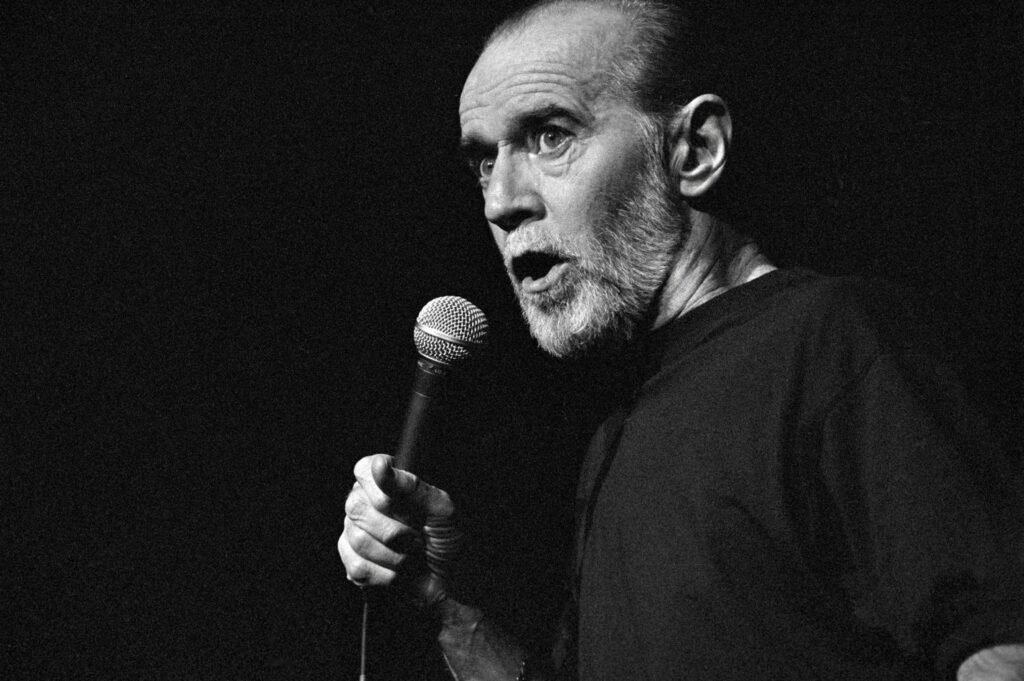
The microphone stand stood silent, the stage lights dimmed, but the echoes of his words, sharp as a surgeon’s scalpel and precise as a laser, reverberate through the very fabric of our cultural consciousness. He didn’t just tell jokes; he dissected society, excoriated hypocrisy, and peeled back the layers of polite absurdity with a gleeful, mischievous abandon. Today, my thoughts gravitate towards an undisputed titan, a comedic philosopher whose legacy continues to shape the very air we breathe: George Carlin.
This isn’t just about a comedian; it’s about a revolutionary force, a linguistic alchemist, and arguably The Godfather of Modern Satire. For me, a lifelong admirer of wit that cuts deep and humor that challenges power, Carlin wasn’t just funny; he was essential. He proved that comedy could be dangerous, profound, and relentlessly truthful, even when the truth made you profoundly uncomfortable.
The Evolution of a Prophet: From Hippie Dippie to Righteous Fury
Carlin’s career spanned over five decades, and his comedic evolution was as remarkable as his impact. He wasn’t born the acerbic social critic we remember; he transformed, shedding personas like a snake sheds its skin, always honing his craft and sharpening his message.
- The “Hippie-Dippie Weatherman” (1960s-early 70s): Early Carlin was known for his counter-culture observations, his genial, laid-back persona, and his iconic bits like “Seven Words You Can Never Say on Television.” He was a playful rebel, charmingly pushing boundaries and questioning authority with a wink. He became a voice for a generation, exposing absurdity with a light touch.
- The Social Critic and Linguistic Dissector (Late 70s-80s): As he matured, his comedy shed its gentler facade and became increasingly focused on dissecting language, hypocrisy, and the systemic flaws of American society. He wasn’t just cursing for shock value; he was meticulously illustrating how language itself could be used to obfuscate truth, control thought, and sanitize brutal realities. His bits on “soft language” and the euphemisms of war were masterclasses in linguistic analysis.
- The Oracle of Righteous Fury (90s-2000s): This was Carlin at his most potent, his most uncompromising. He became a curmudgeonly prophet, delivering blistering, cynical, yet undeniably insightful critiques of politics, consumerism, religion, and human stupidity. He was angry, yes, but it was a righteous anger, born from a profound disillusionment with humanity’s capacity for self-deception and cruelty. His material became darker, more visceral, and utterly fearless. He didn’t seek your approval; he sought to provoke your thought, and often, your discomfort.
This evolution wasn’t just about changing an act; it was a reflection of a man grappling with a changing world, constantly refining his lens to see the absurdities more clearly, and expressing them with increasingly devastating precision.
The Unholy Trinity: Language, Hypocrisy, and the Absurd
Carlin’s comedic brilliance lay in his ability to identify and relentlessly expose the inherent absurdity in human behavior, often by dissecting the very language we use to mask it.
- The “Seven Words You Can Never Say on Television”: This iconic routine wasn’t just profanity for profanity’s sake. It was a brilliant, satirical commentary on societal taboos, on arbitrary censorship, and on the power structures that dictate what is “acceptable” speech. He exposed the hypocrisy of condemning words while ignoring the systemic violence they often masked. It sparked a legal battle that went all the way to the Supreme Court, proving the profound impact of his linguistic rebellion. He showed that controlling words was a way of controlling thought.
- Exposing Hypocrisy: Carlin was a master at unmasking hypocrisy in all its forms—political, religious, social, and personal. He fearlessly called out the disconnect between what people say they believe and how they actually behave. His routines on “saving the planet” (while still consuming relentlessly) or the absurdity of organized religion were scathing precisely because they were so true. He didn’t just critique; he eviscerated.
- Dissecting Consumerism and American Culture: He relentlessly targeted the absurdities of American consumerism, the relentless pursuit of material possessions, and the pervasive culture of marketing and advertising. He saw through the manufactured desires and exposed the emptiness beneath. His observations on “stuff” and the inherent contradictions of capitalism were chillingly prescient.
- The Dark Truths: Carlin pulled no punches. He spoke about war, poverty, disease, and societal decay with a brutal honesty that was often uncomfortable but impossible to ignore. He refused to sugarcoat reality, forcing his audience to confront the darker side of human nature and the systemic failures of society. He showed that truth, however ugly, could be profoundly, terrifyingly funny.
His humor was never mean-spirited towards the vulnerable; it was always directed upwards, at power, at institutions, at complacency. He wasn’t punching down; he was punching up, wielding satire as a weapon against the powerful and the ignorant.
The Godfather’s Legacy: Shaping the Atmosphere of Modern Comedy
Carlin’s impact on comedy and social commentary is immeasurable. He didn’t just set a bar; he created a new firmament, influencing generations of comedians who followed.
- The Comedian as Social Critic: He solidified the role of the comedian not just as an entertainer, but as a crucial social critic, an intellectual provocateur, and a fearless truth-teller. He proved that comedy could be a powerful tool for challenging norms, sparking uncomfortable conversations, and pushing for societal change.
- Unflinching Honesty: He taught comedians the power of unflinching honesty, even when it’s uncomfortable or politically incorrect. He showed that audiences, despite their initial discomfort, often respond to raw, unvarnished truth.
- Linguistic Precision: His meticulous deconstruction of language influenced countless wordsmiths. He taught comedians to choose their words carefully, to dissect meaning, and to understand the power embedded in every syllable.
- Breaking Taboos: Carlin’s willingness to tackle taboo subjects—sex, religion, politics, death—opened doors for future comedians to explore sensitive topics with greater freedom and less fear of censorship.
George Carlin was more than just a comedian; he was a profound philosopher, a keen social observer, and a fearless truth-teller who used laughter to expose the absurdities of the human condition. His legacy is etched into the very fabric of modern satire, a constant reminder that the sharpest wit often comes from the deepest understanding of reality, and that comedy, at its best, is an uncompromising force for honesty. He cleared the air, exposing the truth with devastating precision, and for that, he will always be The Godfather.