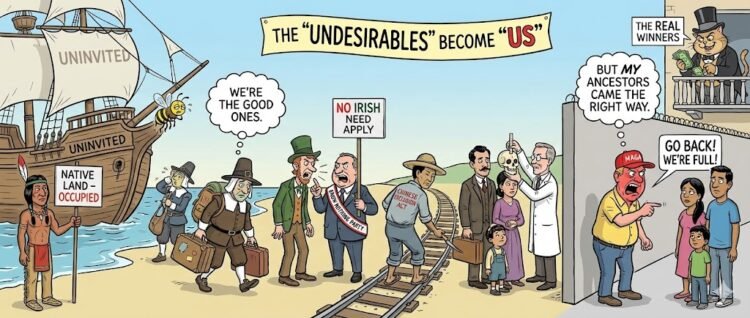
We like to tell ourselves a very specific story about the United States. It is a story printed on glossy brochures, recited by politicians with wet eyes, and taught to children before they are old enough to read the footnotes. It is the story of a “Nation of Immigrants,” a melting pot where the tired, the poor, and the huddled masses yearn to breathe free and are welcomed with open arms and a job application. It is a beautiful story. It is also a lie so large it effectively functions as a load-bearing wall for the American psyche.
If you actually peel back the wallpaper of American history, you do not find a welcoming committee. You find a crime scene. You find a centuries-long panic attack about who belongs here, punctuated by brief periods where we needed cheap labor to build a railroad or pick a crop. The history of American immigration is not a steady march toward inclusion. It is a cycle of invitation, exploitation, and expulsion, repeated with the grim predictability of a sitcom rerun where the only joke is xenophobia.
To understand the current screaming match about the border, we have to go back to the beginning. And by the beginning, I do not mean Plymouth Rock. I mean the people who were already here.
Part I: The Landlords and the Squatters
The only people in the United States who are not immigrants are the Indigenous nations. This is the uncomfortable truth that sits at the bottom of every debate about “border security.” The Native Americans did not cross a border. The border crossed them. It was drawn over their homes, their hunting grounds, and their sacred sites by people who arrived without visas, without passports, and without manners.
When we talk about “illegal immigration,” we rarely apply that term to the Mayflower. But let us look at the facts. The Pilgrims and the Puritans arrived uninvited. They refused to assimilate to the local culture. They did not learn the language. They brought strange religious customs that they insisted on imposing on everyone else. They brought contagious diseases that decimated the population. And they brought a culture of violence that viewed the locals not as neighbors, but as obstacles to be removed.
The early history of European settlement is the story of the first great wave of undocumented migration. The settlers at Jamestown and Plymouth were not “expats.” They were squatters. They seized territory by force, validated by a “Manifest Destiny” that was essentially a divine permission slip for theft. From the massacre at Mystic to the slaughter at Wounded Knee, the “immigration policy” of the founding era was genocide. The reservation system was the original deportation force, corralling the rightful owners of the land onto the least fertile scraps of territory available while the newcomers congratulated themselves on their grit.
So when a guy in a MAGA hat screams about “invasion,” he is participating in a deeply ironic historical reenactment. He is the descendant of the actual invaders, standing on stolen land, demanding to see the papers of people who have been on this continent for thousands of years.
Part II: The Abduction Economy
The second group we must address did not immigrate. They were trafficked.
The foundation of American wealth was not built by “hardworking immigrants pulling themselves up by their bootstraps.” It was built by the forced migration of millions of enslaved Africans. This was not immigration. It was abduction. It was the industrial-scale kidnapping of human beings to fuel the agricultural economy of the South and the textile economy of the North.
These men, women, and children were never treated as immigrants. They were treated as capital. They were assets on a ledger, not potential citizens. The Constitution, that sacred document we love to quote, originally counted them as three-fifths of a person, a mathematical compromise designed to give their captors more political power while denying the captives any humanity at all.
Even after the Civil War, when the chains were legally broken, Black Americans were not welcomed into the fold. They were subjected to a system of apartheid that lasted for a century. When they tried to move—when they participated in the Great Migration, fleeing the terror of the Jim Crow South for the jobs of the North—they were treated as internal foreigners. They were redlined into ghettos. They were barred from unions. They were met with race riots in cities like Chicago and Detroit. They were refugees in their own country, moving from one hostile territory to another, searching for the citizenship that was promised on paper but denied in practice.
Part III: The White, But Not White Enough
Once the Europeans established their foothold, they started arguing about which Europeans were the “right” kind. This is where the comedy of the “white race” really begins to shine. We tend to think of “white” as a fixed category, but for most of American history, it was a VIP club with a very strict bouncer.
In the 18th and early 19th centuries, the “real Americans” were the English and the Scots-Irish. They looked at the Germans arriving in Pennsylvania and panicked. Benjamin Franklin, a man usually celebrated for his wit, wrote grumpy letters worrying that the Germans were too swarthy and refused to speak English. He worried they would never assimilate. Today, the descendants of those Germans are the people yelling at Spanish speakers in the grocery store.
Then came the Irish.
In the mid-19th century, the Potato Famine drove millions of Irish refugees to American shores. They were starving. They were desperate. And they were Catholic. To the Protestant establishment, this was an invasion of Papist sleeper agents. The Irish were depicted in cartoons not as humans, but as ape-like monsters, violent drunks who were loyal to a foreign potentate in Rome. The “No Irish Need Apply” signs were not an urban legend; they were the labor policy of the Northeast.
The “Know Nothing” party—a name that remains the most accurate political label in American history—rose to power on a platform of pure nativism. They burned Catholic churches. They rioted in the streets. They argued that these newcomers were genetically inferior, prone to crime, and incapable of understanding democracy. Sound familiar? It is the same script, just read with a brogue.
Part IV: Building the Railroad, Banning the Builders
Then, the country decided it needed to expand west. It needed a railroad. But building a railroad through the granite of the Sierra Nevada is hard, dangerous work. The “native” white workers didn’t want to do it. So, the captains of industry imported labor from China.
Chinese workers blasted the tunnels. They laid the tracks. They died in avalanches and explosions. They built the infrastructure that made the modern United States possible. And how did the country thank them?
In 1882, Congress passed the Chinese Exclusion Act.
This was the first federal law to explicitly ban a specific ethnic group from entering the country. It declared that the people who had just built the spine of the economy were “undesirable.” They were branded as “rat eaters” and “opium fiends.” They were accused of stealing jobs and corrupting white women. The very people who did the work that made the tycoons rich were legally classified as a contagion to be kept out.
This set the template for the modern immigration system: invite the labor, criminalize the laborer. We want the work. We just don’t want the worker to be a neighbor.
Part V: The Ellis Island Sorting Hat
We love the image of Ellis Island. We love the Statue of Liberty lifting her lamp beside the golden door. But the reality of the turn of the 20th century was less “golden door” and more “cattle chute.”
The waves of immigrants arriving from Southern and Eastern Europe—Italians, Jews, Poles, Greeks—were not greeted as fellow white people. They were viewed with deep suspicion. The eugenicists of the day, the serious men with calipers and charts, argued that these people were of a lower racial stock than the “Nordics” of Northern Europe. They measured skulls. They talked about “racial hygiene.” They worried that the blood of the nation was being diluted by these swarthy, garlic-eating masses.
This panic culminated in the National Origins Act of 1924. This law established strict quotas designed to freeze the demographic composition of the United States. It drastically cut immigration from Southern and Eastern Europe and completely barred immigration from Asia. It was a law explicitly designed to Keep America White (and Protestant).
It is worth noting that during this same era, while we were turning away Jews and Italians, we were also rounding up Japanese Americans. During World War II, American citizens of Japanese descent were stripped of their property and forced into internment camps. They had committed no crime. Their only offense was their ancestry. At the exact same time, the United States turned away the St. Louis, a ship full of Jewish refugees fleeing the Nazis, sending them back to Europe to face the Holocaust because they exceeded the “quota.”
This is the history we skip over during the Thanksgiving pageant. We don’t talk about the quotas. We don’t talk about the skull measuring. We pretend that everyone just showed up, learned English, and opened a pizza shop.
Part VI: The Pivot to the South
In 1965, everything changed. The Hart-Celler Act abolished the racist quota system of the 1920s. It opened the doors to immigration from Latin America, Asia, Africa, and the Middle East. It changed the face of the nation.
But it did not change the panic.
As the source of immigration shifted from Europe to the Global South, the rhetoric shifted from “racial hygiene” to “law and order.” The focus became the southern border.
The relationship with Mexican labor is the most schizophrenic of all. During World War II, when we needed workers, we created the Bracero program. We legally imported millions of Mexican men to work the fields and build the roads. We welcomed them. We needed them. Then, in the 1950s, when the economy shifted, we launched “Operation Wetback” (that was the official government name), a mass deportation campaign that rounded up over a million people, including some U.S. citizens, and dumped them across the border.
This is the cycle. We create a demand for labor. We fill that demand with immigrants. And then, when the political winds shift, we demonize the people we invited.
The modern “illegal immigration” crisis is a direct result of this dynamic. We built an economy that relies on undocumented labor to keep prices low. The agriculture industry, the construction industry, the hospitality industry—they would collapse overnight without undocumented workers. We know this. The politicians know this. The corporations know this. But we refuse to create a legal pathway for these workers because it is politically useful to keep them illegal.
By keeping them illegal, we keep them cheap. An undocumented worker cannot form a union. They cannot report safety violations. They cannot demand overtime. They are the perfect exploitable workforce. The “crisis” at the border is not a failure of enforcement; it is a success of labor discipline.
Part VII: The Good Refugee and the Bad Refugee
The way we treat refugees reveals the geopolitical cynicism at the heart of our policy. If you are fleeing a communist regime we hate, you are a hero. If you are fleeing a right-wing dictatorship we support, you are a nuisance.
Cubans fleeing Castro? Come on in. Here is a path to citizenship. You are freedom fighters.
Haitians fleeing the chaos caused by decades of U.S. interference? Go back. You are economic migrants.
Vietnamese and Hmong refugees fleeing the war we started? We will take you, but you will face decades of racism and resentment in the communities where you settle.
Somali and Syrian refugees fleeing civil wars? We will take a few, but we will subject you to “extreme vetting” and treat you as potential terrorists because of your religion.
This double standard was never more apparent than after 9/11. Overnight, the entire immigration apparatus was weaponized against Muslims and South Asians. We created the NSEERS program, a registry for men from Muslim-majority countries. We detained thousands of people without charge. We turned the immigration system into an arm of the War on Terror, viewing every visa applicant as a potential sleeper cell.
The “Muslim Ban” of the Trump administration was not an aberration. It was the logical conclusion of decades of policy that viewed Muslims as a security threat rather than as human beings.
Part VIII: The Great Distraction
So here we are. It is 2025. The news is filled with stories about “caravans” and “invasions.” The politicians are screaming about the border. They are promising to round up millions of people. They are promising to build camps.
Why?
Why are we still having the same argument we had in 1850, in 1882, in 1924?
Because it works.
Nativism is the most effective political tool in the American arsenal. It is the “break in case of emergency” glass for the ruling class. When the inequality gets too high, when the wages get too low, when the rent gets too expensive, you point at the immigrant.
You tell the struggling factory worker in Ohio that the reason his plant closed wasn’t because of private equity looting or automation or bad trade deals written by corporate lobbyists. You tell him it was because of the guy named Jose. You tell the suburban mom that the reason her schools are underfunded isn’t because of tax cuts for billionaires. You tell her it’s because of the refugee children cluttering up the classroom.
It is a lie. It is a mathematical lie. The immigrant did not write the tax code. The asylum seeker did not deregulate Wall Street. The undocumented worker did not cause the 2008 crash or the inflation of 2022.
But the lie is powerful because it offers a target. You can’t yell at a hedge fund. You can’t punch a global supply chain. But you can yell at a family speaking Spanish in the checkout line. You can vote for a guy who promises to build a wall.
The “Great Replacement Theory”—the idea that elites are importing immigrants to replace “real” Americans—is a distortion of the truth. The elites are importing labor, but not to replace voters. They are doing it to lower wages. They are doing it to break the power of labor. And then, they use the presence of those immigrants to scare the voters into supporting the very politicians who protect the elites’ wealth.
It is a perfect, self-sustaining ecosystem of hate. The corporation hires the immigrant to save money. The politician blames the immigrant to get votes. The worker blames the immigrant for his misery. And the cycle continues.
Part IX: The Thanksgiving Reality Check
This brings us back to the table. Back to the turkey.
When we sit down to eat, we are participating in a ritual that celebrates a lie. But we don’t have to believe the lie. We can look at the history of this country with clear eyes.
We can recognize that unless you are Indigenous, your family came from somewhere else. Your ancestors were the “invaders.” They were the ones who didn’t speak the language. They were the ones who brought crime and disease. They were the ones who were despised by the people who were already here.
The Irish grandfather who is now celebrated as a patriot was once spat upon. The Italian grandmother who is the matriarch of the family was once viewed as a racial contaminant. The Jewish ancestors were turned away at the docks.
We are all the descendants of people who were told they didn’t belong.
The irony of the current moment is that the people screaming the loudest about “closing the door” are the people who only got in because the door was open. They are pulling up the ladder behind them, desperate to prove that they are the “real” Americans now.
But the real story of America isn’t the story of the door. It’s the story of the ladder. It’s the story of the struggle to climb it, and the constant, brutal effort by those at the top to kick everyone else down.
The real line in this country is not between the native-born and the foreign-born. It is not between the citizen and the alien. It is between the top few percent who own everything—the land, the factories, the politicians, the media—and everyone else who is just trying to make a life.
The undocumented worker picking tomatoes in Florida has more in common with the unemployed steelworker in Pennsylvania than either of them has with Elon Musk. They are both being ground down by a system that values profit over people. They are both being used as pawns in a game they didn’t design.
So this year, when the argument starts, don’t just roll your eyes. Don’t just pass the gravy. Lean in.
Remind them that the Pilgrims were undocumented. Remind them that the borders were drawn by gunpoint. Remind them that the economy runs on the labor of the very people they want to deport.
Remind them that the only reason they get to sit at that table, in that house, on that land, is because of a long, bloody history of migration and displacement.
We are a nation of squatters, arguing over who owns the deed. The least we can do is set a place for the new arrivals. Because if history proves anything, it’s that today’s “invader” is tomorrow’s grandfather, carving the turkey and complaining about the next wave. And the cycle will continue, until we finally realize that the only way to win the game is to stop fighting each other and start looking at who owns the board.