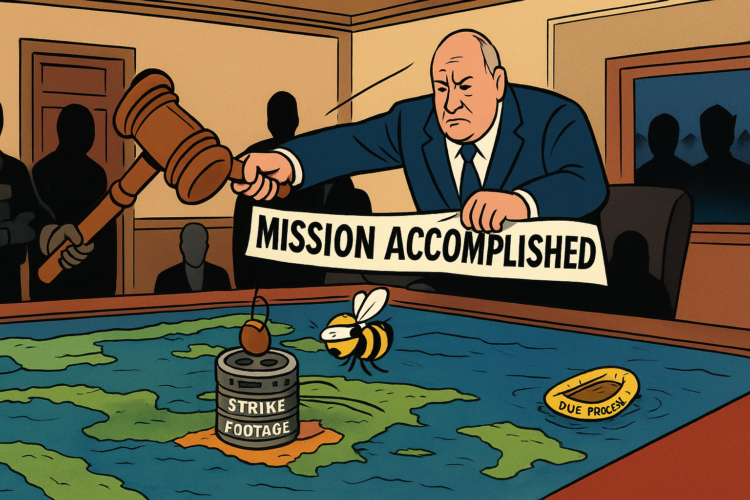
If a missile strikes a survivor in the Caribbean and Mike Rogers is there to ignore it, did it even happen?
In the annals of American military oversight, there are investigations that take years, thousands of pages of testimony, and forensic deep dives that uncover the very soul of the machine. And then there is the House Armed Services Committee’s probe into the September 2 Caribbean boat strike, which lasted approximately as long as a heavy head cold before being declared “done.” On Tuesday, Chairman Mike Rogers stepped out into the light, dusted his hands of any lingering moral residue, and announced that the inquiry into the potential extrajudicial execution of shipwrecked survivors was officially closed. He has “received all necessary information,” he claimed, presumably in the same way one receives all necessary information about a fire by staring at the ashes and deciding they look sufficiently extinguished.
The bare facts of the case have the quiet, rhythmic quality of a nightmare. Since September, the administration has been running a high-kinetic “interdiction” campaign that has turned the Caribbean and eastern Pacific into a floating morgue. Dozens of vessels destroyed. At least 87 people killed. But it was the September 2 strike that turned a standard drug bust into a legal radioactive zone. After the first missile reduced a suspected narcotics vessel to splinters, two survivors were spotted in the water, clinging to the wreckage. Then came the second strike—the “double-tap”—allegedly ordered under a directive from Defense Secretary Pete Hegseth to leave “no survivors.”
Legal scholars, international law experts, and anyone who has ever glanced at a humanitarian pamphlet have pointed out that this is, in technical terms, a war crime. It is a “no-quarter” maneuver. It is the murder of incapacitated persons. But in Washington, a war crime is just a “complex procedural intersection” until it can be successfully rebranded as “methodical defense.”
The narrative coming out of the Pentagon has evolved with the desperate fluidity of a witness in a mob trial. First, we were told the directive didn’t exist. Then, we were told that Admiral Frank Bradley ordered the second strike, not Hegseth. But investigators have pointed out the obvious: Bradley was acting on Hegseth’s specific authorization to treat the ocean as a free-fire zone. The plug was pulled on the investigation before we could ever establish command responsibility, leaving us with a delightful procedural paradox: the survivors were gunned down, but nobody gunned them down, and even if they did, the Chairman of the Armed Services Committee is very tired of hearing about it.
The Mission Accomplished Variety Hour
The entire spectacle feels like a grim farce staged by a mid-level Hollywood producer who specializes in direct-to-video action sequels. One can almost see the “closed-door briefing” in the committee room. There are no maps. There are no legal justifications. There are just “strike-and-accompany” reels—quick, high-definition clips of things exploding against a beautiful turquoise sunset. No context, no survivors, just high-octane accountability-free cinema.
“See that?” an official whispers as a piece of driftwood is vaporized on screen. “That was a narco-terrorist.”
“But he was holding a flotation device,” a junior congressman might murmur.
“The flotation device was an improvised explosive buoy,” the producer replies, as Mike Rogers slides a “Mission Accomplished” banner across the screen before anyone can blink.
The hurried shutdown of the investigation is not about “information received.” It is about institutional impunity. It is about protecting the political theater of the “tough on drugs” narrative from the inconvenient reality of the “we are murdering people in the water” truth. We are told that these are dangerous enemies, but they are anonymous men on fiberglass boats. We use the language of national security—ISIS, Houthi, Taliban—but we substitute a phantom “drug boat” to justify the expansion of war powers into the realm of domestic police work. We are stretching the legal authorities of the 9/11 era until they fit around a go-fast boat, and Mike Rogers is acting as the tailor.
The Moral High Ground is Underwater
The hypocrisy here is so thick it could be used to patch the very hulls we are sinking. The government claims the moral high ground on international law and human rights, yet it uses high-powered military hardware to execute people without a court order, refuses to show the unedited video, and ends the oversight the moment it becomes inconvenient.
If this were happening in the South China Sea or the Persian Gulf, we would be drafting sanctions and talking about the “rules-based order.” But because it’s a drug boat, the “no-quarter” rule apparently goes out the window. According to the Law of War, shipwrecked survivors are hors de combat—out of the fight. You give them a blanket and a bunk, not a Hellfire missile. But the Pentagon press releases respond with vague, sterilized prose: “We are studying whether to release the video.” Translation: “We are waiting for you to forget about this.”
The political rot is unmistakable. Congress once threatened to withhold a portion of the Defense Secretary’s travel budget if the footage wasn’t released. It was a small stick, a petty bureaucratic lever, but it was a sign of life. Rogers ended the probe before that stick ever swung. Oversight has become negotiable. Accountability is an optional accessory for the administration. If you have the right badge, the right button, and a chairman willing to look the other way, you can turn seawater into an unmarked grave and call it a victory for the American people.
The War on Accountability
Zoom out to the human cost, and the scene is haunting. The survivors get erased from public memory, replaced by sanitized double-tap clips that play in the background of Fox News segments. The wreckage sinks. The trauma is localized to families who will never receive justice. Human rights watchdogs call for investigations, but their letters get filed in the same bin as the “unedited footage.”
The war-on-drugs is being rebranded as a war-on-everything-except-transparency. It is a war on poverty, a war on cartels, but never, under any circumstances, a war on accountability. We are turning ships into morgues and seawater into an opaque curtain over state violence.
The cynical observation is that in this new America of executive strikes and congressional shrugging, transparency is a retail product that can be discontinued if the sales are low. Mike Rogers pulling the plug is not closure; it is a cover-up masquerading as efficiency. He is telling the world that we have what we need, and what we need is to stop talking about the corpses in the water.
What kind of “defense” are we building if it turn our procedural norms into props? If boat-strike death becomes a footnote dismissed by a shrug, then extrajudicial killing has been successfully integrated into the policy toolkit. Nameless, drowned, disappeared—future victims will increasingly look like “resource management” rather than human tragedies.
I guess we get to murder drug dealers now? That is the quiet conclusion of the Rogers “done” decree. If the state decides you are a criminal, it can decide you are a combatant, and once you are a combatant, it can decide you don’t exist. The red tape has become a shroud. The investigation is over, the water is calm, and the bodies are at the bottom of the sea.
We move on, Chairman Rogers says. We move on to the next strike, the next video, the next “Mission Accomplished” banner. But the Atlantic doesn’t forget. It just gets deeper. And the transparency we are promised is currently resting somewhere on the ocean floor, right next to the unedited footage we will never see.
Receipt Time
The invoice for this two-week probe is remarkably light, mostly because the work wasn’t done. It charges the taxpayer for “Oversight Theater” and adds a massive surcharge for “Willful Blindness.” The credit for “Democratic Guardrails” has been reversed due to lack of use. The final balance is a country that is a little more dangerous and a lot less honest. We are paying for the missiles that kill the survivors, and we are paying for the men in suits who make sure we never have to look at the photos. The deal is done, the account is settled, and the silence is deafening.