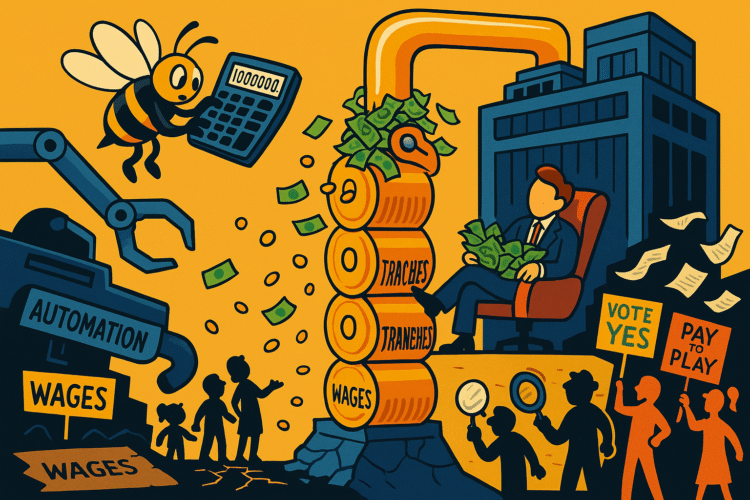
Wealth inequality, vibes-based governance, and the shareholders who just voted themselves into a philosophy seminar
I want you to picture something very simple. Something wholesome. Something that warms the heart.
Imagine a grown man waking up every morning and receiving roughly two hundred seventy four million dollars as a daily allowance. Not annual. Not quarterly. Not tied to chores. Daily. Enough to buy a small country before breakfast, an island by lunch, and the entire ethical section of a bookstore by dinner, all while insisting he is being oppressed by regulators who ask him to please stop beta testing with human lives.
That is the arithmetic behind the near trillion dollar pay package that Tesla shareholders have now approved for Elon Musk. A trillion dollars over ten years. One hundred billion per year. Two billion per week. Nearly three hundred million per day. Numbers so huge they start sounding fictional, like calories on a cheesecake menu or national debt clocks. But this is not fiction. This is shareholder democracy in action. A vibes-based economy choosing spectacle over governance, Thor cosplay over spreadsheets.
And here is the best part: they did it after a court said the original fifty six billion dollar package was too extreme. The Delaware Chancery Court stared at that earlier figure, took one polite sip of water, and nullified it on the grounds that the board behaved like a group of friends electing their chaotic roommate king. And Tesla’s answer was to return with a sequel whose scale makes the first look like a warm-up round.
The Timeline of How We Ended Up Here
Start with the court. Delaware published its ruling voiding the original package because of conflicts, process failures, and disclosures so flimsy they made a lemonade stand look regulated. The judge did not mince words. The board acted more like disciples than fiduciaries. This is not satire. This is governance.
Musk filed an appeal. Tesla reincorporated in Texas, a state that has never met a corporate fantasy it wouldn’t entertain. The board launched a campaign for a shareholder revote. They framed it as existential: pay him or lose him. As if he would simply wander off into the desert, barefoot, muttering about colonizing Jupiter.
Then came the tally. A significant majority voted yes. Norway’s sovereign wealth fund voted no. Proxy advisors warned about disclosure gaps, control risks, and board independence. But the bulls refused to read footnotes. They do not want notes. They want narrative. They want cinema. They want a myth about the man who will lead them into the future even if the future includes robotaxis that cannot recognize stop signs and humanoid robots that move like dancers who missed rehearsal.
The Mechanics of a Trillion Dollar Package
Let us talk about the tranches. They are tied to market cap goals in the multitrillion range and operational milestones across AI, robotaxis and Optimus. Each milestone unlocks compensation so big that the numbers need scientific notation. The dilution math at eight and a half trillion dollars in market value is enough to make small investors faint. The tax math could supply the entire annual budget of some nations.
A trillion dollars over ten years is not merely compensation. It is structural dominance. It folds governance around the whims of a single individual. Boards are supposed to represent shareholders. This structure turns shareholders into the cheering section for a man who has openly described corporate governance as a nuisance.
Cross dealings raise their own questions. Tesla shares vendors, facilities and intellectual talent with xAI and the platform formerly known as a bird sanctuary. The board promises fences. Fences made of what? A post on a social media site he owns? A handshake? A look that communicates trust?
Wealth Inequality and the Daily Allowance Problem
The wealth inequality here is not abstract. It is not a metaphor. It is a planetary insult. When one man can receive more money each day than an entire city block earns in a lifetime you do not have a compensation package. You have a cosmic joke told at the expense of a workforce that will never see a fraction of the value their labor creates.
Automation advocates argue that AI will free workers from drudgery. The question no one answers is simple: free them to do what? Participate in an economy where one man hoovers up financial gravity while the rest of us congratulate him for being a genius enough to allow us to share a sidewalk with his dreams?
Antitrust watchers stare at this and ask who captures the upside of automation. Labor advocates ask why the company cannot tie executive compensation to worker compensation ratios. Economists ask whether this produces distortions. Philosophers ask why we all seem fine with a man being crowned the fiscal equivalent of a small god.
Reactions Across the Spectrum
Bulls are ecstatic. They cheer “pay him or lose him” as if there is a roving collection of trillion dollar CEO recruitment agencies hunting in the night. They insist he is the only one who can deliver autonomous futures, robot workforces, solar networks, interplanetary communities and maybe, someday, a car that does not self-immolate during a software update.
Governance advocates recoil. They see risks that would get any other board hauled off by regulators. They cite independence standards, refer to structures known as 28E style frameworks that forbid concentrated power, and point out that corporate law still applies even when shareholders behave like they are electing a camp counselor.
Labor leaders stare at the deal and wonder if anyone reading these votes has ever met a worker. Not an avatar. Not a meme. A worker. Someone who makes things, fixes things, shows up for shifts, trains new hires and commits their time for compensation that will never, in any imaginable universe, resemble the zero point zero zero zero one percent of what this package represents.
Antitrust observers shake their heads. They see the ramifications of tying the richest man on Earth to the most futuristic segments of the economy. If the next stage of production is robotics, AI, and automation, then the question becomes: who owns the means of algorithmic production? And right now the answer is: a shrinking circle of companies led by men who treat public markets as personality extensions.
Courts and the Blessing Problem
Now we get to the legal question. Does a shareholder blessing cure the defects flagged in Delaware? Does Texas corporate law insulate this package? Does reincorporation erase the problems identified during judicial review?
Corporate lawyers debate quietly over oysters and expense accounts. But the answer rests on something more fundamental. Courts care about process. They care about independence, disclosures and decisions not driven by domination. A shareholder vote might help. It might not. It does not erase the record. It does not remake the board’s history. It does not magic away concerns about control.
The Delaware Supreme Court will decide whether to moot or remand the challenge. Texas law will decide whether a new charter can shield old sins. And governance watchdogs will decide how loudly to yell in the meantime.
The Media and the Vibes-Based Coverage Problem
The financial press often treats compensation packages like sports drafts. Winners. Losers. Upset victories. Moral lessons. Redemption arcs. They speak in metaphors instead of math. They treat this like a referendum on a celebrity CEO rather than a dilution event. They downplay how many shares will flood the market. They downplay how governance will warp. They downplay how workers will see none of the upside.
This is not fandom. It is corporate power. And it should be covered with calculators, not emojis.
Wealth Inequality as the Moral Rot at the Center of This Story
The moral center of this entire saga is not governance. It is wealth inequality. It is the absurdity of a man receiving more in one day than an entire school district budget. It is the spectacle of shareholders applauding their own marginalization. It is the way capitalism sometimes behaves like a cult with quarterly reports.
The question is not whether Musk deserves compensation. The question is whether a trillion dollars over ten years is a sign of brilliance or a sign that markets now function like fan clubs with voting power.
The Near Term Checkpoints
Here are the real markers for what happens next:
Will the courts uphold the package or send it back?
Will reincorporation in Texas shield the plan?
Will Tesla publish enforceable related party guardrails?
Will analysts calculate dilution instead of spinning narratives?
Will markets distinguish between innovation and idolatry?
Because the question is not whether Musk will receive this money. The question is what kind of country calmly watches a trillion dollar pay package sail through a shareholder vote while millions cannot afford rent, while workers wonder if they will be automated out of their jobs, and while entire sectors treat a single man as both prophet and product.
Section Title: The American Inequality Audit
At the end of the day this is not a story about electric cars or AI dreams. It is a story about a country that shrugs at wealth inequality as if it were weather. A story about a company that equates loyalty with surrender. A story about markets that choose mythology over math.
And as the confetti settles, the real audit begins. We have built an economy where one man may soon earn in a year what thousands will not earn collectively in a lifetime. The question is not whether he earns it. The question is whether we want to live in a society where that feels normal.