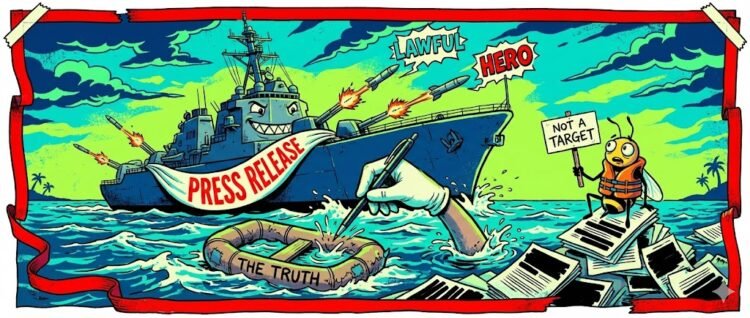
Marketing the abyss, one authorized tragedy at a time.
The water in the Caribbean is specifically blue, the kind of blue that sells rum and resort packages, but on September 2 it was merely the backdrop for a much older, darker commerce. Somewhere in that expanse, a boat stopped moving, disabled by the kind of kinetic force that usually initiates a rescue operation in civilized maritime law. Instead, according to reporting that has slowly bled out from behind the Pentagon’s classified curtain, the pause was only an intermission. The Washington Post tells us that Defense Secretary Pete Hegseth, a man who wears his bellicosity like a tailored suit, allegedly delivered a directive that leaves zero room for interpretation: “kill everybody.” It is a phrase that belongs in a grindhouse script, not a chain of command, yet here we are, watching the machinery of the state try to parse it into something palatable.
The aftermath was not a rescue but a erasure. Officials cited in the probe suggest a second strike was launched, one designed not to disable a vessel but to finish off the survivors clinging to the wreckage. Eleven people were aboard; most are dead. The details are grotesque, a tableau of fire and water that feels less like a military operation and more like a scene from a cartel thriller, except the executioners were flying the flag of the United States. We are used to the fog of war, but this is different. This is the fog of public relations, where the slaughter of shipwrecked sailors is rebranded as “self-defense” against “narco-terrorists,” a label applied retroactively to justify the body count.
Reuters reports that the administration is standing by the strikes, claiming Hegseth authorized Admiral Frank Bradley to conduct them, framing the violence as a lawful response to a threat. They tell us that U.S. forces have struck at least 19 vessels since September, leaving roughly 76 bodies in their wake. The sheer volume of the killing is staggering, yet it is delivered to the public with the bland assurance of a quarterly earnings report. We are meant to nod along, to accept that the Caribbean has become a free-fire zone because the people in charge say the targets were bad men. The circular logic is dizzying: they were killed because they were terrorists, and we know they were terrorists because we killed them.
Then comes the comedic subplot, the farce that makes the tragedy even harder to swallow. ABC reports that the White House account is currently at war with President Trump’s own mouth. The President, never one to be left out of the narrative, has publicly denied wanting a second strike, creating a fracture in the official story that you could drive a carrier group through. We have Hegseth’s alleged bloodlust, Bradley’s operational choices, and Trump’s confusion all swirling together in a toxic stew of incompetence and malice. It is a perfect storm of broken governance, where the right hand doesn’t know who the left hand is killing, but both agree that it was probably legal.
Legal scholars and former JAGs are screaming into the void, warning that attacking incapacitated persons in the water is a textbook war crime. The Geneva Conventions are not ambiguous about this. You do not shoot the shipwrecked. You do not double-tap the drowning. But laws are only as good as the people willing to enforce them, and right now, the enforcement mechanism is broken. The administration is treating lethal force as a branding challenge, turning the rigid language of international law into flexible marketing copy. They are betting that if they say “authorized” enough times, we will forget what the word “murder” means.
This is the new American exceptionalism, a hybrid of hubris and theater where the Secretary of Defense plays the role of a theatrical executioner. Hegseth, lauded on certain corners of social media as a hero for his “kill them all” ethos, is performing for an audience that craves decisiveness over legality. He is the strongman in the drama, the one who cuts through the red tape with a Hellfire missile. It does not matter if the orders were illegal; what matters is the aesthetic of strength. The cruelty is the point, but so is the showmanship.
Meanwhile, the military’s highest echelons are left to paper over the cracks. They draft memos and “authorization” slips, trying to build a legal scaffold around a pile of corpses. Admiral Bradley is praised for “working within his authority,” a phrase that sounds reassuring until you realize his authority apparently includes the summary execution of survivors. The bureaucracy of death is humming along, generating paperwork to cover the stains. It is a banal kind of evil, the kind that thrives in meetings and classified briefings, far away from the blood in the water.
The practical stakes of this farce are terrifyingly real. Bipartisan Armed Services chairs are demanding answers, their letters likely destined for a shredder in the Pentagon basement. Human-rights lawyers are preparing civil suits and war-crimes dossiers, gathering the receipts that the administration ignores. Regional governments are outraged, watching the U.S. turn their coastal waters into a shooting gallery. Air and sea lanes are disrupted, commerce is choked, and the stability of the entire region is threatened by a superpower that has decided the rules no longer apply.
Yet the operational secrecy battles continue in federal court, a shadow war fought with redaction pens and privilege claims. The administration argues that revealing the truth would harm national security, a classic defense that usually means “revealing the truth would make us look like criminals.” They are fighting to keep the details of the strikes buried, knowing that sunlight is the one thing this policy cannot survive. The looming question is who will be held responsible if the orders to kill survivors are proven. Will it be the Admiral who gave the command? The Secretary who set the tone? Or the President who tweeted his confusion?
In a functioning democracy, these questions would be answered by a tribunal, not a press secretary. But we are living in a moment where the instruments of force are run like a cable-news drama, with legal experts serving as stagehands to move the props. The normalization of extrajudicial maritime killings is not just a policy shift; it is a cultural rot. We are accepting that the executive branch has the power of life and death, unmoored from judicial oversight or moral restraint. We are cheering for the “badass” quote while ignoring the bloated bodies washing up on the shore.
The “narco-terrorist” label is the ultimate silencer. It strips the victims of their humanity before the first shot is fired. It tells the public that these people do not count, that their lives are forfeit, that their deaths are a service to the state. It is a convenient fiction that allows us to sleep at night, secure in the knowledge that we are the good guys. But looking at the timeline, at the discrepancies, at the sheer chaotic malice of the operation, it is hard to maintain that illusion. We look less like the world’s policeman and more like a heavily armed gang protecting its turf.
The confusion from the White House is perhaps the most damning piece of evidence. If this was a righteous strike, a necessary act of self-defense, why can’t they get their story straight? Why is the President contradicting his Defense Secretary? Why are officials leaking conflicting accounts to the press? The answer is that there is no truth here, only spin. They are improvising the justification after the fact, trying to find a narrative that fits the body count. It is governance by gaslight, a constant shifting of reality to suit the needs of the moment.
This is not just about one boat or one strike. It is about the precedent we are setting. If the U.S. can declare open season on anyone it labels a “narco-terrorist,” what is to stop other nations from doing the same? We are dismantling the framework of international law that we helped build, replacing it with a system of raw power. We are teaching the world that might makes right, that the strong do what they can and the weak suffer what they must. It is a lesson that will inevitably come back to haunt us.
The spectacle of Hegseth, the warrior-pundit, directing the fleets is a satire that writes itself, but the laughter catches in the throat. He is the perfect avatar for this administration: loud, aggressive, and utterly uninterested in the nuances of governance. He treats the military not as a solemn responsibility but as a personal fiefdom, a tool to settle scores and project dominance. And the system, rather than checking his impulses, is bending to accommodate them. The generals, the admirals, the career officials—they are all falling in line, normalizing the abnormal, making the unacceptable routine.
We are witnessing the erosion of the very idea of a lawful order. When a directive to “kill everybody” is treated as a valid military command, the line between a soldier and a murderer dissolves. The discipline that is supposed to define our armed forces is replaced by a mob mentality, sanctioned from the top down. It is a betrayal of every service member who believes in the code of conduct, who believes that there is honor in restraint. We are turning our military into a blunt instrument of terror, and we are doing it with a smile and a press release.
The legal fog that ABC describes is not an accident; it is the strategy. By creating enough confusion, enough competing narratives, the administration ensures that accountability is impossible. Who do you charge when the orders were verbal, the rationale was classified, and the President says he didn’t want it? The system is designed to absorb the shock, to disperse the blame until it evaporates. It is a masterclass in impunity.
And through it all, the machine grinds on. The drones fly, the missiles launch, the press releases are typed. The 76 dead are just statistics, lines on a spreadsheet that will be classified for decades. The survivors who were finished off in the water are ghosts, their final moments erased from the official record. We are left with the theater, the heroic poses, the tough talk. We are left with a government that prefers theatrical deniability to transparent law enforcement, that treats the death of human beings as a PR problem to be managed.
The terrifying part is not that they are lying to us. We expect that. The terrifying part is that they don’t seem to care if we believe them. The lie is not meant to deceive; it is meant to demonstrate power. It is a way of saying, “We can tell you this absurd story, this obvious falsehood, and there is nothing you can do about it.” It is the ultimate expression of dominance.
As the legal scholars warn of war crimes, as the JAGs prepare their cases, the administration just turns up the volume on the distraction machine. Look at the border! Look at the economy! Don’t look at the water. Don’t look at the bodies. Don’t ask why the Secretary of Defense sounds like a villain from a straight-to-DVD action movie. Just consume the content. Click the link. Share the outrage. The outrage is part of the fuel; it keeps the engine running.
This is the state of our union: a grotesque tableau of violence and incompetence, wrapped in the flag and sold as patriotism. We are exporting our own dysfunction, turning the Caribbean into a stage for our internal political dramas. The rest of the world watches in horror, but we are too busy arguing about the optics to notice. We have become a nation of spectators, watching our own decline on a split screen, unable or unwilling to intervene.
The double-tap strike is the perfect metaphor for this era. First, the initial blow, the shock of the new reality. Then, the follow-up, the deliberate extinguishment of hope, the confirmation that mercy is a weakness. We are all in the water now, waiting to see if the second strike is coming, or if it has already hit.
Receipt Time
The bill comes due in silence. It arrives not in a courtroom or a hearing, but in the quiet erosion of the soul. We pay for this theater with our own numbness, trading our moral clarity for the comfort of cynicism. The receipt is long, printed on thermal paper that fades in the sun, listing every authorized kill, every justified atrocity, every lie we swallowed to keep the peace. The total is illegible, but the currency is clear: we are paying with the last shreds of our credibility. And the worst part? We didn’t even order the meal; we just sat at the table while the chef decided what we would eat.