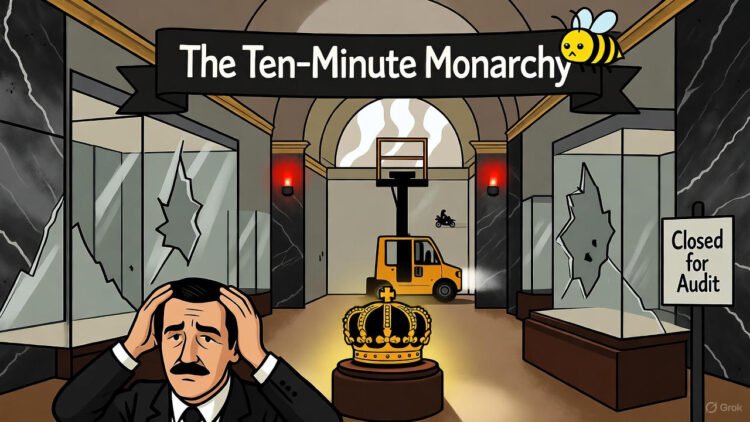
There’s a reason Paris loves a good crime. The city romanticized heists before Hollywood did, and it’s been living off the legend of the 1911 Mona Lisa caper for more than a century. But this one isn’t charming. This one hurts. In a daylight raid that lasted roughly the length of an espresso break, a small crew of thieves turned the Louvre’s Apollo Gallery—the glittering artery of France’s royal jewelry collection—into an object lesson in how not to guard the symbols of national glory.
Eight Napoleonic-era treasures are gone: sapphire-and-diamond tiaras, necklaces, brooches, a reliquary, and a handful of other baubles that once adorned Empress Marie-Louise, Queen Hortense, and assorted ladies who never had to check their bank balances. The thieves ignored the famed Regent Diamond—too big, too famous, too traceable—and went for pieces that could be broken down, pried apart, and reborn on the black market. They entered with a vehicle-mounted ladder, climbed to a high window, used grinders and a blowtorch to pop the locks, smashed vitrines, stuffed history into bags, and roared off on motorbikes. The Louvre sealed itself, stunned. Paris, the city of light, discovered that it can still be outshined.
The Great Glitter Grab
The footage—because of course there’s footage—is almost comic. High-vis vests. Hard hats. A telescoping lift parked under the museum’s façade as if someone had filed a work order. The entire operation looks less Ocean’s Eleven and more Maintenance Guy Eleven. In under ten minutes, the vitrines shatter, the alarms lag, and the world’s most famous museum is left staring at a hole where its crown should be.
Security analysts say it was professional but simple—proof that you don’t need lasers or acrobatics when complacency is on your side. Parisian police have assigned dozens of detectives to retrace the route and reconstruct the kit: the ladder, the grinders, the torch, the confidence. Culture officials call the loss “inestimable,” which is polite-bureaucratic for “we have no idea how to explain this to the taxpayers.”
One diadem was reportedly dropped in the scramble—a royal metaphor if ever there was one. The rest vanished into the fog of back-alley refineries and private vaults.
A Museum on Snooze Mode
The Louvre’s statement was brisk and bloodless: the gallery sealed, the investigation ongoing, the staff “cooperating fully.” What it did not include was an answer to the obvious question—how does a truck with a mounted ladder park under the world’s most surveilled building without anyone asking why?
France’s cultural guardians have spent decades treating museum security as a matter of optics: guards who glide, alarms that whisper, and policies that prioritize “visitor experience” over vigilance. The Apollo Gallery, the very room where Louis XIV wanted to be painted as Apollo himself, was apparently being guarded like a suburban mall kiosk.
The timing made it worse. Staffing was light. Maintenance crews were due later that afternoon. It’s as if the thieves checked the calendar and found “ideal conditions for embarrassment.”
From Crown Jewels to Craft Supplies
Experts already fear the worst: that the treasures will be dismantled. The gemstones pried out, recut, and scattered across anonymous auction lots; the metals melted down and reborn as bracelets for billionaires who like their accessories guilt-free. “You can’t fence a tiara this famous,” one investigator told Le Monde. “But you can make it disappear in pieces.”
That’s the irony of royal regalia. It was designed to symbolize permanence—imperial eternity cast in gold. But the market has no sentiment. Melted, the jewels are just elements: carbon, aluminum, gold, and stupidity. The thieves may not realize they’ve stolen an argument about civilization.
History Repeating as Farce
Parisians still tell the Mona Lisa story like folklore: a handyman, a frame, and a gap that became legend. But that heist, for all its embarrassment, made the painting famous. This one makes the Louvre look negligent. The optics are worse because the target wasn’t a painting, it was a promise—that the Republic could safeguard the remnants of the monarchy it guillotined.
To lose crown jewels is to lose narrative control. You can’t tweet “Liberté, Égalité, Sécurité Oops.”
The French government has rushed to reassure the public, promising “a full review of alarm protocols.” But the subtext is damning: the alarms worked, just late. Which is also the best summary of modern governance.
Global Fallout: The Jewelry Market Has Trust Issues
This heist doesn’t stop at the Seine. Museum insurers, lenders, and curators from London to Tokyo are rewriting their risk manuals as we speak. Loan terms will tighten. Display rotations will shorten. The traveling-exhibit economy—those blockbuster shows that shuttle priceless objects between capitals—just got a reality check.
A curator in Vienna put it bluntly: “If the Louvre can lose the crown jewels, what chance do the rest of us have?”
Expect the ripple effects: canceled loans, new sensor mandates, security audits that temporarily shutter galleries. Meanwhile, the art-heist industrial complex—Netflix producers, podcasters, and click-bait crime chroniclers—are already circling like paparazzi around a casket. The thieves don’t even need to sell the jewels. The cultural capital alone is priceless.
The Heist Industrial Complex
We glamorize these crimes because we mistake audacity for art. Every museum director secretly fears the day their security footage becomes a movie trailer. Every journalist dreams of writing “The Heist That Stole History.”
But this is not romance; it’s recycling. A handful of pros turned national treasures into scrap metal in less time than it takes to order a croissant. They didn’t outwit lasers—they outwaited bureaucracy.
It’s the same cultural sickness that treats thieves as folk heroes while museum guards are written as punchlines. Pop culture sells the fantasy that crime restores justice—Robin Hood with better lighting. But in reality, art crime is an industry of entropy. The thieves don’t redistribute beauty; they dismember it.
The Optics of Denial
What rankles is the official tone. Culture Minister Frédéric Blanchard called the theft “a blow to our heritage,” while assuring the public that “our institutions remain secure.” That’s like saying, “Other than the fire, the house is fine.”
Politicians framed the loss as “symbolic,” which is precisely the problem. When a country known for its symbolism loses the symbols, it loses face. The French presidency has built much of its soft power on the image of cultured competence—Versailles summits, art diplomacy, the Louvre as living proof of French exceptionalism. Now the optics are closer to Keystone Cops : The Musical.
Every Parisian newspaper headline doubles as an accusation: “Where Were the Guards?” “Ten Minutes to Disaster.” “The Crown Falls Again.”
Coffee-Break Capitalism
What makes this heist sting isn’t just the loss—it’s the speed. Ten minutes. That’s shorter than a Paris Metro delay. Shorter than a Macron soundbite. Shorter than the average French lunch queue.
The Louvre was undone by efficiency—the one trait France is rarely accused of. The thieves treated the nation’s cultural treasury like a drive-through. Order jewels. Pay nothing. Exit left.
And yet, the metaphor feels painfully apt. Modern institutions, from museums to governments, have optimized themselves into vulnerability. The fewer guards you hire, the more faith you place in sensors and slogans. The result? A country that can’t decide whether to staff its heritage sites or its influencer summits.
France’s PR Problem: Broken Glass and Broken Trust
This isn’t just about jewels. It’s about credibility. France positions itself as Europe’s cultural spine, the steward of civilization’s greatest hits. When it fails this publicly, the damage isn’t confined to one gallery—it seeps into diplomacy.
If France can’t protect its own relics, how can it guarantee the safety of artifacts on loan from Egypt, Greece, or Nigeria? Already, foreign cultural ministries are asking awkward questions. The Louvre, normally a symbol of stability, suddenly looks porous.
And so begins the bureaucratic theater: emergency task forces, high-level audits, committees on “best practices.” The glass will be replaced, the alarms recalibrated, the press releases polished. But trust, once cracked, doesn’t buff out.
The Insurance Gospel According to Reality
Insurers, usually the dull accountants of tragedy, are now the unlikely prophets of consequence. Behind closed doors, they’re deciding how much faith to keep in human vigilance. Premiums will soar. Coverage limits will shrink.
The Louvre’s crown collection may have been technically insured, but its real value was reputational. The difference between a museum that can say “we have Napoleon’s diadem” and one that must say “we had Napoleon’s diadem” is the difference between legacy and obituary.
The Netflix Effect
We’ll get the series, of course. The Paris Job. A moody score. Actors with cheekbones sharp enough to cut glass. A closing shot of sapphires glittering under Caribbean moonlight.
What we won’t get is the sequel: The Insurance Adjustment. No slow-motion glamour, just auditors cataloguing losses and curators filling out forms under fluorescent lighting. The real heist isn’t cinematic. It’s mundane. The thieves are gone, but the paperwork is forever.
Still, the culture machine will spin this tragedy into content. Think pieces will debate whether the thieves are “artists.” Museums will issue statements about “rethinking accessibility.” Somewhere, a venture capitalist will propose blockchain-tagging artifacts. Civilization, meet disruption.
Paris, the Eternal Optimist
And yet, Paris will romanticize it anyway. The city that turned heartbreak into chanson and barricades into tourism can’t resist a myth. The cafés are already humming with speculation: insiders, ex-guards, disgruntled contractors, thieves who “did it for love.” The romance of loss is irresistible.
But beneath the poetry lies exhaustion. France has spent centuries curating beauty as proof of identity. Now beauty is just another thing that can vanish before lunch.
Lessons From a Broken Display Case
If there’s a moral, it’s not about jewels—it’s about priorities. For decades, cultural institutions have relied on mystique to do the work of vigilance. The Louvre trusted its aura to keep thieves away. But aura doesn’t set off alarms.
The hard truth: the next thieves won’t need a Netflix pitch. They’ll just need a ladder, a drill, and the confidence that bad press scares museums more than broken glass.
In the end, France lost more than ornaments. It lost a little of its myth that civilization is self-defending. The heist is over, but the reckoning isn’t.
Closing Section: The Empire of Shards
Somewhere tonight, under the hum of a grinder, history is being undone. A tiara becomes loose stones. A reliquary becomes raw material. The glory of queens and empresses is reduced to melt value.
The thieves may think they stole riches, but what they really stole was continuity—the illusion that culture, once achieved, is permanent. The Louvre will recover, but it will never again be able to claim it cannot be breached.
Civilization survives on faith that its glass cases hold. Break them, and the sound carries farther than alarms.
The empire is gone in ten minutes. The receipts, as always, will take centuries to process.