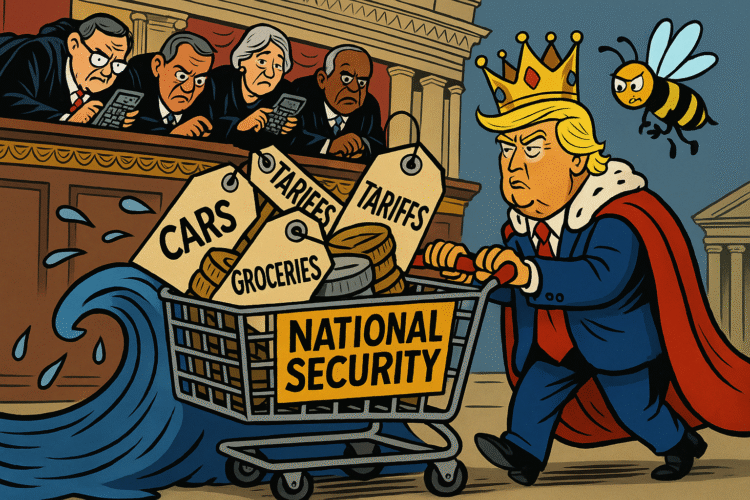
The Supreme Court spent the morning doing something rare in the modern republic: pretending to remember that Congress exists. In a hearing that felt equal parts economics seminar and constitutional therapy session, the justices took up the question no one in Washington has wanted to answer for six years—can a president tax Americans by calling it “national security” and signing it in Sharpie?
At the center of it all is Donald Trump’s signature obsession, the tariff. The kind of tariff that isn’t really a tariff, because if you label it that, someone might ask Congress to vote. No, these are “emergency duties,” “foreign affairs measures,” and “security actions,” all invoked under statutes with numbers that sound like passwords: Section 232 of the Trade Expansion Act of 1962 and Section 301 of the Trade Act of 1974. If you ever wanted proof that the past isn’t dead, just rebranded, those two statutes are it.
Act I: The Courtroom as Economics Classroom
On one side stood a coalition of business groups and states arguing that Trump’s emergency-style tariffs sidestepped Congress, drained consumers, and redefined “national security” to mean “whatever gets applause at a rally.” On the other side was the Solicitor General, gamely defending the executive’s “sweeping discretion” under the same statutes—because once you inherit a weapon that powerful, you don’t hand it back, even if it smells like bankruptcy.
The justices’ questions read like a civics exam graded by accountants.
Can the President use “national security” to justify taxing microwaves?
Where exactly does “foreign affairs” stop and “domestic price inflation” begin?
If a tariff is called a duty, and the duty acts like a tax, and the tax isn’t approved by Congress, how is it not just a shopping cart shakedown?
For once, everyone in the room agreed on one thing: groceries are more expensive. The dispute was over who’s responsible.
Act II: Standing, Nondelegation, and the Ghost of Separation of Powers
The Court began by wading into “standing,” the legal question of who gets to complain about being fleeced. Business groups say they do, because their balance sheets look like they’ve been through a dryer. The government countered that importers “benefit from clarity.” Justice Kagan raised an eyebrow, as if to ask whether “clarity” now means “paying more for steel.”
Then came the nondelegation doctrine, the constitutional principle that Congress can’t hand its lawmaking power to the executive like a lost umbrella. That principle has been asleep since the 1930s, buried under decades of administrative convenience. But Trump’s tariff spree has done what no civics textbook could: it woke it up.
Justice Gorsuch mused about the “outer edges” of delegation, while Justice Sotomayor asked whether “calling something national security makes it so.” Justice Alito, in a rare moment of candor, wondered aloud if the Court was supposed to decide when a tariff becomes a tax, or if voters should just “get used to surprise price hikes.”
The solicitor general replied that “foreign affairs require flexibility,” which is government code for “we like doing whatever we want.”
Act III: The Economics of Presidential Adventurism
Tariffs are supposed to be tools of policy. In Trump’s hands, they became his favorite toy. Average U.S. tariff rates, which hovered around 1.6 percent in 2017, soared into the high forties on certain categories by 2020. The list of casualties reads like an American shopping list: cars, washing machines, computer components, canned goods.
Economists tracked “pass-through effects,” which is the polite term for “you’re paying for this.” Prices for appliances rose by 12 percent in the first year of Trump’s trade war. Car manufacturers faced input costs that shaved billions from profits. Farmers lost export markets as retaliation from China and Europe hammered soybeans and pork. Meanwhile, Trump bragged about “hundreds of billions in tariff revenue,” as if the money appeared from thin air instead of your checkout line.
At one point, the Court’s liberal wing pressed the solicitor general on those claims. “If tariffs are taxes paid by Americans,” Justice Jackson said, “how do we square that with claims of revenue from foreign countries?” The solicitor general smiled the bureaucratic smile of someone paid to defend math as performance art.
Act IV: The Timeline of Economic Theater
The procedural history of this case is a master class in bureaucratic endurance. Business groups first sued in late 2019, arguing that Trump’s steel and aluminum tariffs exceeded statutory authority. They lost. Courts said the president had wide discretion. They appealed. They lost again. Then came Trump’s Section 301 tariffs on Chinese goods, justified under “unfair trade practices,” which led to fresh suits. Meanwhile, states like Texas and Michigan joined, arguing that their manufacturers were collateral damage in a presidential vanity project.
By the time the Supreme Court granted certiorari, tariffs had become less about China and more about control. The Biden administration, inheriting the mess, kept many of the duties intact, quietly admitting that no one wants to be the president who ends a tariff war and gets blamed for inflation.
The oral arguments this week are the final act in that saga. What began as a trade spat has morphed into a constitutional referendum on how much chaos the word “emergency” can authorize.
Act V: The Justices as Reluctant Accountants
Chief Justice Roberts, ever the institutionalist, tried to sound neutral. “We don’t run the economy from this bench,” he said, which is true, though someone should tell that to the bond market. Justice Barrett asked whether courts could “police when a tariff becomes a tax,” prompting nervous laughter from the solicitor general, who responded that “Congress can always act.” Congress, of course, cannot even pass a budget on time.
Justice Kavanaugh asked about “guardrails.” Justice Thomas, silent as usual, stared into the middle distance like a man remembering the gold standard. The Court’s younger members seemed genuinely unsettled by the scale of presidential power—though not unsettled enough to promise limits.
As one advocate put it: “The Founders didn’t write a Constitution so one man could raise prices on toasters by calling it national security.”
Act VI: The Human Cost in Numbers
Behind every “policy instrument” is a price tag with a family attached. Economists at the Peterson Institute estimated that the tariffs cost the average household roughly $800 a year in higher prices, a hidden tax that hits hardest on groceries and household goods. For exporters, the retaliation cut deep. Soybean shipments to China collapsed by more than half in 2019. Whirlpool, which initially cheered Trump’s appliance tariffs, later reported losses as steel prices soared.
Even the Treasury’s vaunted “tariff revenue”—the “hundreds of billions” Trump bragged about—came from U.S. importers paying duties to U.S. customs. In other words, it was Americans taxing Americans to teach foreigners a lesson.
If you’ve ever wondered what a self-inflicted economic wound looks like, check your grocery receipt.
Act VII: Political Theater, Economic Fallout
After a summit with China in 2020, Trump quietly trimmed some tariffs and declared victory. The administration called it “the Phase One Deal,” which is bureaucratic language for “we stopped hitting ourselves.” The tariffs that remained, however, still covered roughly two-thirds of Chinese imports. The result was a patchwork of selective punishment and public confusion.
Companies scrambled to reconfigure supply chains. Some absorbed costs, others passed them on. Small businesses found themselves outbid by larger competitors with the capital to navigate exemptions. The United States, which once lectured the world about free trade, became the planet’s most prolific tariff collector.
And now, years later, the Supreme Court is being asked to decide whether that was ever legal.
Act VIII: Remedies, Risks, and Reality Checks
The justices spent a surprising amount of time on “remedies,” which is legal shorthand for “what do we do if we admit this was insane.” Could the Court strike down certain tariffs while leaving others in place? Could it order Congress to act? Could it tell the executive branch to “write better findings” and call it a day?
The Solicitor General floated the idea of “prospective limits,” meaning the Court could draw boundaries without undoing past actions. Translation: no refunds.
Business groups argued for more. They want clarity, predictability, and—if the stars align—a refund check. States want the power to plan budgets without wondering whether tomorrow’s refrigerator tariff will wipe out a manufacturing sector. Consumers, not represented directly, want to buy a blender without subsidizing someone’s geopolitical tantrum.
The justices, sensing the scale, hinted at incrementalism. The Court that gutted Roe and rewrote the EPA’s authority may suddenly discover the virtue of restraint when the issue is price tags.
Act IX: Who Pays, Who Profits
If the Court narrows the president’s tariff power, importers and consumers win. Prices ease. Markets stabilize. Congress regains some control. If the Court blesses presidential adventurism, we enter a new era of “executive taxation,” where every election comes with an attached invoice.
Corporations that rely on imports are watching nervously. So are exporters who fear retaliation if tariffs become a bipartisan tradition. Meanwhile, hedge funds are already pricing risk. Analysts say that if the Court curbs Section 232, steel and aluminum futures could fall. If it doesn’t, brace for a new wave of tariffs the moment someone decides wind turbines are a “foreign threat.”
Congress, humiliated but hopeful, is drafting proposals for “bright line triggers”—clear reporting requirements and sunset clauses that force periodic review. Whether those survive partisan politics is another question.
In the meantime, Customs and Border Protection may quietly pause new enforcement actions. The Office of the U.S. Trade Representative might rush to publish more “national security findings” to cover itself before the Court rules. Bureaucracy, as always, hedges bets faster than markets.
Act X: The Political Spin Cycle
Cable news has already chosen its narratives. Conservative outlets cast the hearing as an assault on “strong leadership.” Progressive ones frame it as accountability for “economic authoritarianism.” Business networks just want to know what to tell shareholders.
Trump, from his Truth Social bunker, has called the case “a hoax by globalists” and reminded followers that “I MADE AMERICA RICH.” Economists, reviewing the numbers, beg to differ. Manufacturing growth during the tariff years lagged. Inflation rose. The trade deficit widened.
If this is what winning looks like, the victory parade is marching backward.
Act XI: What Comes Next
The Court’s decision, expected by summer, will set the tone for decades of economic governance. A narrow ruling could impose reporting and justification requirements on the president’s trade actions, effectively reining in future tariff adventures. A broad one could bless unlimited discretion, turning the Oval Office into a checkout counter with a nuclear button.
Between now and then, watch four things:
- Customs Activity: If CBP halts or slows tariff collections, it means the administration smells risk.
- USTR Filings: Expect a rush of national security justifications, an attempt to retroactively legalize old sins.
- Market Reaction: Commodity prices will swing with every hint of judicial skepticism.
- Congressional Ego: Lawmakers are already introducing “Trade Power Restoration Acts,” performative bills designed to pretend they still own the purse.
The real test isn’t legal. It’s linguistic. If the Court says “national security” means what it used to mean—missiles, not microwaves—then separation of powers might get a pulse again. If not, get ready for four years of tariffs on “strategic hair dryers.”
Coda for a Nation Billed by Its Own Government
At the end of arguments, Justice Kagan summed up the absurdity. “We are here,” she said, “because Congress gave away its taxing power and now wants us to find it again.”
That’s the story in one sentence. The presidency has become a vending machine for economic policy. Press “emergency,” collect revenue. Press “security,” raise prices. Press “China,” watch Congress salute.
Trump may be gone from office, but his trade legacy remains—a template for future presidents to tax by decree and call it patriotism. The Court now faces a choice between restraint and convenience, between law and loyalty to power.
The rest of us just face the checkout line.
If the justices bless this kind of authority, it won’t be long before “national security” covers anything from avocado imports to luxury sneakers. If they strike it down, we might rediscover something older than tariffs: the idea that taxation without representation was supposed to be a problem, not a policy.