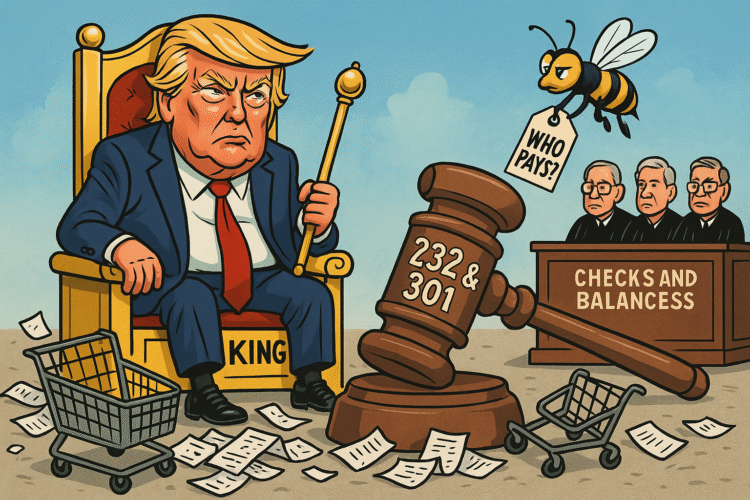
There is something exquisitely American about watching a courtroom full of black-robed justices debate whether the President of the United States can wake up one morning, decide that toasters are a national security threat, and slap a fifty percent tax on them before lunch.
That is, more or less, what the Supreme Court heard this week in United States v. The Concept of Separation of Powers. The docket title is different, of course—something opaque about standing, delegation, and Section 232 of the Trade Expansion Act—but the stakes are simple. The justices must decide whether Donald Trump’s self-declared “national security tariffs” were a lawful use of authority or a constitutional joyride powered by grievance and a Sharpie.
At issue is whether the president can keep taxing Americans without Congress ever voting on it, so long as he calls it foreign policy.
I. The Emperor’s New Excuse: “National Security”
The Solicitor General arrived ready to defend the imperial presidency as if it were a trade preference. Her argument, dressed in the finest procedural jargon, was that Trump’s use of Sections 232 and 301—those Cold War-era provisions written for a time when “foreign steel” meant Soviet tanks—fell squarely within executive discretion.
Never mind that Trump had invoked them not to counter a geopolitical threat but to punish Canada, Germany, and the entire European Union for existing in a world where their cars sold better than ours.
Justice Kagan asked the obvious question: “At what point does ‘national security’ become an economic policy by another name?”
The government’s answer, though politely phrased, amounted to “Never.”
Under this reading, “national security” can mean anything from defending supply chains to soothing the president’s ego. If domestic appliance manufacturers feel sad, if a Mar-a-Lago dinner companion complains about German dishwashers, if Elon Musk tweets about foreign batteries—national emergency!
It’s an impressive trick: rename your tariff a security measure, and you can tax anyone, anytime, for anything, indefinitely.
II. Standing, Schmanding
Before diving into constitutional first principles, the Court spent a good forty minutes pretending to care about standing.
Could businesses, states, or consumers even challenge the tariffs when the tariffs weren’t technically “taxes” but “import adjustments”?
Chief Justice Roberts frowned at the semantics. “If I pay more for my refrigerator, is that an import adjustment?”
The Solicitor General smiled like someone holding a briefcase full of plausible deniability. “No, Your Honor, that’s simply the market’s response to a strategic policy recalibration.”
Translation: You paid more for groceries because the president needed a headline.
If the Court tosses the case on standing grounds, it would mean that nobody—not you, not your governor, not the Chamber of Commerce—has the right to challenge when a president decides to treat international trade like a mood board.
It would also mean that the Founders’ favorite branch, Congress, remains the world’s most overpaid spectator sport.
III. The Price of Greatness
Under Trump’s tariff spree, average U.S. import duties spiked from roughly two percent to nearly fifty on certain categories. It was, by any measure, the most aggressive use of tariff power since Herbert Hoover accidentally deepened the Great Depression.
Prices responded accordingly. Cars, appliances, building materials—all rose. The costs were not paid by the Chinese Communist Party, as promised, but by American households and small businesses caught in the crossfire.
When China retaliated, soybean farmers became collateral damage.
Trump called it “short-term pain, long-term gain.” Economists called it inflation.
By the time he pivoted—quietly cutting certain rates after a summit with Xi—his administration was already bragging about “hundreds of billions” in revenue. It was the equivalent of a pickpocket congratulating himself for generating cash flow.
Revenue, after all, is just another word for someone else’s expense.
IV. The Court and the Question of Empire
Back at the marble temple, the justices grappled with two overlapping crises: legal delegation and political cowardice.
Under the Constitution, Congress alone holds the power to tax and spend. But Congress, in its infinite timidity, has spent decades writing blank checks to the executive branch. The result is a network of statutes—232, 301, 201—that let presidents act like emperors so long as they invoke a few magic words about “emergency” and “security.”
Justice Gorsuch, always ready to cosplay as a textualist philosopher, asked, “Is there any limit on what counts as national security? Could the president declare Canadian milk a threat to our sovereignty?”
The government’s lawyer did not blink. “If it affects critical infrastructure, yes.”
Somewhere in Ottawa, a dairy cow mooed nervously.
The nondelegation doctrine—an old idea that Congress cannot hand over its core powers wholesale—has been dormant since the New Deal. The major questions doctrine—its newer cousin—suggests that Congress must speak clearly before presidents make sweeping policy calls.
Both doctrines hovered like ghosts in the chamber, daring the justices to remember that words like “emergency” were not meant to substitute for lawmaking.
V. When a Tariff Becomes a Tax
One justice asked the question that should define the case: “At what point does a tariff become a tax that only Congress can impose?”
The government, again, danced. Tariffs were not taxes, they said, because they targeted imports, not citizens.
But the Court seemed unconvinced. The tariffs may be imposed on imports, but they’re paid by Americans—manufacturers, retailers, and consumers—at the cash register. They are taxes without representation, imposed by proclamation instead of vote.
If that sounds familiar, it’s because we fought a war over it once.
VI. The Economics of Authoritarian Nostalgia
What makes Trump’s tariff crusade particularly absurd is how proudly it violated his own party’s decades-long orthodoxy.
For half a century, Republicans worshiped free trade like scripture. Then Trump arrived, ripped out the gospel, and replaced it with “Buy American” slogans that doubled as campaign ads.
He didn’t believe in trade policy; he believed in applause.
Economists warned that tariffs would slow growth, hurt exports, and drive up consumer costs. Trump’s response was to hold rallies in Ohio and declare that “tariffs are making us rich.”
He wasn’t wrong about who the “us” referred to. The Treasury collected billions in tariff revenue while shoppers emptied their wallets at Home Depot. The money flowed up, not out.
Corporate lobbyists called it industrial policy. Everyone else called it theft.
VII. The Markets and the Moment
When the Court took the case, Wall Street barely blinked. Markets assume the justices will split the baby—perhaps a procedural remand, perhaps a scolding footnote about separation of powers—but nothing that truly limits presidential discretion.
Still, traders are watching the telltales.
If Customs and Border Protection suddenly pauses new actions, if the U.S. Trade Representative rushes to paper justifications for existing tariffs, if the White House starts floating “national security reviews” of non-strategic imports—those are signs of panic.
Because the truth is that presidents of both parties love emergency powers. They’re fast, flashy, and unaccountable. Limiting them would mean restoring Congress’s authority, which is the one thing neither party wants.
VIII. A Court Divided Against Itself
The Court’s conservatives are torn.
On one hand, they adore executive power when it’s used for immigration bans, military strikes, or law-and-order theatrics. On the other, they resent it when it touches business. Tariffs offend the Chamber of Commerce wing but delight the nationalist one.
The liberals, meanwhile, seem to understand the irony: they must now champion limits on executive power to stop a man who used to call them tyrants.
It’s an ideological farce wrapped in legalese. The justices aren’t deciding whether tariffs are good policy. They’re deciding whether the Constitution still matters when it’s inconvenient.
IX. The Real Taxpayer
For all the courtroom sparring, the economic reality remains simple: Americans paid.
Every imported washing machine, every foreign car, every can of soup that used steel from abroad carried a hidden Trump tax. The average family paid several hundred dollars a year for the privilege of “standing up to China.”
Meanwhile, China retaliated strategically—targeting farm exports from swing states like Iowa and Wisconsin. The victims of Trump’s trade war were not his rivals; they were his voters.
It was the rare case of a man lighting his own base on fire and calling it patriotism.
X. What Happens Next
If the Court upholds Trump’s maximalist reading, presidents will wield tariff powers like cudgels. Any future occupant of the Oval Office—Republican or Democrat—could tax entire sectors without legislation.
Imagine a President DeSantis taxing Hollywood films as “foreign propaganda” or a President Harris slapping tariffs on fossil fuels under “climate security.”
The slope is not slippery; it’s vertical.
If, however, the Court reins him in, expect chaos. The White House will need to rejustify years of tariffs, Customs will scramble to refund or reimpose duties, and Congress will face pressure to actually legislate for once.
Wall Street will cheer the predictability, farmers will breathe easier, and presidents will fume at the return of checks and balances.
XI. The Legislative Path Not Taken
Congress could fix this tomorrow.
It could pass bright-line rules requiring that all Section 232 or 301 tariffs expire after ninety days unless renewed by vote. It could define “national security” in plain English, ban retroactive duties, and require impact assessments before implementation.
It could even—radical idea—reassert its constitutional power to tax and spend.
But Congress won’t. It prefers to outsource hard decisions, then complain about executive overreach. It’s the same dynamic that lets lawmakers rage about deficits they voted for and wars they funded.
The imperial presidency exists because the legislature keeps abdicating.
XII. Euphemism at the Checkout Line
The press, predictably, will cover this case as a “trade dispute.”
They will quote analysts about “market volatility” and “policy uncertainty.” They will avoid the phrase “taxation without representation,” because it sounds old-fashioned.
But that’s exactly what this is.
When a president can impose multi-billion dollar taxes by fiat, label them “tariffs,” and call it patriotism, the revolution has gone corporate.
The victims are not just exporters and importers. They’re everyone who shops, eats, drives, or lives in the economy.
They’ll see it not in legal briefs, but in grocery receipts.
XIII. The Real National Security
The irony of Trump’s “national security tariffs” is that they weakened the very economy they were supposed to protect.
They fractured alliances, distorted supply chains, and trained industries to rely on political favor rather than competition. They turned “national security” into a brand—one that could be stamped on any policy to silence criticism.
In the long run, that’s far more dangerous than cheap Chinese steel.
XIV. The Final Bill
Whether the Court sides with restraint or with monarchy, someone will pay.
If Trump’s reading survives, it will be consumers and small businesses footing the bill for the next wave of economic nationalism. If it falls, the political class will finally face the bill for decades of cowardice.
Either way, the myth of the “self-funding presidency” dies. Tariffs don’t make us rich; they make us poorer, one receipt at a time.
And yet, somewhere in Palm Beach, the man who started it all will still call it a victory.
Because in his America, taxing the people is patriotism, calling it “national security” is branding, and watching the Supreme Court debate the legality of your impulse purchases is just another episode of the long-running show called power.
Final Reflection: The Cost of Greatness
The justices will issue their ruling in a few months. Commentators will debate constitutional nuance, markets will twitch, and lobbyists will rewrite talking points.
But the core question will remain the same: Can one man tax a nation by proclamation?
If the answer is yes, then “national security” has become the ultimate loophole—an all-access pass to rule by impulse.
If the answer is no, then maybe, just maybe, the country remembers that democracy was never meant to be a brand.
It was meant to be a bill, with signatures, debate, and votes—so that no one, not even a self-styled Tariff King, could call it freedom when he makes you pay more for breakfast.