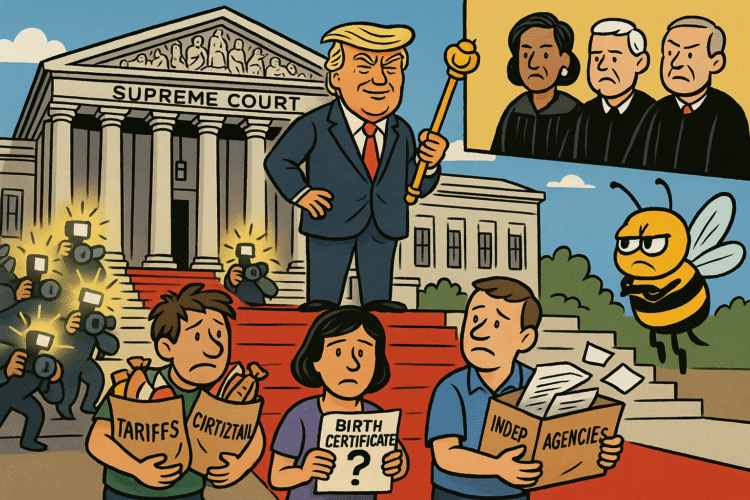
On October 6, 2025, the United States Supreme Court flung open its majestic marble doors to launch the 2025–26 term, and the BBC wasted no time pointing out what the docket really is: a season pass to the Trump Expanded Universe, where executive power is both the script and the punchline. Forget your garden-variety disputes over arcane statutory clauses or whether some rural county’s zoning board misused a comma. This year, the justices are teeing up cases that will decide whether Donald Trump can legally crown himself head of all three branches and, presumably, the DMV.
The themes? Tariffs, citizenship, and the power to decapitate the administrative state one commissioner at a time. Add in side plots about transgender athletes, gerrymandering, campaign cash, and the minor question of whether we still have a republic, and you’ve got yourself a blockbuster docket. It’s less Supreme Court term, more streaming-platform miniseries, except instead of prestige drama we’re getting a constitutional reality show where the stakes are your groceries, your passport, and whether the FTC still exists by Christmas.
Act I: Tariffs Without Tears (Unless You’re Buying Groceries)
First up: can Trump, without bothering Congress, impose broad import levies by stretching existing trade statutes into his personal Swiss Army knife? The administration already previewed its appetite on September 25 with new tariffs that landed like a brick on supply chains already wobbling from inflation. Now the Court will decide whether the president is an unshackled economic maestro or just a guy throwing darts at a global dartboard.
The legal hook is whether decades-old trade laws give the White House carte blanche to wallop imports whenever the mood strikes. If the Court greenlights this, forget market stability—consumer prices will swing harder than a toddler at a piñata. Your next iPhone might cost as much as a used Toyota, and avocados will be as precious as caviar. Business coalitions are already pacing like nervous parents at a middle-school talent show, warning of market shock if the justices hand Trump a blank check.
Act II: Birthright Citizenship, Redux
Remember the Fourteenth Amendment, the one that guaranteed citizenship to anyone born here, reinforced by the Court in 1898’s United States v. Wong Kim Ark? Trump doesn’t. On January 20, he signed an executive order attempting to curtail birthright citizenship. Federal courts immediately blocked it, citing the small inconvenience of the Constitution. Yet here we are: petitions filed on September 26 to fast-track the case for this term, with Trump insisting his pen outweighs the Fourteenth Amendment.
The consequences? Catastrophic bureaucracy. Children born after February 19, 2025, could live under dual legal regimes—citizens in some states, stateless in others. Imagine state vital-records offices issuing birth certificates that may or may not be valid, Social Security numbers printed with invisible ink, and passport clerks asking parents whether their newborn has a loyalty oath. Immigration agencies are already modeling “contingency workflows,” which is bureaucrat-speak for “chaos on spreadsheets.”
Civil-rights groups are ready to sue until their filing cabinets collapse, but if the Court blesses Trump’s gambit, America will pioneer a new pastime: watching parents discover at the DMV that their five-year-old may or may not be a citizen.
Act III: Firing Squads for Independent Agencies
Then there’s the fight over whether statutory protections for independent-agency heads—those little guardrails from the New Deal era—can withstand Trump’s Article II wrecking ball. The immediate spark: his attempt to sack an FTC commissioner and fire other regulators who had the temerity to believe “independent” meant anything.
If the Court rules that presidents can purge at will, the administrative state becomes less a balance of powers and more a seasonally decorated White House staff chart. Independent watchdogs would become houseplants—easy to replace when inconvenient. Imagine the SEC chair axed because the stock market sneezed, or the Fed board reshuffled over a bad inflation headline. The “administrative state” would become the “presidential mood ring.”
Subplots for Extra Drama
Because no season is complete without side quests:
- Title IX and transgender athletes. Conflicting lower-court rulings and a wave of state bans have left schools whiplashed. The Court may now decide whether fairness in girls’ track meets becomes a federal test case in cultural warfare.
- Voting rights and redistricting. With 2026 House control on the line, cases over maps and suppression are queued like dominoes. If the Court loosens guardrails further, gerrymandering may graduate from art to science fiction.
- Money in politics. Another round of campaign-finance cases threatens to turn the thin walls of contribution limits into wet tissue. If you thought billionaires already owned the system, wait until the Court hands them the deed.
All this arrives on the heels of a year of “emergency orders” where the justices narrowed nationwide injunctions and winked at parts of Trump’s program. Court-watchers see a pattern: the 6–3 conservative bloc, including Trump’s three appointees, increasingly comfortable redrawing the boundaries of executive power while claiming they’re simply reading the Constitution “as written.”
The First Day, the Calm Before the Earthquake
The term opened with cases on attorney access under the Sixth Amendment and a medical-malpractice clash over federal-state jurisdiction. Think of them as the amuse-bouche: small, technical disputes offered before the kitchen serves flaming entrees like birthright citizenship and tariff authority. But everyone knows the real feast is in the pipeline.
Dollars, Documents, and Day-to-Day Chaos
The BBC got it right: these aren’t abstract civics disputes. They’re about prices, paperwork, and governance in real time.
- Tariffs: The ruling could greenlight an era where consumer prices rise with every presidential tantrum. Expect your grocery bill to resemble a mortgage payment.
- Citizenship: Dual legal regimes would wreak havoc on state offices, passports, Social Security numbers, even selective-service registration. One unlucky cohort of children could become constitutional guinea pigs.
- Removal power: Watchdogs and regulators would serve at the president’s whim, turning the administrative state into a partisan spoils system.
The stakes aren’t academic—they’re sitting in your shopping cart, your filing cabinet, and your voter registration.
The Guardrails That Might or Might Not Exist
Reactions are already choreographed:
- States and civil-rights groups will rush to injunctions if Trump wins any of these fights. Litigation will sprout like weeds in spring.
- Business coalitions warn of economic calamity if tariffs become unilateral playthings. They’ve already issued press releases that sound like pre-written obituaries for the middle class.
- Immigration agencies are quietly building “what if” spreadsheets, preparing for birthright chaos like doomsday preppers stockpiling canned beans.
- Court-watchers will obsess over whether the justices write narrow rulings or broad doctrines that redefine executive power for decades. Spoiler: broad doctrines are more cinematic.
What This Means for Democracy (Such as It Is)
Strip away the jargon and this term is a referendum on whether any branch besides the presidency still matters. If tariffs, citizenship, and agency removal all bend toward Trump, Article II becomes the Constitution’s only surviving chapter. Congress can pass laws, but the president can treat them as mood lighting. Courts can issue injunctions, but the majority can narrow them into irrelevance. Independent agencies can regulate, but only until they’re inconvenient.
Even the cultural cases—Title IX, redistricting, campaign finance—carry democracy’s fingerprints. Who counts as an athlete, who counts as a voter, who counts as a donor: all of it funnels back into the basic question of who counts at all.
The Public, Stuck in the Waiting Room
Meanwhile, the average American sits like a patient in the waiting room of democracy, flipping through outdated magazines while the nine justices deliberate whether birth certificates, tariffs, and watchdogs still mean anything. The public doesn’t get oral arguments, just headlines that trickle out like weather reports: “Today in Washington, your rights are partly cloudy with a chance of tariffs.”
The irony is suffocating: the Court that once crowned itself the guardian of rights is now the referee for Trump’s experiments in power consolidation. Each case is dressed up in statutory nuance, but the effect is obvious: an executive branch testing whether the words “co-equal branches” are aspirational poetry or obsolete branding.
Curtain Call
So here we are: October 2025, the Supreme Court beginning a term that will decide not only what the president can do but whether anyone else still matters. Tariffs, citizenship, agency firings, voting maps, campaign cash—these aren’t side issues, they’re the architecture of power.
The justices, robed in solemnity, will deliver their opinions months from now. By then, prices may have already risen, children may already be entangled in dual citizenship regimes, and watchdogs may already be unemployed. The rulings won’t just interpret law; they’ll rearrange the furniture of American governance.
The BBC’s framing is right: this isn’t a civics seminar. It’s a live-action experiment in whether democracy can survive when executive power is treated like a buffet—pile as much as you want, no matter who else is waiting in line.
When the Court Becomes the Stage
The Court calls it a docket. The rest of us might call it the season premiere of democracy’s slow implosion. Watch closely: the opinions won’t just cite precedents, they’ll rewrite the script for how this country functions. Whether you notice it in your grocery bill, your child’s birth certificate, or the independence of agencies meant to regulate your bank, the results will arrive faster than you think.
This term, the Supreme Court isn’t just interpreting the Constitution. It’s workshopping a new genre: executive-power maximalism, starring Donald Trump, directed by a 6–3 conservative majority, with America in the supporting cast.
And the ending? Well, that’s not for the Constitution to decide anymore. It’s for the justices, sitting in their marble theater, to reveal—one opinion at a time.