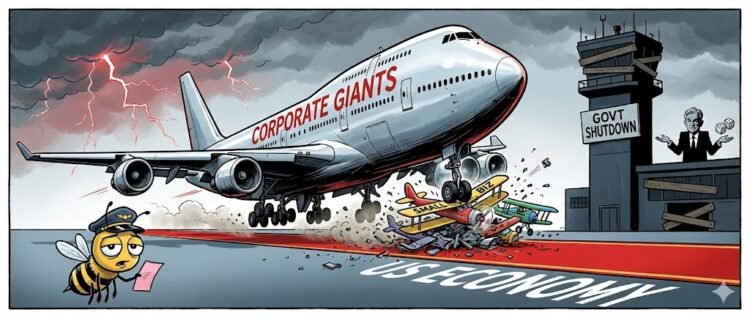
We are told the plane is landing smoothly, but the passengers in coach just fell through the floor.
If you listen closely to the hum of the American economic engine, you will notice a terrifying new sound. It is not the roar of a bull market or the purr of productivity. It is the grinding screech of small businesses being fed into a wood chipper. The latest ADP National Employment Report dropped on December 3 like a lead balloon at a birthday party, revealing that the U.S. private sector didn’t just slow down; it threw itself into reverse. We lost 32,000 jobs in November. That is a negative number. It is a number that is not supposed to happen when the people in charge are telling us that everything is fine, that inflation is tamed, and that we are gliding toward a historic soft landing. Instead, we seem to be executing a controlled crash where the crumple zone is the American small business owner.
The experts, those high priests of finance who read tea leaves in Excel spreadsheets, expected a gain of roughly 5,000 jobs. They were wrong. They were spectacularly, hilariously wrong. They missed the mark by nearly 40,000 jobs, which suggests that their models are calibrated for a reality that no longer exists. But the headline number, as grim as it is, hides the true horror of the situation. The entire loss was driven by small firms. Establishments with fewer than fifty employees shed about 120,000 roles. Let that sink in. The bedrock of the American economy, the “mom and pop” shops, the local contractors, the startups dreaming of becoming the next big thing, are hemorrhaging workers at a rate that should trigger air raid sirens in Washington.
Meanwhile, the medium and large employers—the corporate monoliths with lobbyists and tax loopholes—actually added jobs. We are witnessing a bifurcation of the economy that looks less like capitalism and more like feudalism. If you are big enough to weather the storm, you get to buy the wreckage. If you are small enough to care about your employees’ names, you get to fire them. This is the new American Dream: get big or get liquidated.
The wreckage is not evenly distributed, which adds a layer of geographical cruelty to the mix. The Northeast region was absolutely hammered, losing approximately 100,000 jobs. New England alone lost 50,000. The Mid-Atlantic lost 49,000. It is as if an economic blizzard hit the I-95 corridor and froze the hiring market solid. Conversely, the West added 67,000 jobs, and the Midwest added 45,000. We are no longer one national economy. We are a collection of economic microclimates, where it is sunny in Silicon Valley and raining pink slips in Boston.
The sector breakdown reads like an obituary for the middle class. Professional and business services lost 26,000 jobs. These are the accountants, the consultants, the people who keep the gears turning. Information lost 20,000 jobs, continuing the tech sector’s slow bleed. Manufacturing, the sector we are constantly told is “coming back,” lost 18,000 jobs. Even construction, usually resilient in the face of housing demand, dropped 9,000 spots. The only places hiring are the sectors that service our basic biological needs or our desire to forget our troubles. Education and health services added 33,000 jobs, and leisure and hospitality added 13,000. We are becoming a nation of nurses and bartenders, tending to the sick and pouring drinks for the sad.
This ADP report is particularly terrifying because it is the only map we have. The federal government, in its infinite wisdom, is currently shut down. The Bureau of Labor Statistics, the official scorekeeper of the economy, is closed for business. We are flying blind through a storm, relying on a payroll processor to tell us how close we are to the mountain. ADP’s chief economist, Dr. Nela Richardson, framed this disaster as “choppy hiring” amid “cautious consumers.” “Choppy” is a polite word for “violent.” It is the kind of word you use when you don’t want to panic the passengers, even though you can see the engine on fire.
The timing could not be worse. The Federal Reserve is set to meet on December 9 and 10 to decide whether to cut rates or hold steady. They are supposed to be “data dependent,” but the official data is locked in a filing cabinet in a dark office in D.C. So they are left with this ADP print, a “troubling snapshot” that screams recession. If they cut rates, they admit the economy is in trouble. If they hold, they risk strangling the remaining life out of the small business sector. It is a trap of their own making, baited with high interest rates and snapped shut by legislative incompetence.
We are watching the erosion of the foundational myth of the American economy. We are told that small businesses are the engine of growth. Politicians love to say it. They say it while standing in front of hay bales at county fairs. They say it while cutting ribbons at diners. But their policies tell a different story. When the credit tightens, the small guys are the first to choke. When the regulations pile up, the small guys are the first to stumble. And now, when the job market turns, the small guys are the ones being wiped out. The large corporations, flush with cash reserves and pricing power, can afford to hoard labor or automate it. The local bakery cannot.
The disconnect between the “job stayers” seeing a 4.4 percent pay increase and the “job changers” getting 6.3 percent adds another layer of complexity. It used to be that jumping ship got you a massive raise. Now, the gap is narrowing. The premium for loyalty is rising, not because companies love you, but because the risk of leaving is getting higher. If you have a job, you hold onto it with both hands, because looking at the ADP numbers, you realize there might not be another one waiting for you.
This report raises near-term questions that make the holiday season look bleak. How is seasonal hiring going to hold up if the retail sector is shedding workers? How are consumers supposed to drive the economy if they are worried about their next paycheck? We are entering the most critical consumption period of the year with a labor market that looks like it has the flu. And because of the government shutdown, we won’t know the full extent of the damage until it is too late.
The revisions risk is the final insult. Note that October’s gain was revised upward to 47,000. The numbers are always fuzzy, always subject to change. But a swing from a positive expectation to a negative reality of this magnitude is not a revision error. It is a signal failure. It suggests that the models used to track the economy are broken. They are built on assumptions of stability that no longer apply. We are in uncharted waters, navigating by the stars of a payroll company, hoping that the ship doesn’t hit an iceberg named “Recession.”
The South lost 43,000 jobs, joining the Northeast in the misery column. This regional split suggests that the economic pain is migrating. It is no longer just a Rust Belt problem or a coastal elite problem. It is a systemic failure that is probing for weaknesses in every corner of the country. When the South, usually a bastion of business-friendly growth, starts shedding jobs, you know the rot has set in deep.
This is what happens when you treat the economy like a casino where the house always wins. The Fed jacked up rates to kill inflation, and they succeeded in killing the job market for the people who can least afford it. They engineered a slowdown that was supposed to be precise, surgical. Instead, it was a blunt instrument that smashed the small business sector while leaving the corporate giants bruised but standing.
The silence from the official channels is deafening. With the BLS shuttered, the narrative is being seized by whoever has the loudest microphone. The ADP report will be used by everyone to prove everything. The doves will say it proves we need cuts. The hawks will say it is an outlier. The politicians will blame each other. And the 32,000 people who lost their jobs, and the 120,000 small business roles that vanished, will be treated as debating points rather than tragedies.
We are witnessing the hollowing out of the American middle. The manufacturing jobs are gone. The construction jobs are stalling. The professional services jobs are shrinking. What is left? Serving each other food and taking each other’s blood pressure. We are becoming a service economy in the most literal, subservient sense. The path to upward mobility is being paved over by a gig economy that offers no benefits and no security.
The “cautious consumer” Dr. Richardson mentions is cautious for a reason. They are not stupid. They see the “Help Wanted” signs disappearing. They see their friends getting laid off. They see the prices at the grocery store refusing to come down. They know, instinctively, what the economists are just now figuring out: the party is over, and the bill is due.
And who pays the bill? It won’t be the large employers who added jobs. They have tax shelters and lobbyists. It will be the small business owner in New Jersey who has to close up shop. It will be the contractor in Virginia who has to lay off his crew. It will be the freelance graphic designer in manufacturing who suddenly has no clients. These are the people who pay the price for the Fed’s “soft landing.” They are the landing pads.
The shutdown adds a layer of governmental nihilism to the mix. We cannot even measure our own demise properly because the people we pay to measure it are home without pay. It is a perfect feedback loop of dysfunction. The economy slows, the government freezes, the data vanishes, and the panic sets in. It is the perfect storm for a market correction that feels less like a correction and more like a punishment.
So as the Fed meets on December 9 and 10, they will be looking at this ADP report and wondering if it is a blip or a trend. They will debate “softer hiring” versus “caution.” They will use sterilized language to describe the destruction of livelihoods. But the reality is already here. The negative sign in front of that 32,000 is not just a statistic. It is a warning shot. The era of easy growth is gone. The era of the small business boom is pausing. We are entering the winter of our economic discontent, and the heater is broken.
Receipt Time
The invoice for this economic mismanagement is being sent to Main Street, care of the small business owner. The itemized list includes lost wages, shuttered storefronts, and deferred dreams. The total is rising every day the Fed keeps rates high and the government stays closed. We are paying for the illusion of stability with the reality of our neighbors’ jobs. The soft landing was a myth sold to us by people with golden parachutes. For the rest of us, the ground is coming up fast, and it looks a lot like concrete.