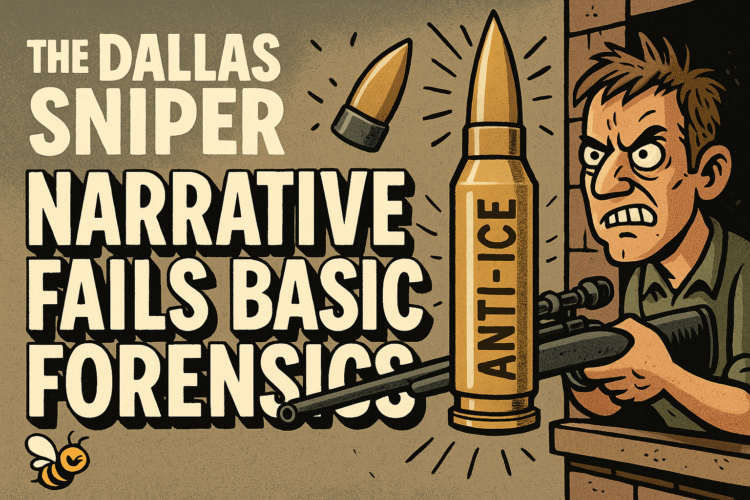
The truth is that political violence is always a tragedy. That should not need disclaiming, but in our era of algorithmic outrage, you practically have to lead with a notarized certificate of sincerity before you dare analyze an event. So let’s start there: what happened at the Dallas ICE field office was horrific. One detainee is dead, two others critically injured, and a 29-year-old man, Joshua Jahn, ended his life with a rifle on a rooftop. A family is grieving, three more families are caught in the machinery of critical care, and the news cycle is already stripping the story for parts.
Now that we’ve cleared the basic moral ground, let’s get to the mess.
Because something about the Dallas shooting doesn’t smell right. Not in the conspiracy-theory sense of dark cabals pulling strings, but in the very ordinary, very American sense of institutions rushing to define a narrative before they even sweep the shell casings.
The Minute-by-Minute
Eyewitness timelines are always imperfect, but we have enough to reconstruct the sequence with some granularity.
- 7:52 a.m.: Initial reports filter through Dallas police scanners of shots fired near the ICE field office on North Stemmons Freeway. Officers are dispatched.
- 7:56 a.m.: The first units confirm active fire from a rooftop approximately 200 yards away, across a commercial lot. The vantage point gives a clean line to the sally port where detainee transport vans load and unload.
- 7:59 a.m.: Return fire is considered but not executed—sniper angles make that risky with civilians.
- 8:04 a.m.: Jahn is found dead of a self-inflicted gunshot wound. His rifle (bolt-action, 7.62mm) is recovered, along with a scope, maps of the ICE complex, and a small quantity of unspent rounds.
- 8:10 a.m.: Initial casualty reports from ICE list two detainees dead and one in critical condition.
- 8:42 a.m.: Correction issued—only one dead, two in critical condition.
- 9:15 a.m.: FBI Director Kash Patel posts to his personal social media feed an image of an unspent round, with the words “ANTI-ICE” scratched into the casing.
That last step matters. Because Patel—never known for subtlety—jumped the gun, literally, on chain-of-custody optics. When the FBI Director blasts “evidence” on X before forensics has even processed the scene, it’s not about informing the public. It’s about seeding the frame.
Confirmed vs. Inferred
Let’s separate what we know from what we’re being told we know.
Confirmed:
- Jahn fired from a rooftop at the ICE field office.
- One detainee is dead, two are critically injured.
- Jahn died by suicide.
- Maps of the ICE facility were recovered.
- An unspent round with “ANTI-ICE” scratched into it exists.
Inferred (but not yet evidenced):
- That Jahn was targeting ICE staff.
- That the detainee deaths were incidental.
- That the “ANTI-ICE” inscription represents his motive rather than a planted or performative flourish.
- That the maps indicate premeditation against ICE rather than obsessive mapping of a building (a not-uncommon behavior in troubled individuals).
Notice the gap? The conclusions about motive and intent are being welded onto facts that don’t yet support them.
The Inconvenient Victims
If this was a targeted attack against ICE, as officials insist, it failed spectacularly. Not a single ICE employee was hit. The only casualties were detainees—migrants in the custody of the federal government.
So what was Jahn aiming at? From the rooftop vantage, the sally port is a blur of motion. Did he intend to hit guards and simply struck detainees by accident? Was he firing indiscriminately, spraying the area without caring who fell? Or—uncomfortable as it is to ask—was he aiming at the detainees themselves?
We don’t know. And yet the official line is already locked: this was “violence against ICE.”
The dead detainee is not being memorialized as the target of a hate crime. The injured migrants are not being acknowledged as the actual victims of this event. Instead, they are collateral footnotes in a morality play about the sanctity of law enforcement.
Patel’s Evidence Theater
Let’s talk about that round.
When Patel posted the “ANTI-ICE” bullet, still in its casing, still shiny and photogenic, it wasn’t evidence. It was content. Investigators don’t leak mid-scene evidence unless they’re trying to shape a narrative.
Chain of custody matters. Forensics matters. If you find a casing inscribed with a message, the first question is when it was inscribed and by whom. Was it carved by Jahn in a moment of ideological fury? Was it scratched long before, part of a theater of intent? Or was it added later, after discovery, by someone eager to make sure the “motive” looked as airtight as possible?
We don’t know. What we do know is that Patel rushed to publish it online before lab analysis. That is not law enforcement. That is political amplification.
The Temptation of Premature Narrative
Why does this matter? Because once a narrative hardens, facts struggle to catch up. The Dallas shooting will now live in political discourse as “the anti-ICE sniper attack,” no matter what forensics eventually prove.
If investigators later determine Jahn’s fire pattern suggests indiscriminate targeting, or even targeting of detainees, that won’t matter. The frame is set: leftist anti-ICE violence.
This premature narrative serves political needs. It reinforces the administration’s insistence on domestic extremism from the left. It offers cable news a simple binary villain. And it allows ICE to present itself as besieged rather than scrutinized.
The Forensics That Matter
If anyone actually cared about truth, the questions would be technical:
- Trajectory Analysis: Where were Jahn’s shots grouped? Were they clustered near guard positions, or scattered among detainees?
- Targeting Evidence: Did his maps mark guard entries, admin offices, or the sally port itself?
- Inscription Timing: Was “ANTI-ICE” scratched into the casing with fresh tool marks, or long ago?
These are answerable questions. They require lab time, ballistic analysis, handwriting comparison. They require investigators to resist the urge to declare motives before motives are known.
But that’s not what’s happening. Instead, we’re getting Instagram forensics.
The Politics of Amplification
It is worth pausing to notice who benefits.
- The Administration: Prematurely branding this as anti-ICE violence bolsters claims of leftist radicalization.
- ICE: Shifts focus from detainee conditions (which are, charitably, horrific) to ICE staff as “targets.”
- Right-Wing Media: Gains fresh fodder for civil war rhetoric, even if the facts don’t support it.
- Patel: Cements his role not as a director of investigations, but as a political showman who delivers hot takes faster than CNN.
The losers, of course, are the detainees—reduced from human victims to supporting characters in someone else’s security narrative.
Stakes Beyond Dallas
Why dwell on one shooting? Because it illustrates the peril of narrative outrunning forensics.
When evidence becomes theater, investigations become PR. When officials leak bullets on social media before chain-of-custody is secure, they aren’t just sloppy—they’re telling us that the story is more important than the truth.
That corrodes trust. It makes the public suspicious of every subsequent revelation. It turns tragedy into culture war fuel. And it leaves actual victims erased.
The Smell Test
So let’s apply the basic civic sniff test:
- The victims were detainees, not guards.
- The shooter’s intent is unclear.
- The evidence was rushed into public view before analysis.
- Officials declared motive before the facts supported it.
That doesn’t mean there’s a conspiracy. It means there’s spin. And spin in the first hours after violence is not harmless—it shapes how the nation remembers the event, how policies are justified, and how future violence is rationalized.
Satire, Unfortunately, Writes Itself
Imagine, if you will, the press conference rewritten as honesty rather than theater:
“We don’t actually know yet whether the shooter was aiming at ICE staff or detainees. We’re still checking ballistics. We did find a bullet with ‘ANTI-ICE’ scratched on it, but we have no idea if the shooter wrote that or if it was some weird cosplay artifact he carried around. Please don’t draw sweeping conclusions until we’ve done the work.”
Instead, we get:
“This was targeted anti-ICE violence. Here’s a shiny photo of a bullet. Please share widely.”
If you can’t laugh, you cry.
Why It Matters
Because the next time something like this happens—and it will—politicians will cite Dallas as precedent. They’ll say, “See, leftists are killing ICE agents.” They’ll fold it into speeches, fundraising emails, committee hearings. And when you point out that the only people actually killed or critically injured in Dallas were detainees, you’ll be told that’s irrelevant.
That’s how narratives ossify. That’s how tragedy is weaponized. That’s how public trust erodes.
Summary: When Evidence Becomes a Selfie
Joshua Jahn opened fire on the Dallas ICE field office from a rooftop, killing one detainee and wounding two more before dying by suicide. Officials first misreported two deaths, then corrected to one. FBI Director Kash Patel rushed to post an “ANTI-ICE” bullet casing on social media, branding the event “targeted violence” against ICE before forensics confirmed motive.
The facts remain unsettled: Was Jahn aiming at staff, detainees, or indiscriminately at the sally port? Was the inscription authentic or staged? What do the recovered maps actually indicate?
The stakes are clear. Premature narratives risk erasing victims, miscasting intent, and turning evidence into propaganda. In Dallas, the detainees’ deaths are being rewritten as ICE’s victimhood. And in that sleight of hand lies the real violence: the murder not just of bodies, but of truth.