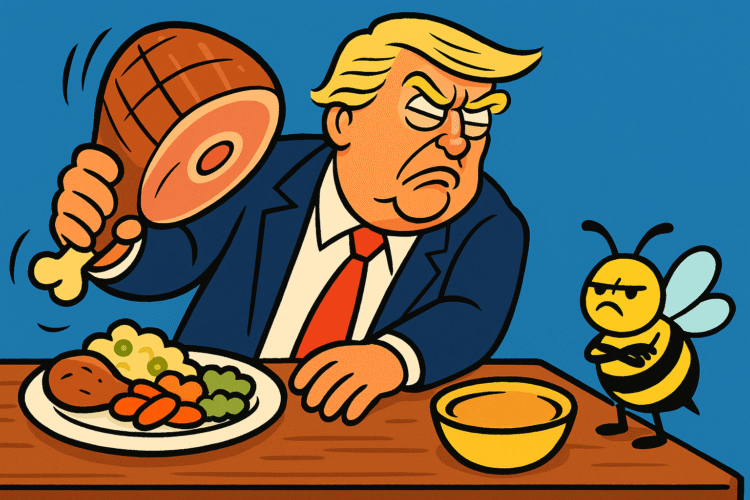
There is a special kind of nausea that comes from watching a government treat 42 million people like a toggle switch. It is the same nausea you get when you open your bank app, see a deposit, exhale for the first time in a week, and then receive a memo from Washington telling you that the deposit you just relied on was an “unauthorized” mirage that might now require a clawback. It is the unique and deranged form of vertigo that only an administration determined to win a shutdown by force feeding chaos can produce. This week, as verified coverage makes clear, the Trump administration decided to conduct a national stress test on families who use SNAP by flipping the benefits guidance four times in six days and instructing states to undo full November payments after Justice Ketanji Brown Jackson issued a temporary administrative stay. The government has many powers, but inventing a psychological carnival ride out of grocery money may be its darkest innovation yet.
The timeline matters because satire depends on documented absurdity, and Washington has provided it in bulk. It began with the Rhode Island ruling that ordered USDA to deliver full November SNAP benefits during the shutdown by tapping the contingency fund and pairing it with the Section 32 child nutrition pot. The Food and Nutrition Act treats SNAP as an entitlement, not a vibes dependent wish list, and the court reminded USDA of exactly that. Massachusetts quickly echoed the legal reasoning. States began preparing full EBT loads. Families made grocery lists based on actual legal rights. Then came Justice Jackson’s administrative stay, the most boring phrase in the English language until you realize it meant the White House had a new lane to weaponize uncertainty. Within hours, USDA told states the full funding order was on pause. Then it told them to hold off on benefits entirely. Then to issue half. Then, Saturday night, the administration told states to “undo” full payments already issued, calling them “unauthorized.” Four flips. Six days. Forty two million people. One government that seems to believe groceries are a chess piece.
The law is not ambiguous, which is partly why the satire writes itself. The Food and Nutrition Act requires that eligible households receive their full monthly allotment. Congress funds the program. Agencies implement. Shutdowns complicate the plumbing but do not erase statutory rights. The Administrative Procedure Act bars arbitrary and capricious agency action, a fancy phrase meaning you cannot run a national nutrition program like a malfunctioning slot machine. The Antideficiency Act prohibits obligating funds without appropriations, but courts noted that USDA held available reserves in both the contingency pot and Section 32. The district court spelled out that the administration had lawful tools to deliver benefits. Instead of using them consistently, the White House treated the litigation as a political opportunity to create a hunger cliff and then blame process.
The stakes land hardest at the level that politicians who drink $8 lattes pretend not to understand. People were already in mid month crisis mode thanks to the shutdown. Grocery budgets are not theoretical. When states like Massachusetts and Wisconsin pushed full benefits, families immediately began planning meals around them. Rent is due. Heating season is starting. Kids need lunches. Grandparents making do with canned soup finally allowed themselves to imagine a cart with produce. Then Saturday night dropped. USDA told states that the full payments were unauthorized and that they might face penalties or clawbacks if they did not reverse them. Imagine being told to take food off the table you had already placed there, not because the law changed but because the White House wanted a stronger negotiating position.
Governors sounded the alarms, and the language was far blunter than usual. Words like catastrophic, destabilizing, and reckless appeared in statements that usually read like colorless budget memos. State agencies warned they did not even know how clawbacks would work or whether they were legal. EBT processors were already struggling to keep pace with the four guidance changes in less than a week. Grocery stores reported increased foot traffic the moment full benefits hit. Pulling the benefits back would create a logistical mess so severe that even the credit card networks flinched. Yet USDA marched forward with the rollback directive, treating operational chaos as a feature, not a bug.
This is the moral and operational equivalent of handing someone a parachute halfway through a fall and then yanking it away to see what happens. It is also a strategy built on calculated cruelty. SNAP is one of the most efficient anti hunger programs in the country, with the vast majority of benefits spent within days, circulating through local economies. A half benefit month leaves households choosing between groceries and medicine, groceries and rent, groceries and childcare. And because food inflation remains painful at the checkout line, a halved deposit often covers maybe ten to twelve days of meals. Everything after that becomes improvisation. Churches and food banks brace for surges they cannot meet. Families ration. Kids stretch cereal over dinner. Adults skip meals altogether.
The administration’s legal rationale is an improvisational collage of misread statutes and selective interpretations. One day the argument is that Section 32 cannot be used the way the district court allowed. The next day the argument is that the contingency fund is too low. Then it becomes a novel theory that the administrative stay gives USDA total discretion to halt benefits. None of these arguments erase the underlying fact that SNAP is an entitlement program. Nor do they override the APA’s demand for reasoned decision making. If anything, the rapid fire shifts strengthen the plaintiffs’ case that agency action has been arbitrary. The administration has changed positions like a student guessing on a true and false exam. Courts tend to notice.
Even inside the system, frustration is rising. Caseworkers cannot explain to clients what the rules are hour to hour. Retailers cannot update their point of sale systems quickly enough. Food producers worry that a sudden spending shock will wreak havoc on inventory that is already thin. And the political cost is building, with polls showing that a majority of Americans blame the White House for the SNAP chaos. The attempt to create leverage has instead revealed how deeply voters resent seeing food used as a bargaining chip.
This should not be complicated. SNAP is a statutory guarantee. Courts have already said what USDA must do. States have infrastructure to issue benefits. Yet the administration has chosen to behave like a landlord changing the rent three times a week. The result is hunger as policy rather than hunger as unfortunate side effect. There is no moral dignity in this approach. It is policy by intimidation, the same logic that produced the initial threat to pay nothing at all. When you consider the scale, forty two million people jerked around because the executive branch wants a better negotiating position on unrelated shutdown demands, the story stops being absurd and becomes obscene.
The timeline is the indictment. Rhode Island ruling on Monday. Massachusetts echo Tuesday. Justice Jackson’s administrative stay midweek. USDA halting guidance by Thursday. Half payment guidance Friday. Full payment reversal Saturday night. That is six days of governance that reads like a fever dream. No one who relies on SNAP should have to consult breaking news alerts to know whether they can make dinner. But that is exactly what the administration created, a national audience forced to refresh their phones while Washington plays process theater.
And now the next forty eight to ninety six hours will determine whether SNAP stabilizes or spirals further. One key question is whether the First Circuit narrows or lifts the stay and restores the district court order. Another is whether USDA uses available reserves even while appealing, as the court permitted. A third is whether FNS publishes binding guidance that ends the chaos and instructs states clearly on what to deliver. Some states have asked whether they can refuse clawbacks on legal grounds. Others want Congress to codify a one month backstop with reimbursement authority. All of this is unfolding in real time, with families waiting to know whether the groceries they bought yesterday were a mistake.
There is also the question of whether the press will tell the truth plainly. This is not process confusion. The White House asked states to take food off the table after states had followed a lawful court order to put it there. It did so for leverage. It did so knowing the operational costs. It did so while insisting publicly that half benefits were all the law allowed even after two courts said otherwise. A functioning press corps would not bury that sentence. It would print it in the first paragraph.
At a deeper level, this chaos reveals the fragility of safety net governance when an administration sees antipoverty programs as bargaining chips rather than obligations. A government that can switch SNAP on and off like a light is a government that has forgotten the difference between power and responsibility. It has also forgotten the basic mechanics of poverty. People budget to the dollar. They plan based on promises. They survive through predictability. When you yank predictability away, you break more than a program. You break trust.
But satire has a role here, and that role is to hold up a mirror with uncomfortable accuracy. The administration did not need to invent a new method of torment. It simply needed to weaponize uncertainty. SNAP became a lever. Courts became props. States became pawns. And hunger became a message. The message is as cold as it is clear. Groceries are negotiable. Rights are negotiable. Stability is negotiable. Everything is negotiable except the demands of a White House that sees shutdowns as stages and human needs as plot devices.
The next chapter is being written now. States are meeting with lawyers to determine the legality of clawbacks. Advocates are racing to document the harms. Judges are reviewing emergency filings. Congress is debating stopgap fixes. Families are refreshing EBT apps. And the administration is still insisting that the chaos is simply process working as intended. It is a claim that collapses under its own weight. Process does not usually require taking food away from children mid month.
In the end, what this saga proves is that the country does not need a new political theory to explain cruelty. It needs only to read the memos. They tell the story plainly. Benefits were ordered. States complied. The White House objected. Courts intervened. The White House pivoted. States scrambled. Families suffered. And all the while the administration insisted that it was the law, not the leverage, that required it to behave this way.
Satire thrives on exaggeration, but this story defeats exaggeration by being real. A government told states to undo groceries. That sentence alone belongs in history books as evidence of a nation drifting into absurdity. And now the question is whether the courts, Congress, and the country will let the absurdity stand.
Because at some point, someone needs to say the quiet part with clarity. Food is not a bargaining chip. Hunger is not a policy tool. And a government that treats it as such should not be trusted with anyone’s dinner, let alone the dignity of a nation.