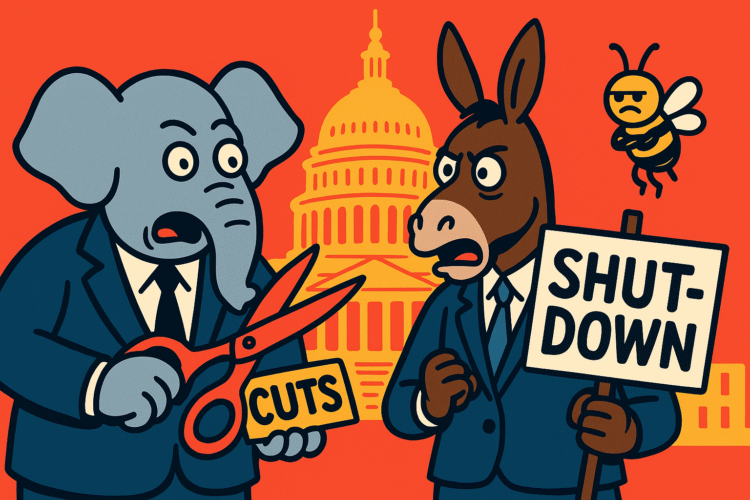
There is a certain kind of American absurdity that only blossoms when the government is closed, the airports are melting down, and someone in the Senate has started speaking of the filibuster as if it is a religious relic discovered deep beneath the floor of the Capitol. You can almost set your watch by it. The lights flicker. Reporters begin using phrases like cautious optimism in tones that imply cautious pessimism. And a parade of leadership figures stride to podiums to explain why reopening the United States government would be lovely, just lovely, but only if it comes bundled with concessions that voters did not ask for, Congress did not debate, and math cannot support.
Into this circus walked Senate Democrats with a surprisingly normal offramp. Not a flashy one. Not a hostage swap. Not a Trojan horse stuffed with unrelated culture war side quests. A simple proposal: reopen the government and extend Affordable Care Act premium tax credits for one year while launching a bipartisan health care working group. That is it. A fiscal bottle of water, handed across the negotiating table to a Republican conference that has been sprinting laps while dehydrated and shouting into microphones about chaos being a negotiating tactic.
The offer lasted approximately eight seconds before Senate Majority Leader John Thune declared it a nonstarter, presumably because the idea of extending health coverage assistance during a shutdown was too sensible, too humane, or too likely to break the spell that Republicans have been casting over themselves since the first week of this mess. Speaker Mike Johnson, meanwhile, refused to commit to even bringing the idea up for a vote, a posture that fits neatly into Johnson’s broader governing aesthetic, which is part haunted Victorian doll, part radio host reading Bible verses while the house burns down behind him.
And then there is President Trump, who, from his throne atop a reality distortion field, continued demanding that the Senate “nuke” the filibuster so Republicans could pass their own bill with a simple majority. Imagine saying that with a straight face. Imagine declaring your contempt for the rules of the chamber while also insisting you have a constitutional obligation to uphold them. Only a man with dozens of felony convictions and a worldview built on the confidence of a man who has never been told no could move the goalposts this aggressively while calling everyone else weak.
To understand the scale of the absurdity, you have to walk the timeline backward. Democrats made their offer. Republicans balked. The Senate failed test votes to pay essential workers. Airports began experiencing slow motion collapse as air traffic controllers and TSA workers hit their breaking points. SNAP recipients faced agency whiplash as courts intervened repeatedly to stop the administration from inventing new ways to starve 42 million people. And through it all, Republicans insisted that Democrats were the ones refusing to negotiate while the country’s infrastructure creaked like an old roller coaster about to derail.
The civics here are not complicated. They are simply inconvenient to those who prefer fantasy governance to the hard labor of legislating.
Article I gives Congress the power of the purse. The president does not get to decide, as a treat, which programs receive funding during a shutdown. The Senate’s Rule XXII requires sixty votes to end debate. No one, not even a president with a supercomputer for a sense of self, can wish that rule out of existence. The SNAP litigation hinges on emergency stay standards, statutory entitlements, and administrative law, not the White House’s preferred talking points. And OMB apportionment mechanics are not mood boards. They cannot be replaced with a vibes based budgeting system simply because someone feels the vibes strongly enough.
But why talk about civics when you can talk about theatrics?
Republicans immediately framed the Democratic offer as an attempt to exploit the shutdown to push a partisan health agenda. As if reopening the government and ensuring people do not lose health care subsidies is an ideological indulgence. As if millions of Americans are sitting around praying that their premiums will rise just so Congress does not accidentally do something bipartisan. As if the country does not rely on a functioning government to keep planes flying, hospitals staffed, labs funded, and benefits delivered.
Republican leadership prefers the shutdown as leverage because a functioning government weakens them politically. It reminds voters that governance is not a performance, it is a service. When the lights stay on and the checks go out and the planes land safely, voters are harder to frighten or distract. When the machinery of government shudders to a halt, the same leaders responsible for the breakdown get to point at the damage they caused and insist the system is broken beyond repair.
And then there is the president’s obsession with eliminating the filibuster, not for democracy, not for efficiency, but for the singular purpose of ramming through his preferred bill while the country is locked into a shutdown he created. The irony here should be installed in a museum. The leader of the party that once treated the filibuster like a sacred shield is now demanding its annihilation because he wants to pass a bill that cannot survive scrutiny, negotiation, or daylight. It is the legislative equivalent of trying to win a chess match by kicking the board across the room.
The consequences are not abstract. They are hour by hour, body by body, budget by budget.
Airports cannot staff their control rooms. Pilots are running out of legal duty hours. TSA workers are hitting food banks between shifts. SNAP recipients are refreshing their EBT balance pages like gamblers watching a roulette wheel. Small businesses that rely on federal contracts are bracing for payroll collapses. Federal workers are calculating which bills can be postponed without triggering fees that will haunt them for the next six months.
And in the middle of it all, the press continues treating this as a bipartisan mess rather than the ideological hostage situation it is. There is something infuriatingly American about a newsroom that will call a cat rescue a miracle but will not call a manufactured crisis a manufactured crisis. This is not gridlock. This is a deliberate attempt by one party to force concessions by starving the government of oxygen and then blaming the other party for not handing over the ventilator.
The next seventy two hours matter. They always do in a shutdown, not because the calendar cares, but because the cracks widen exponentially. If Republicans decide to table or modify the ACA credit extension, we will know the shutdown is being preserved as leverage rather than resolved as governance. If a fix for back pay or airport operations moves through unanimous consent, we will know the pressure has reached a point where optics can no longer sustain the standoff. If the First Circuit narrows or lifts the SNAP orders while USDA taps reserves, we will discover how committed the administration is to its hunger cliff strategy. If the press finally begins naming the cause of the crisis rather than hiding behind euphemisms, we will know democracy still remembers how to speak plainly.
What we are witnessing is not an ideological dispute. It is a stress test of whether a majority can govern without believing in governance itself. Whether a party that fetishizes austerity and disinformation can keep planes in the air and groceries on shelves. Whether a president who treats legislative rules like mood lighting can compel a coequal branch of government to surrender its most basic powers.
The shutdown will end. They always do. But the question is how much will be left standing when it does. The airports. The benefits. The workers. The constitutional norms. The patience of a country that has been asked once again to survive the political equivalent of a toddler holding their breath until they get what they want.
This is not both sides. This is not a misunderstanding. This is not gridlock. This is a test of whether one party’s refusal to negotiate on health coverage can plunge the entire nation into crisis and then insist the crisis is simply democracy doing its thing.
Democracy deserves better. So do the people stuck in airport terminals, the families waiting for benefits, the workers wondering whether their next paycheck will materialize, and the country that keeps being told that governance is a magic trick instead of a responsibility.
There is nothing magical about this. It is policy. It is intentional. And it is time to say it plainly.