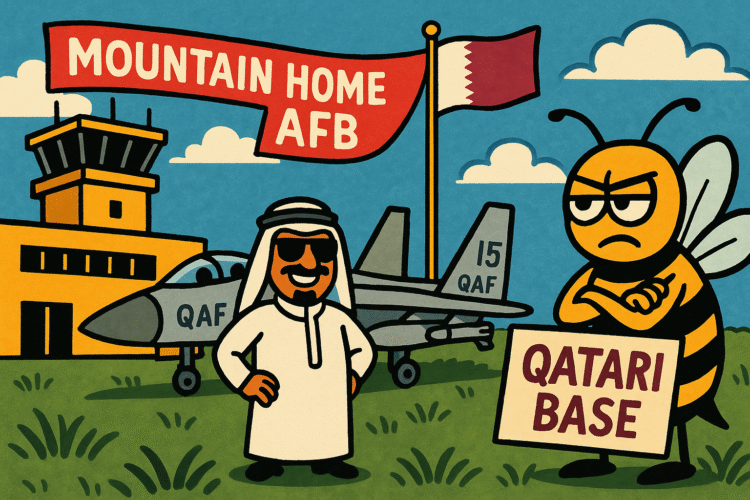
There’s a new kind of foreign investment in America—one that comes with F-15s, a ten-year commitment, and a PR team insisting it’s definitely not a base.
This week, the Pentagon proudly unveiled plans for a Qatar-funded “training complex” at Mountain Home Air Force Base in Idaho, which will host Qatari pilots and their U.S.-made fighter jets for joint training under “American command and jurisdiction.” It’s technically U.S.-controlled, sure, but it’s also, you know, built by another country’s government and permanently staffed with their military personnel.
But don’t worry, the Pentagon swears it’s fine. Nothing to see here. Just a little friendly multinational militarization in potato country.
The Desert Comes to Idaho
The official line is all sunshine and interoperability. The Defense Department says the project will “create hundreds of American jobs,” “strengthen partnerships,” and “deepen regional cooperation.” Qatar’s defense minister flew in for the announcement, smiling beside American generals who looked like they’d just been handed the world’s fanciest donor plaque.
Qatar’s embassy was quick to clarify: “It’s not a Qatari base.”
That’s right. It’s just a Qatari-funded, Qatari-staffed, Qatari-equipped facility permanently housing Qatari jets on U.S. soil. Totally different.
We’ve officially entered the era of the Schrödinger’s Base—a military installation that both is and isn’t foreign, depending on whether you’re trying to calm Twitter or dodge the Constitution.
The MAGA Meltdown (and for Once, They’re Not Entirely Wrong)
Within hours of the Pentagon’s announcement, the usual right-wing outrage machine kicked into overdrive. Laura Loomer, Donald Trump’s unofficial conspiracy concierge, led the charge, calling it “a foreign military base on U.S. soil.” Influencers followed suit, posting Idaho-shaped graphics with captions like “QATAR INVASION” and “BIDEN SOLD US OUT.”
It’s the kind of reaction you’d expect from people who think every Starbucks is a secret UN outpost, but here’s the twist: for once, the paranoia isn’t totally misplaced.
No other nation has been allowed to plant a military installation—training, joint, or otherwise—inside the continental United States. The Pentagon claims it’s just “mutual training.” Critics call it what it looks like: an unprecedented foreign military foothold in the U.S.
Even establishment figures raised eyebrows, suggesting Congress at least debate it publicly instead of slipping it into a ribbon-cutting ceremony.
Because, minor detail, this is the same Qatar that:
- Hosts America’s largest base in the Middle East (Al Udeid).
- Has spent the past two decades buying influence in Washington with sponsorships, think-tank grants, and property deals.
- Is currently under scrutiny for also buying Donald Trump’s affection—literally.
Trump’s Favorite Pen Pals
Remember that $400 million private jet Qatar gave to Trump’s post-presidency network? Or the $5.5 billion golf course project it bankrolled for the Trump Organization?
That’s not metaphorical bribery. That’s PowerPoint bribery.
Trump spent years cozying up to Doha. During his presidency, he called them “friends” after initially blasting them as “terror funders.” Then Qatar hired lobbyists close to him, bought U.S. aircraft, and suddenly—poof!—the criticism vanished.
Now, a few years and a few billion Qatari dollars later, the Pentagon under Trump’s hand-picked successors is greenlighting a Qatar-funded project inside the United States.
Coincidence? Sure, and I’m the Sultan of Boise.
The Pentagon’s New Motto: “It’s Fine, We Have Precedent”
When pressed, defense officials pointed to a “precedent”: Singapore already trains at the same Idaho base.
But that’s like saying your landlord lets one roommate sublet the spare room, so why not let a foreign monarchy park its fighter jets in the driveway?
Singapore’s training detachment is small, transparent, and explicitly limited. Qatar’s setup, by contrast, comes with new construction, its own facilities, and a ten-year plan that looks suspiciously like permanence in camo.
And unlike Singapore, Qatar’s record isn’t exactly democracy-friendly. This is a country where migrant workers still die in stadium heat and satire is punishable by jail time. So naturally, we’re handing them runway access in the American interior.
The Mirage of “American Control”
The Pentagon swears the site will remain under U.S. command and jurisdiction. Translation: we’re in charge until it’s awkward.
Let’s be honest—once the Qatari flag is flying over Idaho (figuratively or otherwise), who’s really calling the shots? If a Qatari pilot crashes into a field, do we handle the investigation, or does Doha? If tensions flare in the Middle East, do their planes get grounded, or do we smile politely while their military presence becomes the diplomatic equivalent of a squatter’s lease?
It’s hard not to recall that other little experiment in “foreign partnership” that started with handshakes and ended with the East India Company owning India.
Meanwhile in the Right-Wing Bubble: Panic and Projection
Conservative commentators, never ones to miss a performative outrage opportunity, immediately reframed the announcement as “Biden giving Muslims a base in Idaho.”
Never mind that the deal has been in motion for years—well before Biden—and that it stems directly from Qatar’s multi-billion-dollar purchases of U.S. aircraft under the Trump administration.
But the right doesn’t care about facts; they care about vibes. And nothing vibes harder than a fear that brown people have access to military-grade equipment in America.
Still, the irony is thick enough to fuel an F-15. These are the same people who scream about “globalists” while cheering foreign cash propping up Trump’s businesses. They rail against “foreign influence” while their own hero literally sold American branding rights to a foreign regime.
If hypocrisy were a fighter jet, it’d have its own hangar in Idaho.
The Real Story: The U.S. Military Is Now a Franchise
Forget “joint training.” What we’re seeing is military globalization, American-style.
Think of it like a Starbucks model. You get the brand, the management structure, and the glossy brochures about “community impact.” They bring the capital and a ten-year contract. Everybody wins—until somebody realizes you’ve just franchised national security.
The Pentagon loves these deals because they offload costs while pretending it’s all about cooperation. Congress loves them because they bring local construction jobs. Local leaders love them because they can brag about “investment.”
And by the time anyone notices that a foreign monarchy just built part of the U.S. defense infrastructure, it’s already ribbon-cut and operational.
The Optics Problem
The announcement couldn’t have come at a worse time.
We’re in the middle of an authoritarian rebrand at home—Trump’s “second-term” orbit openly fantasizing about loyalty oaths, DOJ purges, and ICE as a national police force. Abroad, he’s spent years praising strongmen who build fake democracies out of oil money.
Now we’re letting one of his biggest benefactors build a literal monument to “partnership” in red-state America.
Imagine the campaign ads:
“President Trump: Keeping America First, even when our air bases are sponsored by foreign monarchies.”
It’s as if the Pentagon decided to cosplay as FIFA.
The Local Angle: Potatoes, Planes, and Public Relations
In Idaho, reactions are mixed. Some locals are excited about jobs and infrastructure. Others are quietly wondering whether “hosting Qatari fighter jets” was in the tourism brochure.
One county commissioner reportedly said, “It’s good for the economy.” Which is the same argument people used for coal, opioids, and strip malls.
Give it a year, and the “Qatar Complex Gift Shop” will be selling souvenir prayer beads next to Idaho spud magnets.
What Could Possibly Go Wrong?
Maybe nothing. Maybe this really is just a benign training partnership.
But history rarely ends at “benign.” Bases evolve. Missions expand. Contracts renew. The Pentagon’s ten-year commitment could quietly become twenty, then fifty. And soon enough, “Mountain Home” sounds more like “Doha North.”
And when the next administration—say, a Trump 2.0—decides to renegotiate, what’s the leverage? He’s already taken their golf money and their jet. You think he’s going to tell them no now?
The Broader Picture: The Pay-to-Play Republic
This story isn’t just about Qatar or Idaho—it’s about what happens when America’s institutions forget the difference between partnership and purchase.
We’ve blurred the line so badly that foreign governments now understand the secret: don’t lobby the U.S. government, just buy the guy who runs it.
Qatar didn’t invade us. It didn’t even have to. It just wrote checks—to our defense industry, to our former president, and now to our infrastructure.
And the Pentagon, desperate for funding and friendly headlines, handed them a runway.
Closing Section: A Nation for Sale (Comes with Runway Access)
The Qatari base—sorry, “training complex”—in Idaho is the perfect symbol for where America stands in 2025: morally overleveraged, financially compromised, and still pretending the uniform makes it patriotic.
For a country that spent two centuries terrified of “foreign entanglements,” we now lease our sovereignty like Airbnb property.
Trump took the gifts—jets, golf courses, global praise—and set the tone. Biden’s Pentagon is following the script. And in between, the public’s too numbed by culture wars to ask the obvious question:
How did we get to a point where a foreign monarchy has fighter jets parked in Idaho and everyone’s arguing about Taylor Swift conspiracies instead?
Maybe the real threat to democracy isn’t coming from abroad. Maybe it’s the one quietly signing construction contracts in Mountain Home, smiling for the cameras, and calling it “a training opportunity.”
Because at this point, the United States isn’t selling out—it’s just leasing patriotism, one foreign-funded hangar at a time.