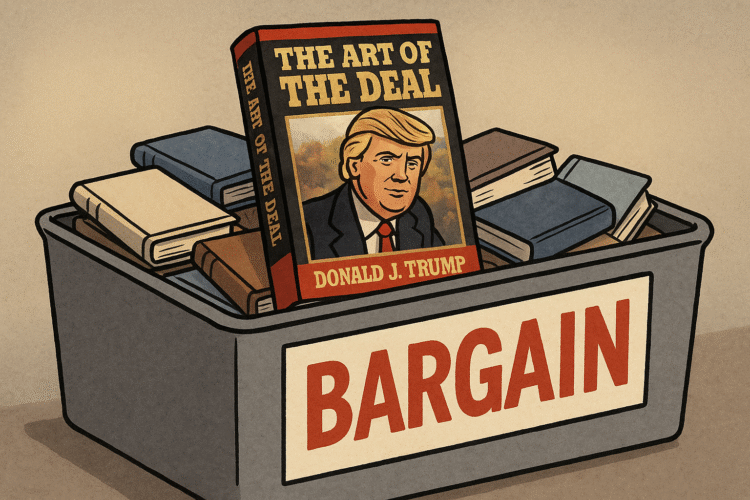
The Trump administration’s second act has arrived—unseasoned, unfiltered, and flush with the confidence of a man who thinks The Art of the Deal is still in print. What began as a 2016 fever dream has curdled into a 2025 reality show reboot: America’s Next Top Autocrat.
Naturally, there’s been some turbulence. The president, emboldened by legacy, cable news loops, and a suspicious number of unnamed sources who “feel very strongly,” has recently rolled out a bouquet of lawsuits, executive orders, and budgetary tantrums that somehow manage to be both unconstitutional and deeply on brand.
Let’s begin with the DEI rollback—an administrative love letter to the days when workplace inclusion meant inviting “the good one” to the cookout. Federal funding for Diversity, Equity, and Inclusion has been not just restricted, but gutted, doused in gasoline, and offered up as a burnt offering to the gods of Fragile Meritocracy.
Legal challenges are already underway. Plaintiffs argue that the administration’s order violates both the First Amendment and basic human decency, though the White House insists the goal is simply “fairness”—defined here as a complete return to 1953.
To paraphrase Press Secretary Greg Gutfeld, “Diversity is fine, but do we really need all these pronouns and chairs at the table? Especially when we’ve already printed the menus?”
Meanwhile, the President’s long-standing beef with Federal Reserve Chair Jerome Powell has entered its Renaissance phase. What began as a minor disagreement over interest rates has escalated into a full-blown architectural turf war over renovations to the Federal Reserve headquarters. The projected costs ballooned after Trump suggested adding “more gold trim, taller columns, and maybe a few tasteful portraits of him, shirtless, in front of a burning dollar.”
Powell, typically stoic, released a rare statement: “The Federal Reserve is not Mar-a-Lago.” A comment which, according to sources, sent the president into a rage spiral so profound it interrupted his 3 p.m. Diet Coke meditation.
Renovations are currently paused pending further review—or until the contractor agrees to install a golf simulator on every floor.
But nothing quite says “freedom” like an executive order targeting immigration and the unhoused in the same breath. Trump’s latest directive, Operation Homefront and Borders, aims to “restore dignity to American cities” by criminalizing sidewalk loitering, tent encampments, and “general vibes of destitution.”
In related news, a Washington D.C. mural reading “Housing is a Human Right” was mysteriously painted over with the phrase “Rent Builds Character.” A follow-up investigation revealed the paint order came from a Trump family LLC registered in the Cayman Islands.
Civil liberties groups have protested the move, pointing out that “immigration reform” and “criminalizing homelessness” have never historically led to stability—unless your definition of stability includes gated communities and press conferences at gun shows.
When pressed about the backlash, Trump clarified: “The order is about compassion. Real compassion. The kind where you tell people to get jobs and stop sleeping near the Whole Foods.”
The administration then hosted a “Humanizing the Streets” summit at a former ICE detention center turned boutique hotel.
Not to be outdone, the Department of Justice has quietly released long-sealed files related to Martin Luther King Jr., an act of transparency that feels a little too convenient in the context of, well… everything else. The release includes surveillance memos, unsanctioned wiretap summaries, and a hastily stapled note from J. Edgar Hoover labeled “Unverified But Spicy.”
Scholars argue that the move reeks of misdirection—an attempt to reframe King’s legacy as “complicated” in order to dilute his moral authority in modern discourse. Critics suspect that by making his image more polarizing, the administration hopes to suppress its invocation during protests, policy critiques, and awkward dinner conversations with uncles named Rick.
The files are now available for public review in a password-protected Dropbox folder labeled “Civil Rights, Sort Of.”
And in what can only be described as a bipartisan case of political whiplash, lawmakers have introduced a bill to ban federal agents from wearing masks. The argument? Masked agents evoke “secret police” imagery—an alarming suggestion, since the agents in question have been active in major cities, operating in unmarked vans, detaining protestors without clear identification.
The new bill, ironically named the “Face of Freedom Act,” is being promoted as a transparency measure. Because nothing says public trust like turning facial recognition software into a civil rights tool.
Supporters claim the bill will “restore accountability,” while critics note it will more likely just make government intimidation easier to livestream. Either way, the optics are… evocative. Think: V for Vendetta meets COPS reruns with worse production value.
The president, for his part, seems pleased. “We’re just putting faces to names,” he explained at a press conference. “People love faces. I have one of the best. Tremendous face. A lot of people say that.”