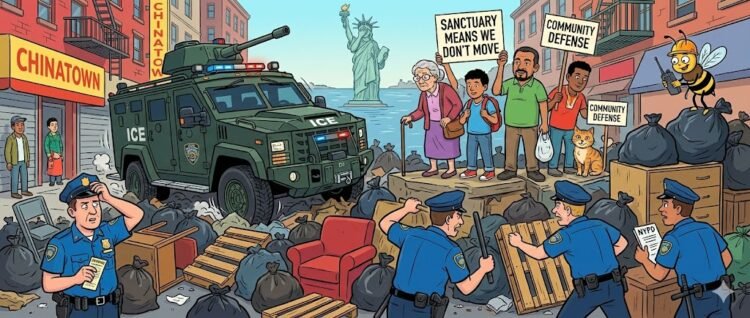
If you want to understand the current state of American immigration policy, do not look at the statute books or the federal register. Look at a pile of trash bags on Centre Street. On the weekend of November 29, that refuse pile became the most effective border wall in the United States, a tactical fortification erected by a coalition of grandmothers, students, and elected officials to trap a convoy of federal agents inside a parking garage. It was a perfect, smelling-salts moment for a city that loves to call itself a “sanctuary” right up until the moment the rubber meets the road, or in this case, the moment the NYPD meets the people trying to stop the rubber from leaving the garage.
The scene in Chinatown was less a law enforcement operation and more a piece of avant-garde performance art about jurisdictional confusion. Agents from Immigration and Customs Enforcement, presumably fresh off their strategy meetings about how to look tough for the cameras, attempted to exit their lair to conduct a raid. They were met not by a welcoming committee, but by a blockade of New Yorkers who had decided that “sanctuary” is a verb, not just a sticker on a bodega window. The protesters, armed with nothing but their bodies, their lungs, and the aforementioned debris, turned a routine extraction mission into a weekend-long standoff that exposed the hollow core of our civic compromises.
This theater of the absurd follows an October dress rehearsal where federal agents swept through Canal Street to arrest counterfeiters, a crackdown that managed to detain a dozen people and terrify a neighborhood while doing absolutely nothing to stop the global trade in fake Gucci bags. That operation was the prelude. This weekend was the main event. It featured a star-studded cast of local resistance figures, including Public Advocate Jumaane Williams and the New York Immigration Coalition’s Murad Awawdeh, rallying on Howard Street to remind the city that “protection” is supposed to mean something more than “we promise not to ask for your papers while we hold the door open for the guys who do.”
The official narrative from the Department of Homeland Security is that they were besieged by “violent agitators” who endangered officers. This is a fascinating use of language. In the DHS lexicon, “violence” apparently includes standing in front of a van and shouting. It transforms the act of civil disobedience into a tactical threat, justifying the deployment of pepper spray and batons against people whose primary weapon was a wooden pallet and a deep sense of betrayal. The “agitators” included Hannah Stauss of Hands Off NYC and a collection of locals who seem to have missed the memo that they are supposed to be terrified of the federal government, not inconvenienced by it.
But the real satirical meat of the weekend lies in the behavior of the New York Police Department. Commissioner Jessica Tisch and her department have been playing a high-stakes game of “Don’t Look at Me.” The NYPD insists, with a straight face that deserves an Academy Award, that they do not coordinate with ICE. They claim they do not enforce civil immigration law. And technically, if you squint until your eyes water, this is true. They don’t check visas. They just arrest the people trying to stop the people who check visas.
It is a distinction without a difference. When the NYPD clears the street for an ICE convoy, shoving protesters out of the way and spraying chemical irritants into the crowd, they are functioning as the heavy cavalry for the deportation machine. They are the offensive line blocking for the federal quarterback. The fact that they aren’t technically holding the ball doesn’t mean they aren’t part of the play. This is the “Tisch Paradox”: a police force that is simultaneously sworn to protect the city’s immigrant population and operationally committed to crushing anyone who tries to physically protect that same population from federal abduction.
The fallout from this clash is already rippling through the political ecosystem like a shockwave in a sewer. We are looking at a near-term future filled with legal skirmishes that will test the limits of the First Amendment and the patience of the voting public. The NYPD has arrested several people—police sources murmur about “double digits”—but has been characteristically vague about the formal charges. We can expect a litany of “obstructing governmental administration” and “disorderly conduct” counts, the catch-all categories used to criminalize inconvenience.
These charging decisions are not just legal maneuvers; they are political grenades. Every prosecutor who signs off on these complaints is effectively taking a side in the war between the city’s values and its enforcers. Every judge who hears these cases will have to decide whether a pile of garbage used to stop a deportation van is a weapon or a shield. It sets up a civil suit bonanza where the city will likely pay millions to settle claims of excessive force, a hidden tax we pay for the privilege of having a police force that acts like a private security firm for the feds.
For Mayor-elect Zohran Mamdani, this is the nightmare scenario. He ran on a platform of affordability and justice, promising to be the anti-Adams. Now he faces a city where his own police department is macing his base to clear a path for Donald Trump’s deportation force. He has to navigate a landscape where his “cordial” meeting with the President is being replayed on loop while his constituents are being dragged off Centre Street in zip ties. It is a stress test for his administration before it even begins. Can he rein in the NYPD? Can he actually enforce the “sanctuary” laws in a way that stops the cooperation, or is he destined to be another mayor who issues stern press releases while the precinct captains do whatever they want?
The broader implication is that we have entered an era where the law is secondary to the spectacle. The federal government uses raids not just to enforce the law, but to create content. They want the images of the agents in tactical gear. They want the fear. And the resistance has responded in kind. The blockade is not just a tactical maneuver; it is a counter-spectacle. It is a way of saying, “If you want to do this, you are going to have to do it on camera, and you are going to have to look like the bad guys while you do it.”
It raises the uncomfortable question of whether public spectacle or civic law will ultimately decide who is protected and who is criminalized. Right now, the law is a mess of contradictions. The sanctuary statutes say one thing; the “Criminal Illegal Alien Act” says another. The Constitution says we have the right to assemble; the NYPD patrol guide says they have the right to clear the street. In the absence of legal clarity, the street becomes the courtroom. The verdict is rendered in real-time by who holds the ground and who holds the camera.
We are left with the image of a city at war with itself. We have a government that claims to welcome immigrants and a police force that treats their defenders as enemies of the state. We have federal agents who act like an occupying army and locals who treat them like one. And in the middle, we have the immigrants themselves, the people whose lives are being debated, detained, and discarded, watching as their neighbors build barricades out of trash to buy them one more night of freedom.
The “Golden Door” has been replaced by a garage door in Chinatown. And the only thing keeping it shut is the stubborn, chaotic, beautiful refusal of New Yorkers to let the machine run smoothly. It is a messy, dangerous way to run a democracy, but right now, it is the only defense we have. The sanctuary isn’t in the law books. It’s in the garbage pile. And God help us if they ever clear the street.
Receipt Time: The Cost of the Show
The most cynical part of this entire affair is the realization that the federal government wants the resistance. They want the footage of the “agitators.” It feeds their narrative of lawless cities and radical leftists. DHS accusing the protesters of being “violent” is not a complaint; it is a marketing strategy. It justifies the next budget increase. It justifies the next deployment of the National Guard. They are goading the city into a fight because they believe they can win the optical war, even if they lose the tactical one. But they underestimate the endurance of a city that deals with rats, rent hikes, and the L train every day. We are used to things that don’t work. And we are very good at making sure they don’t work for you, either.