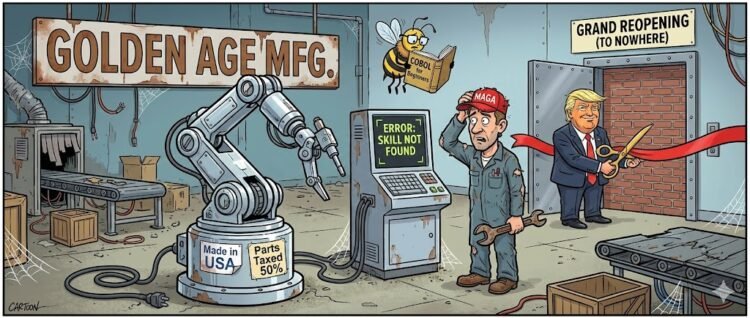
Eight months ago, we were promised a manufacturing miracle. We were told, with the kind of decibel level usually reserved for monster truck rallies, that aggressive import taxes would be the adrenaline shot that brought American factories “roaring back” to life. The logic was simple, loud, and beautifully wrong: slap a tariff on everything that crosses the border, and suddenly, magically, Pittsburgh becomes a steel titan again, Detroit rebuilds itself overnight, and the American worker is restored to the golden age of a single-income mortgage. It was a compelling story, the kind of economic fan fiction that feels good until you actually have to pay the bill.
But here we are, less than a year later, and the roar has turned into a whimper. For the first time since the pandemic paralyzed the global economy, blue-collar employment is falling. We haven’t just stalled; we are sliding backward. Roughly 59,000 industrial jobs have vanished into the ether, a statistical casualty count that no amount of rally rhetoric can obscure. Manufacturing payrolls are down about 49,000 since January, a grim slide that defies the “boom” narrative being sold from the podium. The engine of the American recovery isn’t roaring; it’s seizing up, choked by the very policies that were supposed to lubricate it.
The tragedy is that this isn’t happening because nobody wants to hire. It’s happening because the strategy is fundamentally broken. There are currently more than 400,000 unfilled openings in the sector, a gaping hole in the workforce that speaks to a profound mismatch between the jobs we have and the people we have to fill them. We are trying to run a 21st-century industrial base with a policy playbook from 1985, and the result is a paralyzed supply chain and a workforce that is being left behind.
Take Viega’s plant in Ohio. This should be the poster child for the manufacturing revival—a facility making high-quality pipe fittings, exactly the kind of “real stuff” we are supposed to be building here. Instead, they are struggling to staff automation-heavy lines because the local workforce hasn’t been trained to run the robots. And to add insult to injury, they are paying more for the imported machine tools and components they need to actually do the manufacturing. Why? Because the same broad-based tariffs that were allegedly meant to “reshore” production are still slapped on the very foreign equipment a factory revival needs to buy. We are taxing the bricks we need to build the house.
Economists and workforce experts have been screaming that this isn’t a mystery; it is simple arithmetic. You cannot tax your way to prosperity when your domestic supply chain relies on global components. Broad-based tariffs function as a stealth tax on U.S. producers and households. One estimate puts the cost at more than $5,000 a year per family—a brutal, silent levy that eats into grocery budgets and rent payments while doing absolutely nothing to reverse offshoring. In fact, it often accelerates it, as companies look for cheaper places to operate where they don’t have to pay a premium just to import a drill press.
While the administration was busy building a tariff wall, they were simultaneously dismantling the ladder that workers need to climb over it. Donald Trump has scrapped key clean energy subsidies, the very incentives that were driving investment in the battery plants and solar factories of the future. He has left “Make America Skilled Again” style programs withering on the vine, chronically underfunded at the precise moment when modern manufacturing jobs demand technicians who are literate in robotics, PLCs, and AI.
We are trying to staff smart factories with a workforce policy designed for assembly lines that don’t exist anymore. The modern factory floor is not a place for a hammer and a wrench; it is a place for a tablet and a diagnostic tool. It requires a level of technical proficiency that isn’t acquired by osmosis. It requires training, apprenticeship, and investment. Instead, we got a bumper sticker slogan and a tax hike.
There are serious proposals on the table, of course. Experts are begging for a reauthorization and expansion of the Workforce Innovation and Opportunity Act. They are calling for union and employer-backed credential pipelines, for robust community college partnerships that actually connect curriculum to careers. But these boring, effective solutions are being drowned out by the noise of rallies about a coming “Golden Age.” The political narrative is obsessed with ribbon cuttings and reshoring photo ops, ignoring the structural rot underneath.
We are left with a surreal industrial landscape: record spending on the shells of smart factories that no one is trained to run, filled with expensive machines that cost a fortune to import, producing goods that are increasingly unaffordable to the average consumer. We are building cathedrals to manufacturing and forgetting the congregation. The “renaissance” is a ghost town.
The Part They Hope You Miss
The most cynical aspect of this failure is the silence regarding the “skill premium.” By cutting funding for training while driving up the cost of goods, the administration is effectively engaging in a double assault on the working class. They are making it harder to get a good job and harder to afford life on the wages of a bad one. The “protectionism” was never about protecting the worker; it was about protecting a nostalgic aesthetic of industry that flatters the ego of the leader while hollowing out the bank accounts of the people he claims to serve. The factories may be coming back in press releases, but the future—the one where a family can cover rent, groceries, and a dignified life—is moving further out of reach.