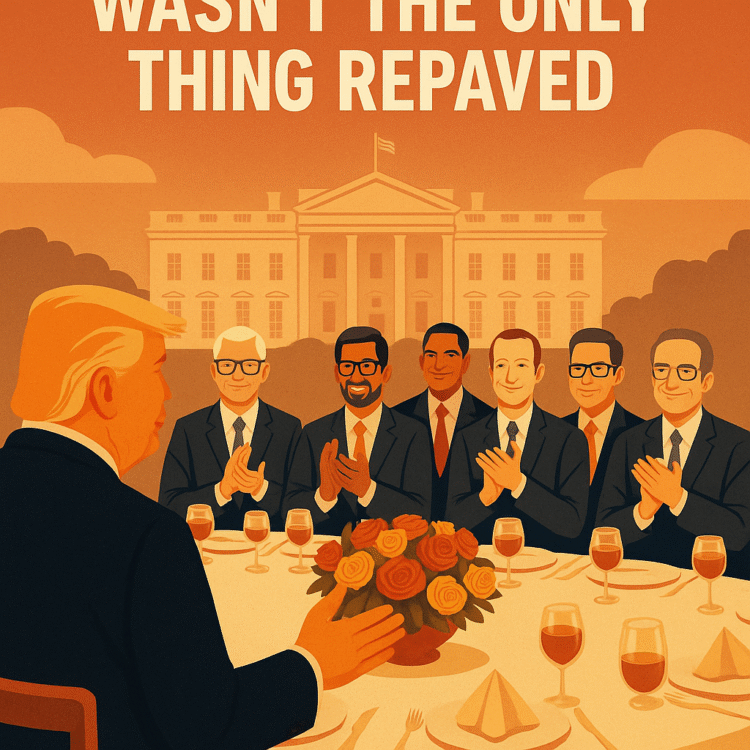
On September 4, 2025, President Trump staged what the official invite called a “White House dinner to celebrate American innovation.” What actually unfolded was a glossy loyalty ritual with better catering. The guest list read like a Silicon Valley shareholders’ meeting relocated to Washington: Tim Cook, Sundar Pichai, Sam Altman, Mark Zuckerberg, Satya Nadella, Arvind Krishna.
It was supposed to happen in the newly repaved Rose Garden—an allegory that wrote itself—but the weather refused to cooperate. So the whole event moved indoors, proving once again that even nature resists being choreographed. No matter. The optics held: Big Tech bosses lined up like groomsmen at a wedding they couldn’t object to, each delivering toasts about Trump’s “pro-AI agenda” while waiters circulated with plates of salmon.
If you blinked, you might have mistaken it for an industry conference. If you stared, you realized it was something stranger: a loyalty ceremony disguised as industrial policy, where titans of tech auditioned to be on the right side of the algorithmic throne.
Industrial Policy as Dinner Theater
Trump billed the evening as proof of his administration’s commitment to AI and chip manufacturing. The CEOs billed it as an opportunity to announce splashy pledges: billions in U.S. investment, job training programs, “AI in schools” initiatives. It looked good on camera, and that was the point.
Policy was secondary. What mattered was the optics of contrition: men who once postured as independent visionaries now queued up to praise a president who treats infrastructure ribbon-cuttings as personality cult rituals.
It was industrial policy as dinner theater. The Rose Garden wasn’t just repaved. Deference was, too.
The Zuckerberg Roast
There was, of course, some ribbing—Trump joked about Zuckerberg’s haircut, as though that weren’t already America’s longest-running meme. The room laughed dutifully. When a president jokes about you, you laugh, no matter how hollow the punchline. It was the kind of comedy that works only when the alternative is awkward silence.
That’s the lesson of these dinners: levity is not a mood. It’s a survival strategy.
The Missing Musk
Noticeably absent was Elon Musk. Once Trump’s favorite tech apostle, now his estranged rival, Musk’s empty chair said more than any speech. Public rifts in oligarchy are always revealing: not everyone can share the same gilded table. Musk had become the ghost of what happens when loyalty curdles.
The other CEOs noticed. They didn’t mention him. You don’t mention the excommunicated at a loyalty dinner.
AI for Schools, or Schools for AI?
Earlier that day, the First Lady had presided over an “AI Education Task Force” roundtable. The idea: integrate AI tools into classrooms. The reality: integrate Silicon Valley into public schools with as few guardrails as possible.
Critics warned that the initiative looked like industry-written curriculum. But at dinner, no one was in the mood for warnings. The CEOs pledged their commitment to “AI literacy” while quietly salivating over an entire generation of children raised on branded homework.
Education, like everything else, had become a vertical to capture.
The Antitrust Amnesty
The subtext of the whole evening was clear: the administration isn’t interested in cracking down on Big Tech. Not really. Not while those companies are writing checks and building data centers that can double as campaign photo ops.
Antitrust is now a mood, not a policy. And the mood, as of September 4, was friendly. The CEOs didn’t just pledge investment. They pledged fealty. In return, they received something more valuable: amnesty.
The Pageantry of Praise
What struck me most watching the footage was the pageantry of it all. The way billionaires, men who command armies of engineers, softened their tone to praise Trump as though they were pitching a startup on Shark Tank. The words “visionary,” “bold,” and “historic” were deployed so often you could have mistaken the transcript for a campaign ad.
This wasn’t policy. It was choreography. And choreography doesn’t lie: the steps were designed to show who leads, and who follows.
Dinner as Algorithm
Think of it this way: the evening was a metaphor for the algorithmic age. Trump supplied the platform. The CEOs supplied the content. The audience supplied the data (cameras, clicks, headlines). The result was a loop of validation, each actor reinforcing the other until the line between governance and feed was erased.
Dinner wasn’t dinner. Dinner was the algorithm, served on fine china.
The Repaved Rose Garden
It matters that this was supposed to be in the Rose Garden. The space had been freshly paved, literally smoothed over, like the metaphor of a leader constantly resurfacing old ground to make it look new.
That the event had to move indoors was almost poetic. Even nature refused to cooperate with the optics. The rain exposed the fragility of the performance: all the money, all the power, all the polish, undone by weather.
But indoors, the pageantry carried on. Because once you’ve invested in choreography, the show must go on.
Critics Outside the Gates
Outside the White House gates, critics called the dinner what it was: a loyalty ritual. Industry pledges scripted in advance. Investment announcements staged for cameras. The administration touting “data-center infrastructure” as if server farms were monuments.
Inside the gates, no one used the word “ritual.” Inside, it was simply called “policy.”
The Fragility of Applause
Watching the footage, I was reminded of how fragile applause can be. A room full of billionaires laughing at tepid jokes, clapping at scripted announcements, nodding in rhythm—it all looked like unity. But unity born of choreography isn’t unity. It’s compliance.
Applause fades. Compliance lingers. That’s the real exchange rate of these dinners: the optics of consent, purchased with silence.
The Haunting Close
On September 4, 2025, the White House didn’t just repave the Rose Garden. It repaved the relationship between power and industry. Big Tech pledged billions, but what it purchased was indulgence. Trump staged a loyalty ritual, and the titans of tech played their part.
The haunting truth is this: when billionaires bow at the same table, it’s not industrial policy. It’s choreography for an empire. And empires don’t collapse because of ridicule. They collapse because everyone inside the gates mistook applause for legitimacy, and no one noticed the rain outside.