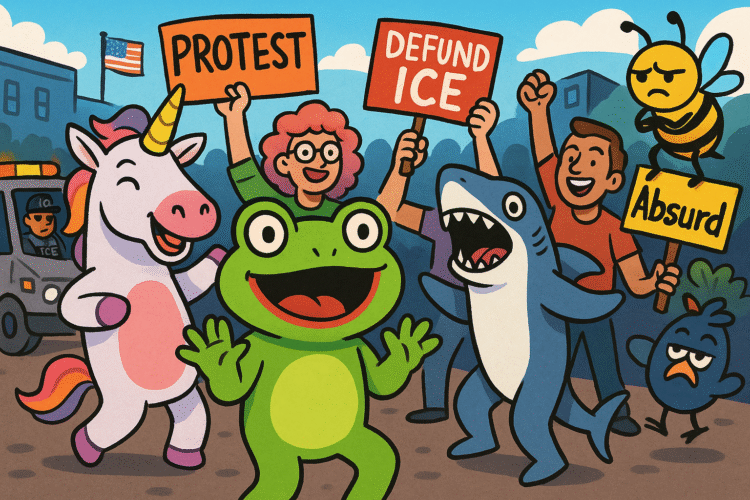
It’s 2025, and in Portland, resistance now comes with a soundtrack and a splash zone. The city once branded a “war zone” by right-wing commentators has become something else entirely—a performance art piece starring inflatable amphibians, unicorns, and a surprising number of sharks.
The Portland ICE facility—once the backdrop for grim standoffs and militarized optics—has been transformed into a scene out of a fever dream designed by Jim Henson and Hannah Gadsby. As the administration warns of chaos, the city replies with choreography. It’s not defiance through destruction—it’s defiance through dance.
The Protest Formerly Known as an Uprising
NBC News reports that local demonstrators, weary of being cast as villains in a dystopian reboot of Escape from Portland, decided to turn the script inside out. They showed up not in black bloc, but in bright green inflatable frog suits. They bounced, they shimmied, they flopped, they croaked.
When DHS called Portland a “security threat,” protesters built a chorus line of frogs doing the cha-cha. When ICE spokespeople talked about “domestic insurgents,” someone inflated a unicorn with a rainbow mane and handed it a cardboard sign reading, We Believe in Background Checks for Fairy Dust.
Within hours, footage of the “Portland Frog” went viral. TikTok, X, and Instagram lit up with loops of this neon-green amphibian twerking in front of an ICE van while a nearby protester, dressed as a shark, attempted to moonwalk. It’s hard to sustain a narrative of violent disorder when your supposed insurgents look like characters from Finding Nemo: The Resistance Years.
Fear as Farce
Authoritarianism thrives on spectacle—on the theater of fear. But what happens when the theater kids show up and rewrite the script?
The Trump administration’s playbook for 2025 has leaned heavily on visual control: uniforms, optics, and language like “blitz,” “mission,” “command.” Portland’s counter-play is absurdist. The frogs are not random—they’re symbolic. When power tries to look like a war movie, the protesters respond with a children’s cartoon.
It’s not chaos—it’s strategy. You can’t deploy the National Guard against inflatable frogs without looking like a parody of yourself. The moment troops start side-stepping unicorns on live television, authoritarian aesthetics collapse under their own weight.
And make no mistake, the absurdity is the point. As one local organizer told a reporter, “They can’t accuse us of rioting if we’re line-dancing.”
Law, Order, and Interpretive Dance
Of course, DHS and ICE aren’t laughing. Officials insist the humor “masks coordinated extremism.” But courts, civil-rights groups, and the public are seeing something different: protected speech, creative expression, and the purest example of the First Amendment doing jazz hands.
Portland’s frog parade is not a distraction—it’s a legal firewall. Every spin, every honk of an inflatable nose, reminds federal agencies that expression is still constitutionally protected, even when it’s ridiculous.
It’s difficult to justify kettling a conga line.
Meanwhile, city officials, used to managing both protests and art festivals, note that the frog marches have seen fewer arrests than a typical Blazers home game. The only injuries so far involve one deflated shark and a unicorn costume that briefly got tangled in a stop sign.
Operation Midway Blitz Meets the Muppet Rebellion
To understand why this matters, rewind a few weeks to “Operation Midway Blitz,” the administration’s national immigration crackdown. In Chicago, it led to lawsuits and injunctions. In Portland, it inspired street theater.
Federal agents in tactical gear patrolled the ICE facility like it was a warfront. Drones hovered overhead. Commentators described “anarchist swarms.”
Then came the frogs.
And suddenly, the imagery shifted. Instead of danger, viewers saw whimsy. Instead of enemies, neighbors. Instead of chaos, choreography.
It was a political jujitsu move—one that turned fear into farce.
The crowd sang. They danced. They carried signs reading, Amphibians Against Authoritarianism and Hop Out of Fascism. Even the police couldn’t help cracking a smile. When laughter enters the equation, intimidation loses its grip.
The Political Value of Ridicule
Humor has always been the kryptonite of autocrats. Laughter disarms power because it denies it reverence. When people mock your uniforms, your slogans, your sacred rhetoric, you lose control of the stage.
That’s what’s happening in Portland. Every inflatable costume is an act of narrative sabotage.
The administration wants footage of chaos for campaign reels; instead, it gets frogs flossing in slow motion. It wants talking points about “lawless radicals”; instead, it gets children’s characters protesting immigration raids. It wants fear—and the crowd gives it whimsy.
Even conservative outlets struggled to spin the imagery. One host on a right-wing network sighed mid-broadcast: “They’re literally… hopping.”
DHS vs. Daffy Duck
Department of Homeland Security officials reportedly considered labeling the protest “coordinated performance interference.” Translation: they’re trying to make musical satire illegal.
But civil-rights lawyers are having none of it. The ACLU filed a brief comparing the frogs to political puppetry traditions dating back to Bread and Puppet Theater and the Yippies of the 1960s. The argument is elegant: when the state brings tanks, bring tinsel.
That logic has spread. Across Oregon and Washington, pop-up protests have adopted the same tone—“Clown the Crown,” “Jesters for Justice,” “Mime the Line.” If power insists on pageantry, resistance will match it with parody.
When the Cameras Turn Back
The genius of the Portland Frog isn’t just its humor—it’s its virality. Within days, the clip became a meme used to puncture fearmongering in every city under “Operation Midway Blitz.” When conservative influencers tweeted about “lawless mobs,” users replied with looping GIFs of dancing frogs and captions like, Ribbit, not riot.
It’s the 2025 version of political satire: you don’t argue with propaganda, you out-meme it.
By the time DHS issued a statement calling the demonstrations “unhelpful to law enforcement,” late-night shows had already turned the frog into a recurring bit. Trevor Noah did a segment called “Leap of Faith: The Amphibian Revolution.”
The more the administration tried to dignify its crackdown, the sillier it looked.
The Absurd Resistance
This isn’t just Portland being Portland. It’s democracy remembering how to laugh at tyranny.
Humor doesn’t minimize injustice—it exposes it. When people in power inflate their own importance, laughter pops the balloon. When officials threaten to send troops into a city of unicorns, they don’t look strong—they look unhinged.
One Portland protester summed it up perfectly while adjusting the zipper on his frog suit:
“If they’re gonna treat us like cartoons, we might as well write the script.”
And that’s the heart of it. Authoritarians can control the police, the courts, and the airwaves—but they can’t choreograph joy.
What Happens Next
Officials expect more protests this weekend, possibly larger and more organized, with music, costumes, and themed marches across the Pacific Northwest. City leaders are preparing for crowds but anticipate minimal conflict.
The bigger test lies in Washington. If the administration doubles down—if it tries to criminalize humor or escalate force—it will only magnify the absurdity.
Imagine National Guard units tiptoeing past giant inflatable sharks while a brass band plays Yakety Sax. Even the Constitution would blush at the irony.
Meanwhile, watchdog groups and congressional committees are calling for oversight hearings on “force posture and protest characterization,” which is bureaucratic for “stop pretending performance art is an insurrection.”
The courts are already on edge from the Chicago case, the shutdown lawsuits, and the DOJ’s internal chaos. The last thing Washington needs is video evidence of soldiers tripping over inflatable frogs.
The Power of the Ridiculous
Portland has always understood performance as politics. This is the city that stages poetry slams in parking lots and drag brunches in libraries. It knows that sometimes, the fastest way to puncture power is to make it laughable.
The “war zone” narrative depends on fear. Fear depends on control. Control collapses when people start dancing.
It’s no coincidence that every totalitarian regime in history fears art. Art reminds people that reality can be rewritten. That stories can be mocked. That even tanks can be props.
And in this moment—this fragile, furious 2025—humor is the last working immune system of democracy.
Closing Reflection: THE SOUND OF LAUGHTER IN A POLICE STATE
When historians look back on 2025, they might not remember the policies or the lawsuits. They’ll remember the frog.
They’ll remember a city that was told to be afraid and decided to dance instead.
They’ll remember how the state called it “unrest,” and the people called it “rehearsal.”
They’ll remember how fear tried to take the streets—and joy beat it to the punchline.
If power is theater, then protest must be art.
And in Portland, at least for now, the show goes on.