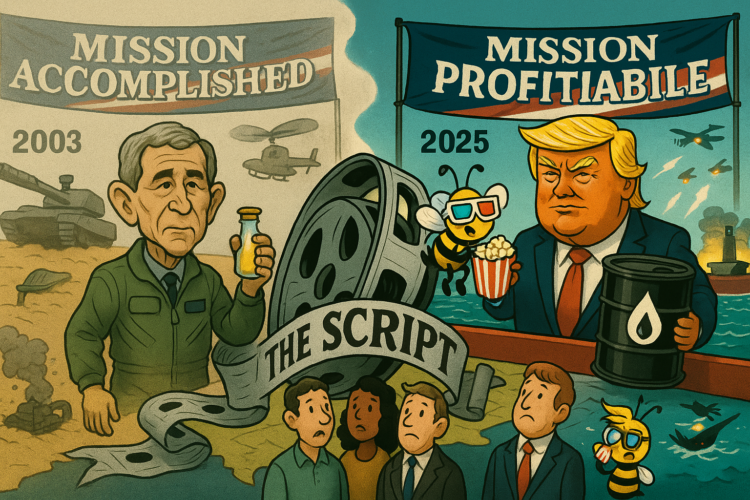
We have seen this movie before, and spoiler alert: the ending involves a lot of sand, a lot of blood, and absolutely zero refunds.
The American military machine has always had a flair for the cinematic, but the recent seizure of the oil tanker Skipper off the coast of Venezuela felt less like a naval operation and more like the cold open of a Michael Bay movie financed by the Republican National Committee. You could almost hear the director shouting “Action!” as the helicopters swarmed and the Marines fast-roped onto the deck. President Trump, watching the feed like a proud producer, bragged about the size of the haul and cracked a joke that landed with the subtle grace of a bunker buster: “When it comes to the oil, we keep it, I guess.” It was a moment of perfect, unscripted honesty in an administration that usually treats the truth like a contagious disease. We aren’t just policing the seas anymore. We are pirating them. And we are doing it with a smile.
But as the adrenaline fades and the B-roll footage loops on cable news, a strange and unsettling feeling should be creeping up the spine of anyone old enough to remember the year 2003. It is the distinct, metallic taste of déjà vu. We have been here before. We have stood on this precipice, listening to confident men in suits tell us about a faraway threat that requires immediate, kinetic intervention. We have heard the promises of a quick victory. We have seen the grainy photos and the scary diagrams. The only difference is that twenty years ago, the script was about “Weapons of Mass Destruction” in the desert. Today, the script has been hastily rewritten. They scratched out “Iraq” and penciled in “Venezuela.” They swapped “Saddam” for “Maduro.” And they replaced “chemical weapons” with “narcoterrorism.” But make no mistake: it is the exact same screenplay, right down to the part where they promise the war will pay for itself.
The Split Screen of History
Imagine, if you will, two timelines playing side by side on a giant monitor in the Situation Room. On the left screen, it is early 2003. Colin Powell is holding up a vial of anthrax (or a model of one) at the UN. We are looking at blurry satellite photos of “mobile biological weapons labs” that look suspiciously like milk trucks. The airwaves are filled with talk of aluminum tubes and yellowcake uranium. The phrase “mushroom cloud” is being deployed like a tactical nuke to shut down any conversation about containment or diplomacy. We are told that Saddam Hussein is a madman, an irrational actor who is sitting on a stockpile of doom and is moments away from handing it to Al Qaeda.
Now look at the right screen. It is late 2025. The satellite photos are now 4K drone feeds of “narco-subs” and “go-fast boats.” The scary vial of anthrax has been replaced by a baggie of fentanyl. The aluminum tubes are now “AIS spoofing devices” on oil tankers. The rhetoric is identical. We are told that the Maduro regime is a “narco-state,” a criminal enterprise masquerading as a government that is flooding American streets with poison. We are told they are aided by “shadowy foreign backers”—read: Iran and Russia—and that every shipment of cocaine is not just a crime, but an act of war. The intelligence leaks are flowing again, anonymous whispers from “senior officials” painting a picture of a dark alliance that threatens the homeland.
The parallels are not subtle. They are screaming. In both versions of the story, the enemy is a cartoon villain, a caricature of evil who cannot be reasoned with, only destroyed. In Iraq, Saddam was the new Hitler. In Venezuela, Maduro is the new Escobar, but with an army. In both cases, the intelligence is cherry-picked to fit the conclusion. The doubts of experts are dismissed as naivete. The skeptics are labeled unpatriotic. And the public is fed a steady diet of “new revelations” that always seem to point in exactly one direction: south, towards the Caribbean, with a loaded weapon.
The Sloganeering of Fear
The sales pitch for this new adventure relies on the same emotional levers that sold the last one. In 2003, the mantra was, “We do not want the smoking gun to be a mushroom cloud.” It was a brilliant line. It bypassed the logic center of the brain and went straight to the amygdala. It made debate feel like suicide. If you questioned the war, you were essentially saying you were okay with a nuclear detonation in Manhattan.
Today, the slogan has been updated for the opioid era. “We cannot wait until fentanyl kills every American child.” The mechanism is the same. It weaponizes grief and fear to silence dissent. If you question the wisdom of bombing Venezuelan ports or seizing their ships, you aren’t just a dove; you are complicit in the overdose deaths of teenagers. The connection between a boat in the Caribbean and a tragedy in Ohio is drawn with a thick, black Sharpie, ignoring the complex web of supply chains, demand, and domestic policy failures that actually drive the crisis.
The Iraq sales job leaned heavily on the trauma of 9/11. It fused Saddam Hussein and Osama bin Laden in the public imagination, despite there being zero evidence of a collaboration. The Venezuela sales job leans on the trauma of the overdose epidemic. It blurs the line between independent cartels, the Venezuelan state, and random smugglers until they are all one monolithic enemy. It flattens the world. There is no nuance. There are no competing factions. There is just “The Threat,” and “The Solution.” And the solution always involves high explosives.
The Myth of the Cakewalk
Perhaps the most dangerous echo of the Iraq era is the promise of the “easy war.” Remember the “cakewalk”? Remember how we were told that U.S. troops would be greeted as liberators? We were promised that the war would be quick, surgical, and cheap. We were told that Iraq’s oil wealth would pay for its own reconstruction. It was going to be a self-funding liberation, a venture capital project with tanks.
Listen closely to the rhetoric around Operation Southern Spear. We are being promised surgical boat strikes. We are being promised precision raids on “command nodes.” We are being told that a little bit of naval muscle will cause the Maduro regime to crumble and a democratic paradise to bloom in its place. And, most chillingly, we are being told that the operation pays for itself. The seizure of the Skipper and its two million barrels of oil is being dangled as proof. “We keep it, I guess.” It is the same fantasy of plunder-funded peacekeeping, repackaged for a new generation of suckers.
Generals and politicians are calmly assuring us that this is limited. They promise no boots on the ground (yet). They promise this is not a quagmire. But they said the same thing about Baghdad. They said the planners had it all figured out. They had PowerPoints. They had charts. They had the smartest guys in the room. And then reality intervened, as it always does, and the “cakewalk” turned into a decades-long march through hell.
The idea that you can destabilize a country, decapitate its leadership, and seize its primary economic engine without triggering a chaotic collapse is magical thinking. It assumes that Venezuela is just a gas station with a bad manager, and if we just fire the manager, the pumps will keep working. It ignores the militias, the factions, the foreign interests, and the sheer unpredictability of war. We are looking at the same PowerPoint slides from 2003, just with a tropical color scheme and a new font.
The Media’s Drumbeat
The media, God bless them, are playing their part in the remake with enthusiasm. In the run-up to Iraq, the networks developed a sudden fetish for dramatic graphics and countdown clocks. We had “Target: Iraq” segments with retired generals using laser pointers to show how easy it would be to invade. The skepticism was muted. The patriotism was loud.
Turn on the TV today. You see glossy 3D animations of “narco lanes” and “dark fleets.” You see anchors asking if the administration is being “too cautious” in its use of force. You see footage of boat strikes rolling on a loop, devoid of context, treated like sports highlights. The think tank experts who once sold democratization in the Middle East have rebranded themselves. Now they talk about “stabilizing the Caribbean security environment.” They use the same jargon. They have the same serious expressions. And they are selling the same snake oil.
Reporters who raise questions about proportionality or the long-term strategy are quietly relegated to the margins. The main shows are chasing ratings with explosions and presidential one-liners. It is a feedback loop of bellicosity. The administration feeds the media the visuals—the fast-roping Marines, the burning boats—and the media feeds the public the adrenaline. It is a symbiotic relationship that pushes the country closer to war, one segment at a time.
Regime Change by Any Other Name
Let’s be honest about the goal. In Iraq, the line was that Saddam had to go so democracy could bloom. In the Venezuela scenario, the line is that you cannot stop a “narco-state” without changing the state itself. The rhetoric tiptoes from “targeting smugglers” to “supporting democratic forces” to “ensuring a transition.” It is regime change in drag.
This transition is always described as inevitable and organic. We are told that the Venezuelan people are just waiting for a nudge. We are told that once the U.S. Navy shows up, the local population will rise up and overthrow the dictator. The phrase “they will greet us as liberators” hangs over the Caribbean like a ghost. It is the haunting refrain of American interventionism, the belief that everyone secretly wants to be us, and they will thank us for bombing their country to make it happen.
But history suggests that people generally do not like being bombed, even by people who claim to be helping. They do not like having their oil seized. They do not like having their sovereignty treated as a loophole. The assumption that we can break a country to fix it is the original sin of the Iraq War, and we are committing it again with our eyes wide open.
The Legal Elasticity
The legal justifications for this adventure are as stretchy as a pair of cheap yoga pants. In Iraq, creative lawyers tried to mash together old UN resolutions and new threat assessments into a retroactive permission slip for invasion. They argued that the war had actually been authorized ten years prior, or that the threat of WMDs created a new category of “preemptive self-defense.”
Now, we see the same gymnastics. The administration argues that existing counter-narcotics authorities, combined with anti-terrorism laws and sanctions enforcement, add up to a blanket right to sink boats, seize tankers, and conduct airstrikes in sovereign territory. They are building a legal franken-monster out of spare parts.
They argue it is preemptive self-defense against drugs. “If we don’t stop the boat here, the drugs will be in Chicago next week.” It is the domino theory applied to pharmacology. While the risk of drugs is real, the response is outsized. It is shaped by ideology, not proportionality. We are using a sledgehammer to kill a mosquito, and we are claiming the Constitution gave us the hammer.
This legal drift is dangerous. Once you establish the precedent that you can wage war on a country because of its exports, where does it stop? Do we bomb China for exporting precursors? Do we bomb Mexico for the labs? The logic of the “drug war” as an actual war has no boundaries. It turns the entire world into a battlefield where the only rule is American discretion.
The Erasure of the Human
Finally, we must look at who gets erased in this narrative. In Iraq, the lives of ordinary Iraqis were abstracted into “collateral damage.” We didn’t count the bodies. We didn’t tell their stories. They were just the scenery for our drama.
In this budding Venezuela campaign, the erasure is even more complete. The people on the small craft, the sailors on the tankers, the villagers near the coast—they are reduced to “narco-combatants.” This label is a magic wand. It waves away their humanity. It makes them permanently killable. It doesn’t matter if they are low-level mules forced into the trade by poverty. It doesn’t matter if they are just fishermen in the wrong place. Once the label is applied, their death is not a tragedy; it is a statistic of success.
Compare this to how we treat the powerful. When a banker launders drug money, they get a fine. When a politician takes a bribe from a cartel, they get a pardon. But when a nameless man in a fiberglass boat moves a kilo of cocaine, he gets a Hellfire missile. The double standard is blinding. We have created a two-tier system of justice where the rich get lawyers and the poor get kinetics.
This dehumanization is essential to the project. You cannot wage a war of choice if you acknowledge the humanity of the people you are killing. You have to turn them into monsters, or at least into targets. You have to make them part of the “threat,” indistinguishable from the drugs they carry.
The Sequel Nobody Asked For
Throughout all of this, the sense of déjà vu is not subtle. It is overwhelming. The staging, the language, the beats, the promises—it is all recycled. We are being sold a reboot of a disaster. We are watching the same actors read the same lines, expecting a different ending.
How many times are we going to fall for this? How many times are we going to let them tell us that this time, the war will be clean? This time, the intelligence is solid? This time, the oil will pay for it?
It is a grift. It is a long con played on a short memory. They are betting that we have forgotten the lies of 2003. They are betting that we are too distracted by the spectacle of the seized tanker to ask where this ship is actually heading.
The Warning Light
So here is the challenge. Notice the pattern. Don’t let it slide by in the background. Déjà vu is not a ghost; it is a warning light on the dashboard of democracy. When you hear the recycled phrases about threats that are “too serious for debate,” pay attention. When you see the carefully curated footage of enemies at sea, ask what is happening just out of frame. When every briefing insists that this will be limited, affordable, and morally pure, remember Baghdad.
The Iraq War left hundreds of thousands dead. It destabilized a region for a generation. It cost trillions of dollars. It broke the trust between the government and the people. And now, the same kind of people are pitching Venezuela as the next great action franchise.
Don’t buy the ticket. Don’t eat the popcorn. Because when the credits roll on this one, we already know who pays the price. The oil might be free, but the cost of the war never is.
We are standing at the threshold of another quagmire, and the only thing protecting us is our memory. Use it. Because if we let them rewrite the script again, we have no one to blame but ourselves when the ending turns out to be exactly the same tragedy we swore we would never repeat.
Receipt Time
The invoice for this geopolitical remake is already being printed. It includes a charge for “Willful Amnesia” and a surcharge for “Imperial Hubris.” The credit for “Oil Revenue” is pending and likely fraudulent. The total due is our conscience, our credibility, and the lives of people we will never meet but whose destruction we will fund. The sales pitch is slick, the trailer looks exciting, but we know this movie sucks. Let’s not watch it again.