There’s a certain irony in the fact that Americans can’t define “socialism” but they can sure yell it. It’s our national reflex: hear a policy that sounds vaguely public-minded, grab the nearest flag, and shout “Communism!” as if Khrushchev himself were hiding under your Medicare card.
So let’s do something rare for this political century—define the terms before we torch them.
What Democracy Actually Means (No, Really)
Democracy, in the literal sense, is a system where power flows upward. Citizens elect leaders through regular, competitive elections; those leaders make laws within constitutional limits; and individual rights are protected by a Bill of Rights that the majority doesn’t get to delete on a bad day.
In democracy, the government is accountable to the people. Not a king, not a corporation, not a party committee with secret ballots and loyalty oaths. You can vote them out, sue them, protest them, and meme them.
The Founders built this thing so voters could fire the help. That’s it. No divine right. No “Dear Leader.” No permanent ruling party.
So far, so simple—until the economic systems got involved.
Capitalism: The Loud Room Where the Money Talks
Capitalism, stripped of its romance, is private ownership of productive assets operating for profit in markets. You make, buy, or sell things; the prices are supposed to come from competition; and the government plays referee, not player.
Except that’s the theory. In practice, no country on Earth runs “pure” capitalism because “pure capitalism” collapses faster than a crypto exchange.
Every modern economy mixes market freedom with public regulation, central banking, safety nets, and public goods. Without that mix, capitalism eats itself. It’s like a shark—it swims fine until it stops moving, then it dies. And the moment it bites too many people, the people invent lifeboats.
So when someone shouts that America should have “real capitalism,” they mean an economy with all the guardrails removed—the kind that turns recessions into depressions, monopolies into monarchies, and inequality into a spectator sport.
Even Adam Smith had doubts about that one.
Socialism: Not One Thing, but a Spectrum
Socialism isn’t a single ideology—it’s a family reunion. At one end, you have mild social democrats who just want health care and pensions guaranteed; at the other, you’ve got authoritarian state-planners who think the best way to fix prices is to arrest the economists.
Broadly, socialism prioritizes social ownership or strong public steering of key sectors. The idea is to spread the benefits and risks of modern life so survival doesn’t depend on your boss’s mood or your zip code.
Communism, meanwhile, is the kid at that family reunion who got drunk on theory and stole the car.
Communism: The Dictator Wears Work Boots
Communism, as practiced—not as Karl Marx fantasized on parchment—means a one-party state that claims to speak for the workers while silencing the workers.
Private capital is abolished; the state owns the means of production; elections are for show; and independent unions, media, and courts vanish into slogans about unity.
The result? Famine, fear, secret police, and a five-year plan that mostly counts the dead.
If socialism is a theory of shared power, communism is the practice of stolen power.
Democratic Socialism: The Middle Child Who Pays the Bills
Now we reach the grown-up version: democratic socialism. Lowercase “d,” big picture.
It keeps markets for most goods—clothing, electronics, food, innovation—but guarantees that essentials like health care, education, retirement, and core infrastructure are decommodified. Meaning: you don’t lose them if you lose your job.
Government ensures those basics through public provision or strict regulation, all under the same constitutional checks, elections, and free press as any democracy. Funded by progressive taxes, run transparently, and debated in parliament instead of whispered through party lines.
In this system, your dialysis isn’t a profit center.
The U.S. Reality Check: We’re Already Doing It, We Just Don’t Admit It
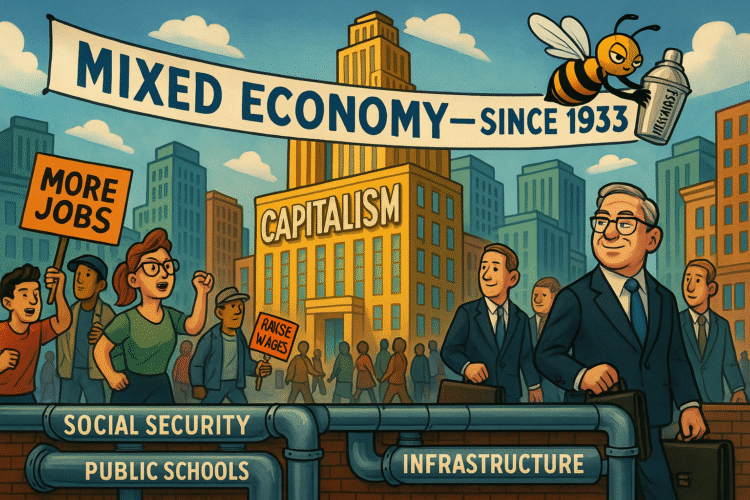
The punchline? America already runs on democratic-socialist plumbing beneath a capitalist skyline.
Take a stroll through our “socialist” infrastructure:
- Social Security – a national pension system.
- Medicare and Medicaid – public health insurance.
- The Veterans Administration – full-blown socialized medicine for millions.
- Public schools, community colleges, and universities – socialized education.
- The USPS – public logistics.
- Libraries and national parks – public culture and conservation.
- Roads, bridges, water, and sewer – public infrastructure.
- The FDIC – public insurance for your private deposits.
- FEMA, farm insurance, utilities co-ops – public risk-sharing in emergencies.
Each of these “socialist” programs underwrites the capitalist system that depends on stable consumers, educated workers, and functioning infrastructure.
It’s a mixed economy. Always has been. The only people pretending otherwise are the ones whose campaigns depend on pretending it’s 1984.
The Nordic Example: Where the Mix Works
When critics scream that “socialism never works,” they’re picturing Stalin, not Stockholm.
Modern social democracies—Sweden, Norway, Denmark, Finland, the Netherlands, Germany, France, Canada, New Zealand—blend capitalist dynamism with universal floors.
They’ve got competitive markets, world-class private sectors, and some of the happiest citizens on Earth. Their taxes fund single-payer or tightly regulated multi-payer health care, paid family leave, child allowances, active labor policies, and tuition-free education.
They rank high in entrepreneurship, freedom of the press, and political pluralism. And unlike America, their citizens don’t crowdfund insulin or GoFundMe their funerals.
In those societies, markets produce wealth. The public ensures that wealth doesn’t become a moat.
The Great American Confusion: Red Scare Residue
If all this sounds like common sense, you can thank a century of propaganda for convincing people otherwise.
The Red Scare didn’t end with McCarthy’s liver. It just rebranded.
In the early 1900s, the Palmer Raids rounded up immigrants for having the wrong pamphlets. In the 1950s, McCarthyism blacklisted writers, actors, and professors for being “subversive.” Loyalty oaths became litmus tests. Civil rights leaders were smeared as communists for daring to ask for equality.
Decades later, the tactic remains: shout “COMMUNISM!” whenever someone suggests feeding kids, regulating Wall Street, or expanding broadband.
It’s a rhetorical panic button that substitutes fear for debate.
The absurdity reached its peak when politicians called school lunches “socialist indoctrination” and pandemic unemployment aid “a Marxist experiment.”
Apparently, sharing is still a threat to civilization.
Authoritarianism ≠ Redistribution
Here’s the adult distinction: authoritarian communism suppresses pluralism; democratic socialism expands it.
Communism concentrates power in the party. Democratic socialism distributes it through elections and unions.
Communism censors the press; democratic socialism funds public media.
Communism nationalizes everything; democratic socialism regulates what matters and lets the rest compete.
Communism jails dissenters; democratic socialism votes them out.
If that sounds like splitting hairs, it’s because the American right has spent seventy years pretending the scissors don’t exist.
The Laissez-Fairy Tale
Then there’s the opposite fantasy—the myth of pure capitalism, sometimes called “laissez-faire,” which roughly translates to “let it burn.”
The idea is that government should do nothing but defend property rights, leaving everything else to “the market.” No labor laws, no safety nets, no public schools, no minimum wage.
But here’s the paradox: capitalism needs government more than any other system.
Without courts, you can’t enforce contracts. Without roads, you can’t deliver goods. Without education, you can’t produce skilled labor. Without the Fed, you can’t stabilize currency.
Even the most hardened libertarian depends on the public sector every morning—driving on public roads to deposit FDIC-insured money in a bank backed by a government lender of last resort.
So the real “laissez-faire” economy is a fairy tale—the kind where the dragon runs the stock exchange.
The American Status Quo: Mixed Economy in Denial
If you peel back the rhetoric, the United States already operates as a mixed economy: private enterprise with public scaffolding.
The problem isn’t the mix—it’s the hypocrisy. We socialize losses and privatize gains, then pretend the whole arrangement is rugged individualism.
When banks fail, taxpayers rescue them. When workers strike, the government lectures them. When corporations demand subsidies, it’s “innovation.” When families need food stamps, it’s “dependency.”
We don’t hate socialism; we just hate when it’s aimed at the poor.
Freedom, Defined for Adults
Freedom isn’t the absence of government—it’s the presence of options.
If your survival depends on keeping a bad job because your insulin is tied to your employer’s insurance, you are not free. If your retirement depends on the market never sneezing, you are not free.
A democracy that guarantees basic survival isn’t taking freedom away—it’s giving it back.
The right likes to quote Reagan’s line that “government is the problem.” But the people chanting that line still cash Social Security checks, send their kids to public schools, and drive on publicly paved roads.
They just prefer their socialism anonymous.
Markets Know How to Sell, Not How to Save
Markets are brilliant at some things. They make iPhones, sneakers, electric cars, and celebrity energy drinks. But they’re terrible at public goods—things we all need but no one can profit from directly.
Markets don’t build levees, vaccinate populations, or maintain national parks. They don’t ensure herd immunity or equal education. They can’t price justice, dignity, or clean water.
A well-run democracy keeps markets doing what they’re good at—innovation—and regulates what they’re bad at—survival.
That’s not socialism. That’s sanity.
The Policy Chart (Without the PowerPoint)
Let’s turn the ideological soup into something readable:
- Democratic Socialism: ballot-box, pluralist, constitutional democracy. Markets for most goods. Public or nonprofit provision for basics. Funded by progressive taxes. Transparent governance. Independent unions and courts.
- Communism (as practiced): one-party rule, censorship, nationalized everything, secret police. No opposition, no market.
- Laissez-Fairy Capitalism: deregulate everything, hope markets self-correct, pretend recessions are moral lessons.
- The American Status Quo: a mixed economy pretending it isn’t, where social insurance props up capitalism while politicians deny it exists.
History’s Quiet Truth: We Already Chose the Middle
Since the New Deal, America has lived in the middle lane. We regulate banks, insure deposits, subsidize farms, fund science, and guarantee retirement income. None of it is “radical.” It’s infrastructure.
When Medicare passed in 1965, conservatives called it socialism. Today, voters call it sacred. The same will be true of universal health care or child allowances if we ever stop performing Cold War cosplay long enough to pass them.
Freedom Without Fear
The real democratic dream is simple: freedom from tyranny and freedom from desperation.
Freedom of speech means nothing if you can’t afford medicine. Freedom of religion means little if you lose your job for praying differently. Freedom to work means less if every employer can hold your health hostage.
Democracy thrives when people aren’t choosing between rent and insulin.
The Right’s Favorite Reflex
“Communism!” they cry, every time someone suggests a public good. Paid leave? Communism. Student debt relief? Communism. Minimum wage hike? You guessed it.
It’s a Pavlovian bark—an allergic reaction to empathy.
But calling everything “communist” doesn’t make capitalism work better. It just makes conversation impossible.
The Adult Answer
The adult answer is boring, pragmatic, and real: the healthiest societies are mixed economies with democratic institutions.
Universal floors plus competitive markets. Shared risk plus private innovation. Voters as the ultimate regulators.
A society strong enough to guarantee dignity and free enough to encourage ambition.
Think of it as a cocktail: the public keeps the shaker, the private sector brings the fizz, and the bartender is the voter—not the billionaire who bought the bar.
Final Pour: The Freedom Blend
The choice before us isn’t capitalism versus socialism. It’s arrogance versus balance.
State-run religion and one-party economics both crush minorities. Monopoly capital and deregulated greed do the same.
Freedom isn’t found in purity—it’s found in pluralism. In governments that can say no to billionaires, and citizens who can say no to the government.
So the next time someone screams “Communism!” at the thought of universal health care, remind them: the fire department is public. The roads are public. The parks are public. The flag they’re waving is publicly owned.
The question isn’t whether we want socialism—it’s whether we’ll finally admit we already have it, regulate it, and make it work for everyone.
Because democracy and capitalism, like gin and tonic, only function with the right ratio—and if you skip the tonic, all you’re drinking is poison.