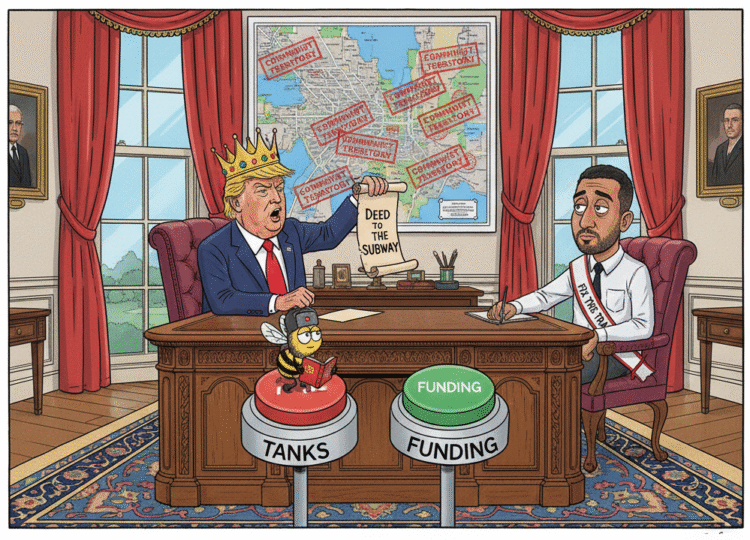
The intellectual architecture of the modern American right wing is built on a foundation of very specific, load-bearing misunderstandings, but none is quite as structural as their inability to distinguish between a democratic socialist and a Soviet commissar. To Donald Trump and the ecosystem that orbits him, there is no difference between wanting to fund the Metropolitan Transportation Authority and wanting to liquidate the kulaks. They are the same picture. This confusion reached its comedic apex on November 19, 2025, when the President took to Truth Social to announce that he has agreed to a benevolent audience with New York City’s newly elected mayor, Zohran “Kwame” Mamdani.
Trump referred to him, naturally, as the “Communist Mayor.”
The meeting, scheduled for Friday, November 21, in the Oval Office, is being framed by the White House not as a negotiation between a federal executive and a municipal leader, but as a sort of diplomatic summit with a hostile foreign power. It is a surreal tête-à-tête brokered only after Mamdani achieved a stunning victory over the ghosts of New York past—specifically the dynastic entitlement of Andrew Cuomo and the red-beret cosplay of Curtis Sliwa—on a platform of “relentless improvement.” That platform, which focuses on things like making the buses run on time and ensuring people can afford rent, has been translated by the Trump administration’s universal translator into “The Hunt for Red October.”
The absurdity of this moment lies in the specific vocabulary of the grievance. Trump has spent the campaign threatening to deport Mamdani, a Uganda-born citizen, send tanks down Fifth Avenue to restore order, and financially strangle the city for its adherence to “unconstitutional DEI principles.” Yet now, faced with a politician who actually won a mandate—Mamdani secured forty percent of the vote in a crowded field—Trump is pivoting to the role of the magnanimous king. He is signaling a willingness to “work something out,” a phrase that in Trump-speak usually means “I will give you your own money back if you say something nice about me on television.”
The distinction between socialism and communism is a matter of political science, history, and economic theory, which is exactly why it has no place in the Oval Office. To the current administration, “socialism” is when the government does things they do not like, and “communism” is when the government does things they really do not like. Mamdani’s brand of democratic socialism, which involves using tax dollars to fund public services rather than tax cuts for private equity, is viewed as an existential threat to the republic. It does not matter that Mamdani is trying to restore tens of millions in SNAP funding that the administration vindictively slashed in a “sanctuary city” tantrum. To Trump, feeding the poor is a gateway drug to the Gulag.
This confusion serves a strategic purpose. By labeling Mamdani a “Communist,” Trump elevates a dispute over transit grants into a battle for the soul of Western civilization. It allows him to frame the withholding of federal funds not as a petty act of political retribution, but as a heroic containment strategy. He is not starving the MTA; he is sanctioning the Iron Curtain. The fact that this “Iron Curtain” runs along the Q line is a detail that his base is happy to overlook.
The policy stakes, however, are aggressively real. The administration has engaged in a systematic dismantling of New York’s federal support structures. They have “zeroed out” NYPD subway funding, a move that achieves the rare feat of defunding the police from the right, punishing the officers to spite the city. They have placed the Second Avenue Subway extension under “administrative review,” a bureaucratic euphemism for holding infrastructure hostage until the ransom is paid in political fealty. This is the “financial strangulation” Trump promised, executed with the dull precision of a budget line item.
Mamdani intends to walk into the Oval Office and press the President on these realities. He plans to leverage his “mandate for change” to extract federal affordability relief. He is bringing receipts, data, and the moral weight of a city that powers the national economy. But he is walking into a room where data is considered a sign of weakness and moral weight is measured in ounces of gold leaf. Trump does not care about the Second Avenue Subway. He cares about the optics of the meeting. He wants the image of the “Communist” bending the knee, or at least sitting on the sofa, acknowledging that the flow of federal dollars depends entirely on the mood of the man behind the Resolute Desk.
The friction here is that Mamdani is not Andrew Cuomo. He is not a transactional creature of the establishment who can be bought with a ribbon-cutting ceremony. He is an ideological opponent who views the President’s policies as an assault on his constituents. Trump, who understands only transaction and dominance, is likely to find this confusing. He is used to Democrats who feign outrage but cut the deal. He is unprepared for a “socialist” who actually believes in the social part of the contract.
The comedic tragedy is that Trump likely respects Mamdani more than he respected the Democrats he beat. Trump loves a winner, even a “Communist” one. He despises “losers” like Cuomo who feel entitled to power without fighting for it. There is a bizarre, twisted mutual respect in the “relentless” nature of both men. Trump campaigned on “relentless” grievance; Mamdani campaigned on “relentless improvement.” They are both battering rams, just pointed in opposite directions. Trump’s invitation is an acknowledgement that Mamdani is now a player on the board, a “boss” in the old New York sense, even if his politics are, in Trump’s mind, straight out of the Bolshevik playbook.
But let us not lose sight of the terminology. The right wing’s insistence on using “Communist” as a catch-all slur for “person who wants rent control” is a sign of intellectual decay. It flattens history. It erases the nuance of political thought. It turns governance into a cartoon. When Trump calls Mamdani a Communist, he is not making a political assessment; he is making a branding decision. He is pasting a scary red sticker on a policy dispute to justify his cruelty. If Mamdani is a Communist, then starving New York of transit funds is patriotic. If Mamdani is just a mayor trying to fix the trains, then Trump is just a bully withholding lunch money. The label is the shield.
The meeting represents a high-stakes collision of political opposites, but also a collision of realities. In Mamdani’s reality, the government exists to serve the people, to ensure that the subways run, the food stamps clear, and the rent is paid. In Trump’s reality, the government exists to serve the President, to reward friends, punish enemies, and generate content for Truth Social. These two worldviews cannot “work something out” because they are speaking different languages. One is speaking the language of civic duty; the other is speaking the language of a protection racket.
The trap for Mamdani is normalization. By sitting down with Trump, by participating in this “benevolent audience,” he risks validating the President’s power to withhold funds in the first place. He risks looking like just another petitioner at the court of the Mad King. But the alternative—letting the city starve—is unacceptable. This is the bind of the resistance in 2025. You have to engage with the arsonist to get the fire hose back.
As Friday approaches, the media will descend on the White House, breathless to cover the summit of the Capitalist and the “Communist.” They will parse every handshake and every grimace. But the real story will be happening in the background, in the subway tunnels where the signals are failing and in the grocery lines where the EBT cards are empty. The story is that the President of the United States is treating the country’s largest city like a conquered province, demanding tribute and fealty, all while shouting about a “Red Menace” that exists only in his own fevered imagination.
The Part They Hope You Miss
The most dangerous aspect of this farce is not the name-calling, but the “administrative review.” When Trump pauses the Second Avenue Subway or cuts transit security grants, he is establishing a precedent that federal funding is not a matter of law, but a matter of executive whim. He is asserting the power of the purse as a personal weapon. By framing the restoration of these funds as a “negotiation” with a “Communist,” he is normalizing the idea that basic infrastructure funding is contingent on the ideological purity of the local government. He is saying, quite clearly, that if you vote for a socialist, you don’t deserve a subway. This is not just a punishment for New York; it is a warning to every other city in America. The definition of “Communist” is elastic, and tomorrow, it might just mean you.
Receipt Time
We should not let the spectacle overshadow the specific, vindictive cuts that precipitated this meeting. The administration slashed tens of millions in SNAP funding. This is food out of the mouths of the poorest New Yorkers. They cut transit security grants. This is safety stripped from the millions of commuters Trump claims to care about. They zeroed out NYPD subway funding. This is the “Law and Order” President defunding the police because the police work for a city he dislikes. These are not abstract policy disagreements. These are direct attacks on the functionality of a major American metropolis. The fact that Trump is now willing to “work something out” proves that the cuts were never about fiscal responsibility. They were chips in a game, leverage created by inflicting pain on citizens, to be traded away for a photo op with a “conquered foe.” The cruelty was the point, but the transaction is the goal.