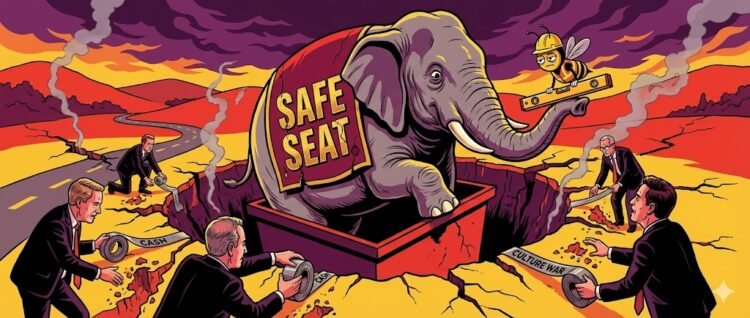
When a twenty-point lead evaporates into the margin of error, it is no longer an election but a structural stress test for a party running on fumes.
In the sanitized, color-coded maps of American political strategy, certain districts are not supposed to be battlegrounds. They are supposed to be fiefdoms. They are the deep-red bastions where the Republican Party can run a ham sandwich with a flag pin and expect a coronation by sundown on Election Day. Tennessee’s latest special election was scripted to be exactly that kind of boring, bureaucratic procession. It is a district that Donald Trump carried by a comfortable, almost sleepy twenty-two points just months ago. By every conventional metric of arithmetic and demography, the GOP candidate, Van Epps, should be measuring the drapes in his new office and ignoring his opponent’s existence. But politics has a nasty habit of ignoring the script.
Instead of a coronation, the GOP is staring down the barrel of a statistical tie. The latest Emerson polling has dropped like a frantic distress flare into the middle of the Republican National Committee’s lunch hour. It shows Van Epps clinging to a terrifyingly thin lead of 48 percent to the Democrat Behn’s 46 percent. This is the statistical equivalent of a heart murmur in a marathon runner who was supposed to be in peak condition. A district that was a fortress of MAGA inevitability has suddenly become a porous, leaking vessel, and the panic is palpable.
The national attention has swiveled to this slice of Tennessee with the speed of a predator sensing a limp. Big-name surrogates are parachuting in, sweating through their dress shirts as they try to rally a base that was supposed to be self-sustaining. The cash spigots have been wrenched open. The messaging has shifted from the lazy confidence of an incumbent power to the shrieking urgency of a campaign facing an existential threat. This is the kind of “all hands on deck” hysteria usually reserved for a wave election in a swing state, not a special election in a district where the pavement itself leans right.
The terrifying reality for the GOP strategists huddled in Washington war rooms is that the actual winner of this seat is almost irrelevant. Whether Van Epps squeaks by or Behn pulls off the upset of the cycle is a detail for the history books. The real story, the one that is causing ulcers from Nashville to D.C., is the signal. If a supposedly safe, structurally gerrymandered, Trump-tilted district can tighten to within the margin of error, then the map is not the map anymore. The map is a lie.
We are watching the fraying of the structural advantages that the modern Republican Party has banked its entire future on. They have relied on red maps drawn with surgical precision to insulate them from public opinion. They have relied on the massive advantage of incumbency and the crushing weight of low expectations for Democratic turnout in rural areas. But what happens when the insulation strips away? What happens when the voters who were supposed to stay home decide to show up? What happens when the message of grievance and retribution stops working its magic and starts sounding like background noise?
This Tennessee race is a laboratory experiment in political decay. It tests the hypothesis that you can run purely on culture war fumes forever without eventually stalling the engine. The 22-point Trump win in this district was supposed to be the floor, not the ceiling. For that margin to evaporate implies a shift in the atmosphere that goes beyond one candidate or one bad news cycle. It suggests that the enthusiasm gap, that elusive and precious commodity, has flipped.
When a party has to fight for its life in a safe seat, it is burning resources it cannot get back. Every dollar spent defending deep-red turf is a dollar not spent attacking a vulnerable Democrat in a purple suburb. Every hour a high-profile surrogate spends rallying the faithful in Tennessee is an hour they are not spending in Pennsylvania or Arizona. It is a resource drain that creates a cascading failure across the entire ecosystem. A narrow win here will read like a loss because it recalibrates the entire calculus for 2026.
If Van Epps wins by two points, the GOP cannot spin it as a victory. They have to explain where the other twenty points went. They have to explain why their brand, in the heart of their stronghold, is suddenly trading at a discount. It destroys the narrative momentum. Politics is largely a game of perception, a theater where you project strength to attract donors and demoralize opponents. A struggle win in Tennessee projects weakness. It smells like blood in the water.
This is the nightmare scenario for candidate recruitment. If you are a rising Republican star looking at the 2026 map, you want to run in a year where the wind is at your back. You do not want to run in a year where safe seats are becoming killing fields. The tightness of this race sends a message to every potential candidate that there are no free rides anymore. It tells them that the Trump endorsement might not be the golden ticket it once was. It tells them that the electorate is volatile, angry, and unwilling to be taken for granted.
Conversely, for the Democrats, this is pure oxygen. Even a close loss here is a proof of concept. It validates the strategy of contesting every seat, of showing up in the places where you are not supposed to win. It tells donors that their money isn’t being set on fire in red states, but is actually moving the needle. It energizes the volunteer base, the people who knock on doors and make phone calls, by showing them that the monolith can bleed.
The Emerson numbers are particularly damning because they show a collapse in the very demographics the GOP takes for granted. You cannot get to a 48-46 split in this district without losing a chunk of the white working-class vote, or suburban moderates, or both. It implies that the coalition is fracturing under the weight of its own contradictions. The “routine walk” has become a forced march through mud.
Consider the optics of the messaging being deployed. The GOP is treating this district like it is under foreign occupation. The rhetoric has ramped up to apocalyptic levels, painting the Democrat Behn not as a neighbor with different tax policies, but as an agent of civilizational collapse. This kind of hyperbole works when you are trying to turn out a low-information base in a national election. But in a local special election, where people actually know the candidates, it can backfire. It looks desperate. It looks like you are shouting because you have nothing to say.
The Van Epps campaign is trapped in a paradox. To win back the defectors, they need to pivot to the center and talk about local issues. But to turn out the base, they need to cling to the MAGA playbook and talk about national grievances. The result is a schizophrenic message that satisfies no one. They are trying to be everything to everyone and ending up as nothing to anyone. Meanwhile, Behn is running a campaign that seems to exist in the real world, talking about things that actually affect the lives of the people in the district. It is a radical strategy in modern politics: actually trying to solve problems.
The specter of 2026 looms over every handshake and every ad buy. The midterm elections are always a referendum on the party in power, or in this case, the party that perceives itself as the government-in-waiting. If the GOP cannot hold the line in Tennessee, how are they going to retake the Senate? How are they going to expand their map in the House? The math starts to look very ugly, very fast.
We are witnessing a stress test of the entire right-wing ecosystem. The media apparatus, the donor class, the consultant industrial complex—they are all throwing everything they have at this one seat. If they fail, or if they win by the skin of their teeth, it exposes the limits of their power. It shows that money and noise can only buy you so much. Eventually, you have to have a product that people want to buy.
The heavy early voting numbers are another ominous sign. High turnout usually favors the party with the enthusiasm, and right now, the enthusiasm is on the side of the people who smell an upset. The GOP relies on low-turnout special elections to sneak their candidates in. When the voters wake up and pay attention, the math gets harder. Democracy, it turns out, is the enemy of entrenched power.
There is a grim comedy in watching the national party establishment descend on a rural Tennessee district. It is like watching a SWAT team try to deal with a noise complaint. They are over-equipped, over-aggressive, and completely out of touch with the reality on the ground. They are bringing national talking points to a local knife fight. They are trying to nationalize a race that should be about potholes and schools. And the voters are looking at them with a mixture of confusion and contempt.
The narrative damage of a close race is hard to overstate. The perception of inevitability is a powerful drug. It keeps the donors writing checks and the volunteers staffing phone banks. Once that perception is shattered, the whole machine starts to grind. Donors start asking tough questions. Candidates start looking for exits. The aura of invincibility is replaced by the stench of vulnerability.
This is why the Van Epps vs. Behn numbers are being scrutinized like the Dead Sea Scrolls. Every crosstab, every demographic breakdown is being analyzed for clues. Is it a fluke? Is it a local anomaly? Or is it the first tremor of a massive earthquake? The smart money says it is the latter. The tectonic plates of American politics are shifting, and the old maps are useless.
The GOP’s structural advantages were built for a different era. They were built for a time when partisanship was rigid and predictable. They were not built for a time of realignment, where coalitions are fluid and voters are fickle. They were not built for a time when the Republican brand has become so toxic to so many people that even deep-red districts are willing to look at the alternative.
If Behn pulls this off, or even comes close, it will trigger a civil war inside the GOP. The finger-pointing will be immediate and vicious. The MAGA wing will blame the establishment for not being pure enough. The establishment will blame the MAGA wing for being too extreme. The consultants will blame the candidate. The candidate will blame the donors. It will be a circular firing squad, televised for our amusement.
And what of the Democrats? A strong showing here gives them a blueprint. It shows them that there is no such thing as a lost cause. It teaches them that if you show up, if you offer a credible alternative, you can compete anywhere. It breaks the psychological stranglehold of the red map. It tells them that the country is not as divided as the pundits say, that there are still people willing to listen if you speak to them with respect.
But let us not get ahead of ourselves. The most likely outcome, statistically, is still a narrow Republican win. The structural advantages are frayed, not broken. The muscle memory of voting red is strong in Tennessee. But a narrow win is a pyrrhic victory. It is a warning shot across the bow. It is a sign that the fortress is under siege and the walls are thinner than they look.
The fundraising implications are immediate. If donors see that they have to spend millions to defend safe seats, they are going to close their wallets. They want to invest in winners, not in salvage operations. A competitive race in Tennessee sucks the oxygen out of the room for Republicans in swing districts who actually need the help. It forces the party to play defense on a map that should be offensive.
This is the vast political theater that decides which party is seen as ascendant. It is not about the policy or the governance; it is about the vibe. And right now, the vibe in the GOP is one of frantic, sweaty panic. They are looking at the numbers and seeing their future, and it terrifies them. They are realizing that they have built a house on sand, and the tide is coming in.
The “stress test” metaphor is apt. You stress test a system to find its breaking point. This election is revealing where the metal is fatigued, where the rivets are popping. It is showing that the GOP coalition is maxed out, stretched to its absolute limit. There is no room for error. There is no margin for bad candidates or bad messaging. Every race is a crisis.
When the dust settles, regardless of who holds the seat, the landscape will have changed. The comfortable assumptions of the last decade are dead. We are entering a new phase of political volatility, where no seat is safe and no majority is permanent. The Tennessee squeaker is just the opening act.
The irony, of course, is that Trump’s dominance was supposed to secure these areas forever. He was supposed to have realigned the working class permanently. Instead, his presence seems to have accelerated the polarization to a point where it is destabilizing his own base. The very energy that propelled him is now eating away at the foundations of the party he conquered.
So watch the returns on election night. Do not just look at the checkmark next to the winner’s name. Look at the margin. Look at the turnout. Look at the panic in the eyes of the pundits. Because what happens in this deep-red slice of Tennessee is going to echo all the way to 2026. It is the sound of a political certainty dying, and the messy, chaotic birth of something new.
The ordinary margins are gone. The “low expectations” are a luxury of the past. Every inch of ground has to be fought for now. The free ride is over. The GOP wanted a war on the status quo, and they got one. Now they are finding out that the battlefield includes their own backyard.
Receipt Time
The bill for a decade of polarizing rhetoric is finally landing on the table. You cannot spend years telling half the country they are enemies of the state and then expect your own coalition to remain stable forever. The receipt shows a surcharge for “hubris” and a hefty tax on “complacency.” The political capital that was supposed to last a generation has been spent on cheap stunts and culture war sugar highs. Now the account is overdrawn, the creditors are calling, and the only currency left is panic. The safe seats were the savings account, the rainy day fund for a party that refused to govern. Now it’s pouring rain, and the vault is empty.