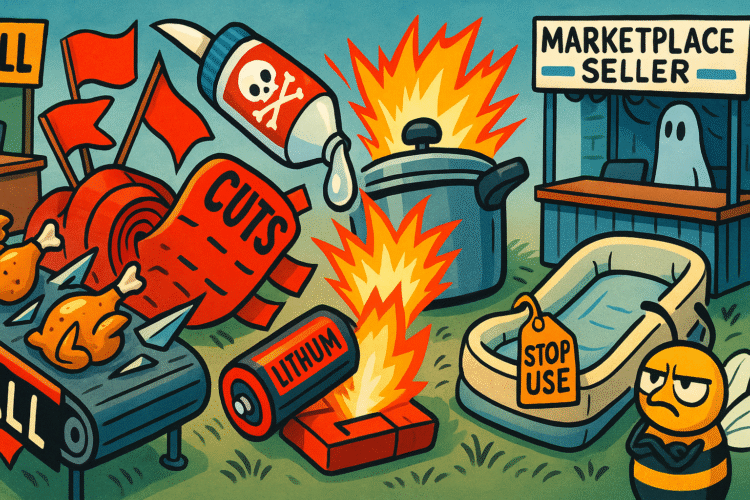
There’s a joke that isn’t funny anymore: if you want to understand American politics, skip the speeches and read the recall notices. The speeches are for theater; the recalls are for people who eat food, put drops in their eyes, buckle a baby into a lounger, or charge a phone without wondering if the battery will become a small sun. Since January 20, 2025—the first day of Donald Trump’s second act—the country has entered a reactive-recall era: product after product tripping alarms after the damage window opens, not before it does. The headlines insist this is “consumer awareness.” The data says it’s regulation with the engine light on, driven until the noise is louder than the radio.
I don’t need to sell you a villain with cape and cackle. The plot is older than my cynicism: starve or sideline the watchdogs, replace prevention with press releases, then act shocked when metal shows up in chicken and bacteria shows up in face wipes. You can call it a free-market victory if you squint hard enough. You can also call it what it is: a tax on the public—paid in ER visits, wasted wages, and bronchial coughs—so that a handful of companies can move fast and break things without paying for the glue.
To see the pattern, group the failures into four buckets and follow the paperwork: (1) mass food supply, (2) drugs and everyday medical/cosmetic products, (3) infant and child gear, and (4) burn/fire/mechanical hazards in consumer hardware. Then set those buckets against the record of a government that spent 2025 shrinking food-safety advisory committees, trimming inspection staff, and preaching speed as a sacrament. The result is not abstract. It lives in your kitchen, your nightstand, and—terrifyingly—your crib.
Bucket One: Mass Food Supply, or Why There’s Metal in Your Chicken
In late October, Hormel recalled roughly five million pounds of fully cooked “fire-braised” boneless chicken after customers found metal fragments in the meat—fragments traced to a damaged conveyor belt. The production window wasn’t a blip; it ran from February 10 through September 19. Seven months of damaged hardware, seven months of distribution to restaurants, hotels, cafeterias, hospitals, schools, and other large service buyers. Federal inspectors told operators to discard it. Hormel said the right things. But the damning fact is the timeline: this wasn’t caught at the plant; it was caught by the public. That’s not a victory for quality; it’s an indictment of it.
In the same breath, Foster Poultry Farms pulled more than three million pounds of frozen chicken corn dogs for foreign-material contamination—wood fragments in the batter, with reported injuries and a high-risk classification. This is the food America feeds its children when time and money are tight. It’s supposed to be boringly safe, because boringly safe is the point. The common denominator with Hormel isn’t malice; it’s process drift that ran for months before the warnings went up.
Pathogens took their turn. In May, a multistate Salmonella outbreak tied to cucumbers forced secondary recalls of fresh-cut deli items and sushi in multiple states. When upstream produce is contaminated, “grab-and-go” turns into “grab-and-get-sick,” because no one cooks a cucumber roll. It’s textbook supply-chain failure: a dirty input became a hundred clean-looking outputs until the lab said otherwise.
If these sound like bad-luck darts on a calendar, look closer. They’re signals from a system running after the contamination, not ahead of it.
Bucket Two: Medicine Cabinet and Vanity Shelf, or How to Recite “Quality Systems” Through Gritted Teeth
In October, a nationwide recall hit more than 140,000 bottles of atorvastatin calcium (generic Lipitor) because the tablets failed dissolution specifications—plain English: the pill might not dissolve correctly, which means the medicine might not work. This is the blue-chip, daily driver of cholesterol care. You take it for years. If dissolution drifts, your LDL drifts, and you learn about quality control from a cardiologist who’s trying to be gentle.
Eyes next. In spring, warnings and recalls covered roughly 75,000+ cases—about 1.8 million cartons—of over-the-counter eye drops and gels for sterility deviations and “significant manufacturing” lapses. This isn’t edge science; sterile ophthalmic filling is QA 101. When that much product is pulled because basics weren’t honored, it means a plant ran out of spec for a long time while the shelves filled and the risk multiplied.
Even the make-up wipes flinched. Kenvue/Neutrogena recalled Makeup Remover Ultra-Soft Cleansing Towelettes after internal testing found Pluralibacter gergoviae contamination—bacteria that can cause infections, particularly in vulnerable people. Again, this is not exotic. This is a wipe you drag across an eyelid. The theme writes itself: late catches of basic lapses.
If you’re counting, that’s chronic heart meds, the surface of your eye, and the wipes near your tear duct. Not rare, not boutique, not buyer beware—mainstream goods that behave when regulators do their job before the barcode beeps.
Bucket Three: Babies and Children, or The Shame of “Destroy It” Recalls
No modern country that claims to love children should tolerate the phrase “cut up and destroy” in a recall notice for nursery gear. Yet 2025 is littered with alerts telling parents to immediately stop using infant loungers and play yards that violate the mandatory Infant Sleep Products standard—because the side walls are too low, the pad is too thick, the foot opening is too wide, and suffocation or falls can kill. These items are often sold by third-party marketplace sellers that vanish when the regulator knocks. Result: no fix, no refund, just a warning to destroy what you bought to keep your baby alive. That’s not consumer choice. That’s policy failure with a pacifier.
The infant-product pipeline is a perfect case study in platform loopholes. If you can list it fast and ship it cheap, you can move units before anyone in Washington—or the retailer—has decided whether it belongs in a U.S. nursery. By the time the government shouts stop, the cart has been abandoned and the seller has dissolved into a different storefront with the same stock. The burden falls on parents in night-mode at 3 a.m., trying to figure out whether the pillow their baby is sleeping on is illegal. Safety officials can warn; they cannot conjure a responsible party from a P.O. box in another time zone.
Bucket Four: Fire, Burn, and Mechanical Hazards, or Cooking With the Lid Off
You’ve seen the videos: pressure-cooker lids that blast off under pressure, splashing scalding food across walls and bodies; lithium-ion battery packs that turn into bonfires; torches that don’t meet lighter standards; power stations that overheat and ignite. This is not fear-mongering. It’s the daily parade of recall notices listing units in the hundreds of thousands to more than a million, plus injuries, ER visits, and lawsuits. In June, more than a million power banks and related lithium products made the fire list. In September, nearly half a million more units joined the roll. Each block of numbers is a geometry problem in harm: how many households, how many seconds before it fails, how many kids nearby.
The “fix” is always the same: stop use, contact the company, request a refund or replacement lid. The lesson is always the same: you can’t regulate thermal runaway by public statements. You need pre-market enforcement with teeth, enough staff to make surprise visits, and a culture inside companies where “it didn’t explode in the test lab” is not the bar.
The Quantitative Signal: Recalls Rising, Warnings Surging
Let’s zoom out. Consumer-product recall counts aren’t the whole story, but they’re a clean proxy for hazard exposure and regulator workload. In 2018, they were in the mid-260s. In 2020, the pandemic year, they dipped to the high-230s. By 2024—the tail end of the Biden era—the figure was in the low-330s. In 2025, with months still to go, the count has already pushed past that number, with the Commission publicly noting it has exceeded 2024’s total and is on pace to challenge historic highs. The volume is up; the cadence is faster; the warnings are more urgent. That’s not a partisan chant; that’s arithmetic.
Two interpretations compete. The charitable one: more recalls mean an aggressive safety commission is finding more hazards. The realistic one: more dangerous goods are entering the stream, particularly through online marketplaces and consolidated supply chains, and the Commission is playing paddleball with a fire hose. Both can be true. The difference between prevention and cleanup is measured in burns, infections, and funerals.
What Changed in 2025: The Policy Weather
If you’re tempted to tweet, “Recalls happen all the time,” please read the next paragraph twice.
In March, the administration disbanded two cornerstone USDA food-safety advisory committees: the National Advisory Committee on Microbiological Criteria for Foods and the National Advisory Committee on Meat and Poultry Inspection. These are the brain rooms—science tables where industry, academia, and government hash out pathogen control, inspection rigor, and how not to repeat the last tragedy. They cost almost nothing. They matter a lot. Ending them wasn’t housekeeping; it was downgrading the early-warning system that spots the weak seam in a conveyor belt before you’re mailing back five million pounds of chicken.
At the FDA, 2025 began with staff cuts and departures in the very programs that steady the food and drug supply. The head of the food division resigned in February, pointing to sweeping personnel reductions; health-agency layoffs bled into FDA’s food, device, and tobacco centers. When you cut inspectors and technical experts, you don’t make contamination illegal; you make it later. The Inspector General, in June, told FDA to increase facility inspections and meet required timeframes. Translation: they’re behind, and the backlog isn’t fiction.
The agency did announce expanded unannounced foreign inspections in May, a tacit admission that the globalized supply web will exploit every soft seam unless you show up when no one expects you. Good step. But a single good step doesn’t erase a sprint in the other direction. In parallel, trade press flagged regulatory uncertainty around dietary supplements and food oversight—Washington tilting the table to accelerate “removing burdens” even as the failure list grew. Speed without staff is another way to say risk.
What about USDA’s meat and poultry oversight? The committee shutdown is the loudest bell. The quiet bell is how much science capacity you lose when you erase the venues where scientists and inspectors compare notes. This is how process control degrades: the conveyor scrapes for a few runs; the shavings spike; the magnet on the line is under-calibrated; the line lead is undertrained; an external complaint finally breaks through the noise. You can still recall. You just can’t rewind the last seven months.
And it’s not only food and drugs. Marketplace-seller loopholes remain wide enough to drive a container ship through. The government can push a recall or issue a stop-use warning. But when the seller is an offshore LLC, the remedy often stops at “destroy it and email us a photo for a gift card.” That’s a policy design problem, not a parenting one. It’s also a deregulatory choice: treat platforms as bulletin boards, not retailers; treat unsafe product floods as collateral; then call the warnings proof the system works.
Comparing Eras: Biden’s Prevention Tilt vs. 2025’s Cleanup Tilt
Under Biden, recall counts were already climbing—into the 330s—because the safety commission had rebuilt some enforcement muscle and was pushing warnings for marketplace goods that never would have hit a brick-and-mortar shelf. But two other things were true: advisory architecture in food safety still existed; and FDA was moving—haltingly but tangibly—toward a prevention-first culture after the infant-formula crisis. You could quibble with the pace. You couldn’t miss the direction.
In 2025, the direction pivoted. “Reduce bureaucracy” wasn’t a slogan; it was a series of cuts, closures, and vacancies that pulled teeth from the very agencies we count on to catch the metal in the chicken at the plant, not at the hospital cafeteria. This is the difference between a recall that proves vigilance and a recall that proves drift.
The Surge by Category: A Closer Ledger
Food: Two multi-million-pound meat recalls (metal shards; wood fragments) within weeks, plus Salmonella cucumbers that cascaded into deli items. The agencies still have pullback power—bless them—but the time to detection now tells the story, and the story is late.
Drugs/OTC: A generic statin with failed dissolution and mass eye-drop sterility failures are not gotcha moments. They’re quality-system collapses that scaled, reaching hundreds of thousands to millions of packages before enforcement barked. These are the kinds of failures a robust cGMP inspection regime prevents. Weak inspection throughput turns prevention into post-market triage.
Cosmetics: Contaminated wipes near the eye are the banality of risk in a stretched regulator world. The bacteria has a name; the pattern has a thesis: if the lab is understaffed or the culture tolerates drift, consumers will be the assay.
Infant/Child: A cascade of illegal sleep products sold online, many with design features long banned by the infant sleep rule. The warning cadence rose from occasional blasts to a steady drumbeat. Warnings tell you something. So does the absence of a fix when the seller disappears. This is not a parenting failure; it’s a platform policy failure; and it’s a deregulatory ideology failure that treats the marketplace like a sewer system: anyone can dump anything until the smell gets on television.
Burn/Fire: Lithium-ion hardware and pressure-cooker lids aren’t new hazards. But the scale of recalls—hundreds of thousands to over a million units at once—combined with the injury count tells you the guardrails aren’t keeping up with manufacturing speed or the global supplier web. We will keep learning this lesson until we fund pre-market labs and post-market inspectors like we mean it.
“More Recalls Mean More Safety,” Says the Press Office. Let’s Test That.
In theory, a rise in recall counts could indicate heightened vigilance. In practice, the mix of recalls in 2025 skewed toward basic failures—metal shards, wood pieces, non-sterile drops, suffocation-hazard loungers—that should be screened out upstream. When the basic failures rise as advisory committees are dissolved, staff are cut, and inspection backlogs persist, it’s not a coincidence; it’s a correlation begging to be called what it is. The administration can argue it’s clearing red tape. The ER will call it something else.
To be ruthlessly literal: the erosion of regulatory infrastructure materializes as metal in institutional chicken, non-sterile fluid in a bottle for corneas, baby pads that smother, and batteries that torch garages. The difference between those outcomes and their opposites is not a speech about burdens. It’s a line item in a budget, a staffed position that wasn’t eliminated, a committee meeting that wasn’t canceled, a surprise inspection that didn’t wait for a press release.
The Political Alchemy: Deregulate, Then Call the Cleanup “Proof We Care”
There’s a nihilist elegance to the current posture. Shrink the apparatus that prevents harm. Allow more suspect goods to reach consumers. When injuries and outbreaks force recalls, step forward and praise the agencies for “responding swiftly.” The public remembers the podium, not the line you deleted from the org chart. Meanwhile, industry players who prefer fewer questions enjoy the float. Externalities become invisible when they’re dispersed across millions of households and hundreds of ERs.
And yes, in the same period the safety commission issued more recalls and warnings than in any Biden year—already topping last year by early fall. The agency framed it as an achievement. On one level, it is: the cops are moving. On the level that matters to burned skin and infected eyes, it’s a smoke alarm proving there’s more smoke.
But Weren’t There Recalls Under Biden?
Of course there were. Perfection isn’t on the menu in a continental-scale economy. The comparison isn’t “zero” vs. “non-zero.” It’s posture and trajectory. Under Biden, the agencies leaned into preventive structure—imperfectly, yes—after the formula crisis. Under Trump II, the structure itself took direct hits (advisory committees gone; staff cuts felt; quotas missed) at the same moment the recall graph bent upward. You don’t need a conspiracy board to draw that line; you need a ruler.
The Marketplace Loophole: Where Babies Become Beta Testers
If you want a single fix that would save lives this quarter, close the marketplace-seller loophole. Treat platforms as retailers for purposes of safety obligations. If you profit from the transaction, you own the remedy—refunds, outreach, the whole unsexy thing. Until then, the government will keep writing “destroy it” into notices, because you can’t compel a ghost to issue a shipping label. In 2025, the ghost was busy.
The Cost Ledger: How Much Deregulation Costs When You Measure in Humans
This year’s invoices don’t look like ideology; they look like:
- cafeteria trays scraped into the trash because the institutional chicken was recalled for metal fragments;
- parents standing over a pack-and-play with scissors because the regulator told them to destroy an unsafe product the seller won’t fix;
- a cardiology pharmacist explaining to an elderly patient why the atorvastatin refill needs to be swapped, and yes, the pills looked normal;
- an ER nurse charting second- or third-degree burns from a cooker lid that let go;
- an ophthalmologist treating an eye infection that began with a bottle labeled “lubricating drops.”
These are not culture-war abstractions. They are billable hours, co-pays, PTO burned, childcare scrambled, trust corroded.
The Fix Is Boring, Which Is Why It Works
If you came here for a cathartic scream, I can offer gallows humor and a list of verbs: staff, inspect, test, enforce, disclose, recall early. The fixes are embarrassingly unmagical.
- Reconstitute USDA’s food-safety advisory committees and fund them beyond coffee money. These committees are force multipliers; they identify systemic hazards before they metastasize.
- Hit FDA’s inspection targets with real people and real travel budgets. The oversight watchdog didn’t mince words; the quotas are behind. Hire, train, and retain. Make current Good Manufacturing Practice mean exactly what it says, including for foreign facilities.
- Codify platform responsibility so “marketplace” stops being a magic word that dissolves accountability for infant sleep gear and high-risk electronics. If you collect the fee, you fund the fix.
- Publish recall-trend dashboards that break down causes (design defect, process contamination, supplier failure) so the public can see where the system is fraying and Congress can’t pretend not to.
- Fund pre-market testing grants for small manufacturers on high-hazard categories (lithium-ion, pressure vessels, infant products) so corners aren’t the business model.
- Tie executive-comp clawbacks to safety metrics for regulated industries. Culture changes quickly when bonuses notice the burn rate.
None of this is romantic. All of it is cheaper than the current model: call it pay now in inspectors or pay later in injuries.
The Cynical Realist’s Coda
I promised mock seriousness, so here it is: if you wanted to design a country to produce more metal-tainted chicken, more non-sterile eye drops, more suffocation-risk baby loungers, and more battery fires, you’d do exactly what the United States did in 2025. You’d dissolve the science committees that irrigate food safety with actual microbiology. You’d trim the staff who look down the barrel of a filling line and say “stop.” You’d preach about burdens and worship at the altar of speed. Then, when the headlines arrive, you’d praise the recalls as evidence of a system working—like applauding the fire department for sprinting while you sell the hydrants for scrap.
During Biden, the trend line for recalls rose while guardrails were being rebuilt. During Trump’s second term, the trend line rose while guardrails were removed. If you can’t feel the difference, check your hands for soot.
This isn’t about disliking the word “deregulation.” It’s about understanding the invoice. The “cost savings” are paid by the public, in blood sugar spikes after a recall wipes out a week’s lunches, in vision clouded by a contaminated drop, in a scar that will outlive the quarter’s margins. The recall economy isn’t “more efficient.” It is louder. It is later. And it is the predictable outcome of an ideology that calls regulations burdens until the burden arrives at your table.
If we want the curve to bend the other direction, we do the boring things immediately: put the scientists back at the table; stack the inspection calendar to the ceiling; make sellers responsible for what they sell; and measure success not by how quickly we draft the press release, but by how rarely we need one.
Until then, keep your receipts and keep the pediatric scissors handy. The roulette wheel doesn’t care what you voted for. It cares whether anyone is paid to stop it spinning.