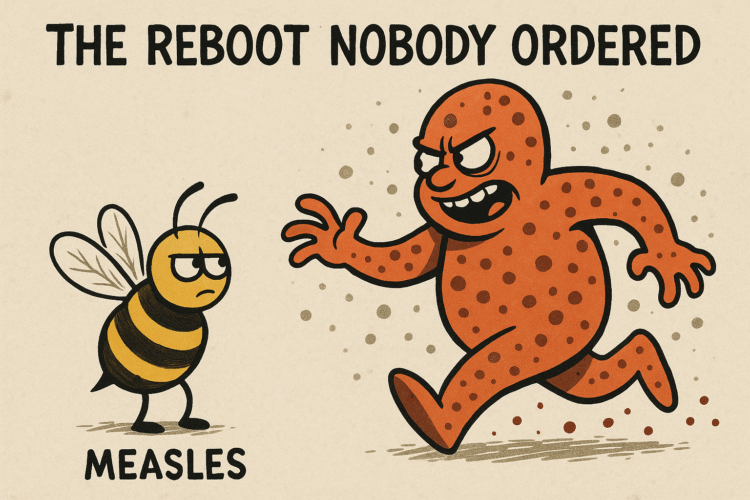
It is 2025, and America has managed to drag an old virus out of retirement like a boy band on a nostalgia tour. Not the fun kind of reboot—no slick streaming revival, no “Measles: The Musical.” This is a disease revival, unwanted, unnecessary, and entirely predictable. The CDC’s latest report confirms 1,544 measles cases so far this year. That’s not a typo, it’s the consequence of letting vaccine denial metastasize until it rewrites the health section of the national script.
The plot points are brutal in their clarity: 86 percent of these cases are clustered in about forty outbreaks, and when vaccination status is known or inferred, ninety-two percent of the people are either unvaccinated or their status is unknown. Four percent had one dose, another four percent had both. In other words, the disease is not outsmarting science—it’s outsmarting people who insist science is optional.
Week by Week: The Case Count’s Slow Climb
The narrative arc runs from early September, when there were 1,431 reported cases, to the end of the month at 1,544. That’s 113 more in a single month, each case a seed that grows clusters: families, classrooms, congregations, travel companions. And the numbers don’t politely stay put. Minnesota announced ten new cases on October 1, bringing its yearly total to eighteen. All were unvaccinated. Seven tied to domestic travel, three to international. The kind of plot twists you can see coming from miles away, and still nobody moves off the tracks.
South Carolina logged a solitary case, a lonely statistic with outsized consequences: every “single case” is a potential tree trunk, waiting to sprout branches of transmission in the right conditions. Geography tells the real story here—pockets of susceptibility, gaps in immunity, each one a crack in the national firewall that lets the virus slip through.
How Outbreaks Spread: Travel, Schools, and Sanctuaries
The mechanics of this reboot are straightforward. Someone travels abroad, or just across state lines, incubates the virus, then seeds it into an unvaccinated community. Within days, family spreads it to family, who spread it to schools, who spread it to places of worship and clinics. The virus doesn’t need imagination. It just needs gaps in MMR coverage.
This is why measles clusters are not polite little bonfires. They are wildfire flares. A single international trip becomes a chain reaction. A school where parents opted out of vaccines because of Facebook becomes a flashpoint. A church with a “natural living” congregation turns into a megachurch-sized incubator.
The Real-World Consequences
The CDC’s bulletins do not read like thriller novels, but the consequences are cinematic. Hospitals and urgent cares launch post-exposure prophylaxis drives, chasing down everyone who shared air with a contagious child. Epidemiology teams—already stretched thin from pandemic burnout—are pulled into contact tracing that feels Sisyphean, each rock rolling back downhill when another exposure event comes in.
Schools issue exclusion orders: if your child isn’t vaccinated, your child doesn’t come back until the incubation window clears. Families scream about freedom while teachers quietly thank the gods for one less vector in the classroom. Clinics juggle booster clinics, urgent immunization drives, and the unending work of explaining, again, that two doses of MMR are ninety-seven percent effective and the needle is not the enemy.
The costs are staggering. Not just in hospital bills, but in human labor: hours of interviews, tracing airline seats, church pews, playground benches. Multiply that by forty outbreaks. Suddenly the “cheap” choice of skipping a shot becomes a billion-dollar invoice mailed to the entire public.
Context Beyond Borders
The United States does not get to imagine itself an island. The Americas are seeing regional growth in measles cases, cross-border importations fueling domestic sparks. When Mexico or Brazil or Canada sees clusters, the United States does too. Pathogens do not recognize sovereignty. The virus has no respect for the TSA, it breezes through security.
What matters is vaccination coverage, and across the hemisphere, coverage has been sliding. Pandemic disruptions, supply inequities, and above all, misinformation have created the perfect conditions for a regional relapse. The “Americas had eliminated measles” headline is now as dated as floppy disks. The reboot is regional, not just national.
The Policy Stakes: Loopholes and Lies
The problem is not that measles got stronger. The problem is that human policy got weaker. Kindergarten MMR coverage has been declining, thanks to a patchwork of non-medical exemption loopholes that allow parents to opt out for “personal belief” reasons. These loopholes are effectively legal invitations to outbreaks.
Misinformation campaigns have done the rest. Social media influencers who think “research” means five minutes on YouTube have convinced swaths of parents that measles is a “childhood rite of passage” instead of a potentially deadly virus. The result is predictable: clusters of unvaccinated children, ripe for exploitation by a pathogen with no chill.
What Public Health Agencies Are Doing
Public health agencies are trying. Isolation windows and quarantine guidance are dusted off, booster clinics pop up in gyms and churches, urgent calls go out for families to check immunization records. But agencies are fighting on two fronts: biology and ideology. One can be solved with a needle, the other requires prying misinformation out of cultural bedrock.
Epidemiology teams, county health departments, and state immunization programs are writing the same emails over and over: “Two doses, safe and effective.” They are begging parents to think not only of their child but of the immunocompromised neighbor, the infant too young for vaccination, the pregnant woman exposed in a clinic waiting room.
The Reboot Metaphor
This is the reboot nobody asked for. America is reliving a pre-1963 nightmare because it has chosen to indulge in 2025 conspiracies. Vaccination denial is the streaming platform that picked up an old show we thought was canceled. Only this reboot doesn’t end with applause. It ends with hospitalizations.
Imagine Hollywood announcing the triumphant return of smallpox, polio, or diphtheria. Audiences would revolt. Yet that is what vaccine denial has scripted: old diseases, resurrected not by science fiction but by human neglect. The tragedy is that this reboot was optional. The cancellation was already written into history. We just tore up the contract.
What Comes Next
Families can expect more exclusion orders, more emergency immunization clinics, more local health departments issuing “no school until cleared” notices. Employers will see sick days multiply, not because measles is unstoppable, but because the public let it restart. Fall travel and holiday gatherings will amplify exposure networks, layering transmission onto already dense webs of contact.
The real danger is sustained transmission. Once measles regains a foothold, every immunity gap becomes a permanent vulnerability. That is the specter haunting the CDC’s numbers: not just spikes, but sustained seasonal circulation, a virus re-domesticated after decades of exile.
Closing Reflection
We live in an era where people line up overnight for the reboot of a sitcom, but revolt at the idea of a simple two-dose vaccine. Where parents film TikToks bragging about “natural immunity,” only to discover that natural immunity sometimes means natural funerals. Where the country tolerates loopholes that treat public health like an à la carte buffet.
Measles should have remained a ghost, a historical footnote in dusty textbooks. Instead it is back on stage, headlining outbreaks in schools, churches, and clinics. And all because people preferred rumor to research, myth to medicine.
The reboot nobody asked for is here. The only way to cancel it again is not by applause, not by nostalgia, but by needles in arms and the collective will to say: enough reruns.