Somewhere inside the air-conditioned quiet of Foggy Bottom, a handful of diplomats are trying to sell the world on an illusion that’s fraying faster than the paper it’s printed on. The U.S. State Department, ever the dealer in optimism laced with caveats, has warned allies that it has “credible reports” Hamas is preparing an imminent attack on Palestinian civilians in Gaza. Not Israel. Not rival militias. Civilians. It’s a sentence so heavy with contradiction it practically demands an exorcism.
The warning landed like a dull thud in a region already vibrating with exhaustion. Gaza’s ceasefire, that glass figurine of international diplomacy, is balanced on an unsteady shelf made of hostage lists, phased IDF pullbacks, and corridors that feed aid as unpredictably as an IV drip in a blackout. The truce has no walls, no disarmament clause, and no one really in charge of keeping the lights on. It’s a “peace” that resembles a software update—plenty of bugs, no rollback option.
Now, imagine trying to enforce it while warning that one of its signatories might soon turn its guns inward. The logic reads like a bureaucratic riddle: to save the ceasefire, we must prepare for the possibility that it destroys itself.
The new “credible reports” were shared in whispered cables to allies and mediators—vague enough to provoke alarm, specific enough to justify whatever happens next. Washington, citing the need to protect sources and “ongoing coordination,” declined to share operational details. That’s diplomatic code for “we don’t know if this is real, but we can’t afford to be wrong.”
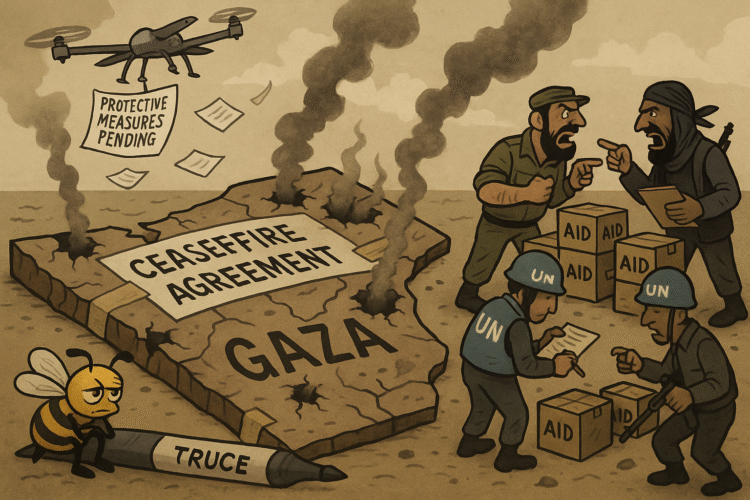
The message came with the kind of dry gravity only seasoned bureaucrats can deliver: protective measures will follow any breach. The phrase “protective measures” is elastic enough to cover everything from satellite surveillance to full-blown intervention, which is exactly how the State Department likes it—ambiguity as deterrence, deterrence as doctrine.
It’s a delicate choreography. Humanitarian aid is ramping up—unevenly, haltingly—through Kerem Shalom. Hostage exchanges continue in slow motion, traded like grim currency. Remains cross borders under escort. Meanwhile, rival factions within Gaza, each claiming to represent resistance, governance, or divine will, are redrawing the map of control one checkpoint at a time. The truce, such as it is, has not disarmed anyone. It has only paused the tempo of the violence.
Inside Gaza, the peace feels like an afterthought—a scaffolding built from press releases and drone footage. Streets that were shelled last month are now the jurisdiction of men with clipboards and AK-47s, arguing over which faction’s fighters get to guard the aid trucks. The so-called “governance structure” is less government than stage play: everyone has a role, no one has authority.
And into this vacuum, the specter of Hamas turning its weapons on Palestinian civilians has drifted like a rumor wrapped in gasoline. If true, it would not just collapse the ceasefire. It would burn the scaffolding of international credibility that Washington, Doha, and Cairo have spent months pretending was stable. The truce would become a Potemkin peace—impressive in communiqués, hollow on contact.
The political geometry is absurdly uneven. The United States is desperately trying to sustain a peace it brokered without being seen as the occupying power that enforces it. Netanyahu, cornered by coalition politics and his own rhetoric, has declared that “the war ends only when Hamas disarms”—which is like promising sobriety at an open bar. Europe, never one to miss an opportunity for moral bookkeeping, is deploying inspectors and border monitors to confirm that what’s happening on the ground matches the talking points in Brussels. (It doesn’t.)
Meanwhile, regional actors hover like vultures with flight plans. Hezbollah toys with border incidents. Iranian proxies test missile ranges. The Red Sea shimmers with patrols that look more ceremonial than strategic. Everyone is probing for weakness, waiting to see which clause of the ceasefire will collapse first: the one about aid corridors, the one about hostages, or the unspoken one about hope.
The result is an equilibrium that’s both fragile and grotesque—a ceasefire that depends on faith in institutions that long ago outsourced their moral credibility to press secretaries.
The State Department’s announcement fits neatly into this theater of contradiction. It’s an alarm that may or may not be based on truth, issued by a government that can’t afford to appear inactive, about a truce that barely exists, in a territory that’s functionally ungovernable. It’s the diplomatic equivalent of sending flowers to a house you accidentally set on fire.
What makes it even more surreal is the moral framing. Washington’s statement, cloaked in humanitarian language, essentially warns that Hamas might attack the very people it claims to represent—a rhetorical loop that absolves everyone while condemning no one. The logic is exquisite: if Hamas kills Palestinians, it proves Israel right. If it doesn’t, it proves Washington’s vigilance prevented it. Either way, the machinery of narrative control hums along untroubled.
Beneath the policy speak, the situation on the ground is devolving into something more primal. Aid convoys are ambushed by rival factions. Local committees barter allegiance for diesel. Families dig makeshift graves beside aid stations. The truce may have stopped the bombing, but it hasn’t stopped the dying.
Inside the labyrinth of tunnels that serve as both refuge and prison, rumors spread faster than food. Fighters talk of betrayal, of infiltration, of leaders negotiating safety in exchange for surrender. Civilians whisper about reprisals. No one trusts the monitors, who rotate between European NGOs and Arab League envoys like substitute teachers afraid of their own classrooms.
If the U.S. warning proves accurate—if Hamas does turn inward—the humanitarian disaster will metastasize into something darker: a civil fracture within an occupation. A war without sides, just concentric circles of suffering.
The irony is that everyone involved knows this. The diplomats know. The generals know. Even the spokespeople know, though their job is to sound surprised later. Yet the machinery keeps moving, because the illusion of process is the only thing left to sell.
Washington insists it’s holding the line on “credible penalties.” Jerusalem insists it won’t tolerate backsliding. Europe insists it’s monitoring compliance. But in practice, none of these actors have the bandwidth or the political will to enforce anything stronger than a sternly worded statement. The enforcement “spine” of this peace—lists, monitors, deconfliction maps—has all the rigidity of a wet napkin.
When the shooting resumes, as it inevitably will, the talking points will be ready. The same adjectives will make their rounds: tragic, regrettable, disproportionate, necessary. The same podiums will host the same choreography of concern. And once again, the people of Gaza will serve as both constituency and collateral—a population perpetually caught between the abstract nouns of foreign policy and the concrete realities of rubble.
The U.S. doesn’t want to own this war, but it already does. You can tell by the tone of its briefings. The language has shifted from observer to manager, from coordination to command. When Washington starts “declining to share specifics,” it means the decisions have already been made. The theater continues because it must. Admitting ownership would mean admitting responsibility.
Netanyahu, meanwhile, keeps threading the impossible needle—promising victory without victory, peace without partners, normalcy without normal conditions. His government’s definition of success shifts daily, like a mirage receding across diplomatic sand.
Europe’s contribution is equally on brand: spreadsheets of “inspection frameworks,” PowerPoints about “sustainable stabilization,” and a humanitarian fund that exists mainly as a photo op. The idea that inspectors can secure a ceasefire in a territory with no functioning law is the kind of delusion only postcolonial guilt can afford.
So the question isn’t whether the truce holds on paper—it will, because paper is forgiving—but whether it holds in the streets, in the tunnels, in the hearts of people who’ve stopped believing in signatures.
If Hamas fractures internally, the ceasefire collapses under its own contradictions. If Israel reenters Gaza “for security enforcement,” the peace dies by suffocation. If Washington responds with another round of sanctions, statements, and “monitored engagement,” the region will simply absorb the failure into its bloodstream.
This is how modern conflict sustains itself: through bureaucratic inertia and political cowardice, wrapped in the vocabulary of humanitarian concern. Everyone gets to be tragic without being responsible.
Closing Section: The Ceasefire Industrial Complex
There’s a moment in every endless conflict when the language of peace becomes indistinguishable from the machinery of war. Gaza has long since reached that point.
The State Department’s warning, delivered in the careful syntax of concern, is less a revelation than a reflex. It’s what institutions say when they need to sound moral without taking sides, decisive without committing. It’s the language of a system that measures stability not by lives saved, but by how long it can delay the next explosion.
If Hamas truly turns its guns inward, it will not mark a new chapter, only a new configuration of despair. The truce will be declared “under review.” The monitors will be “temporarily suspended.” The diplomats will convene another summit in another European capital to discuss “pathways to de-escalation.” And the rest of the world will scroll past, murmuring that familiar incantation: “At least they tried.”
But the truth is simpler and harder. The ceasefire isn’t failing because of bad actors or rogue factions. It’s failing because it was never designed to hold. It’s a Potemkin peace—a façade erected to buy time, to protect egos, to maintain the illusion that someone, somewhere, still has control.
And maybe that’s the final, cruel symmetry of Gaza’s tragedy: that even the pauses in violence are transactional, even the hope is leased. The peace exists just long enough for the paperwork to look humane, before the next explosion resets the cycle.
The diplomats will call it progress. The leaders will call it resilience. The historians will call it inevitable. But the people living beneath it—the ones whose streets, tunnels, and bodies bear the cost—will call it what it’s always been. A ceasefire in name only.