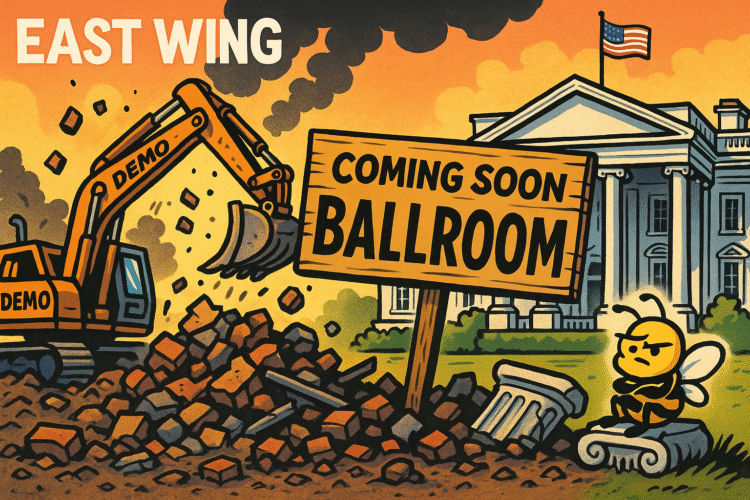
Let’s start with the blunt fact: the East Wing of the White House—the entire public-facing half of the executive mansion—no longer exists. It’s gone. Not “under renovation,” not “under review,” but demolished. The Office of the First Lady, the Social Office, the Calligraphy Office, the Visitor Entrance, the East Colonnade, the Family Theater—flattened to rebar and chalk lines under a “modernization” sprint so frenzied it makes the Nixon-era reconstruction look polite.
The official word from the West Wing is that this is all part of a visionary “expansion,” a privately funded project to build a 90,000-square-foot ballroom. The official word also says that approvals are forthcoming, paperwork is “in process,” and the word demolition doesn’t mean quite what it used to. But from the looks of it, the people’s porch has been replaced by a crater wrapped in security fencing. And in that crater lies the ghost of American civic space.
What’s Gone, Down to the Studs
The Office of the First Lady—the suite where literacy campaigns, mental health initiatives, arts education drives, and military family programs were conceived—is now dust. The Social Office, where the choreography of diplomacy played out in napkin folds and seating charts, has vanished. The Calligraphy Office, where invitations were once hand-lettered in the republic’s own script, is gone.
The visitor security corridor—where millions queued up for tours, where children from Iowa to Guam passed magnetometers and glimpsed the marble floors of their own government—is gone. The climate-controlled staging areas, the Garden Room connectors, the staff lockers, the East Colonnade itself—gone. The Family Theater, where presidents from Roosevelt to Obama watched films with their families and staff, has been reduced to rubble.
You can’t rebuild memory from blueprints.
The East Wing: Born Temporary, Died Permanent
The East Wing began as a disguise. In 1942, the Roosevelt administration quietly built a “temporary” addition to conceal the digging of the Presidential Emergency Operations Center (PEOC) beneath it—a bunker for continuity of government in wartime. It was supposed to be modest and short-lived. Instead, it evolved into the heartbeat of the White House’s public life.
This was the front door for the nation’s civic ritual: Medal of Honor ceremonies, cultural showcases, press events, school visits, and holiday tours. It was the working home of the First Lady—a space where soft power translated into policy, where the “nonpartisan” acts of care, culture, and civic unity were made manifest.
It was also the literal entry point for millions. The East Wing said, “Welcome to your house.”
Now, the bulldozers have said something else entirely.
Five Moments Buried in the Rubble
- September 11, 2001. The PEOC, directly below the East Wing, became the country’s nerve center as senior officials huddled behind blast doors during the attacks. Above them, the walls of the East Wing stood as both shield and symbol—a fragile house sheltering continuity.
- The East Colonnade. The long, sunlit hall between the residence and the event spaces became an informal national photo album. Kennedys strolling to a State Dinner, Reagans waving to schoolchildren, Obamas hand-in-hand on Easter Sunday, Bidens walking toward a podium. It was the White House as theater of democracy—unscripted, humane, visible.
- The Family Theater. Presidents and their families used it not as luxury but as ritual—watching films that humanized policy: Saving Private Ryan before Normandy commemorations, Lincoln before legislative battles, Selma before speeches on race. Staffers were invited to family screenings. It made government feel, for a few hours, like community.
- The First Lady’s Office. From Eleanor Roosevelt to Michelle Obama, this space birthed initiatives that reached beyond politics: anti-drug campaigns, literacy drives, “Let’s Move,” “Joining Forces.” The desk where those ideas were drafted is now landfill.
- The Social Office. The unseen artisans of diplomacy worked here. They plotted seating charts that balanced rival nations, wrote invitations that symbolized honor, arranged floral details that told stories. Every State Dinner, Medal of Honor ceremony, and holiday open house began here. You can’t algorithm that.
“Privately Funded” Doesn’t Mean Publicly Accountable
The demolition’s defenders insist it’s fine because “taxpayer money isn’t being used.” Translation: private donors with undisclosed interests are bankrolling the new ballroom. The contracts are opaque, the oversight boards are toothless, and the officials tasked with reviewing it include the very staffers who approved it.
“Privately funded” isn’t a virtue when the public loses the asset. You can’t launder civic destruction through philanthropy.
Even the process itself reeks of improvisation: the National Capital Planning Commission (NCPC) and Commission of Fine Arts (CFA) haven’t completed reviews. Yet the bulldozers rolled in under “modernization” exemptions. The chair of the NCPC, Will Scharf—who also happens to serve as Trump’s Staff Secretary—is now overseeing a review of his own demolition.
That’s not modernization. That’s monarchy with better Wi-Fi.
A Timeline of Additions, Subtractions, and Now, Subtractions Disguised as Additions
Every administration has tweaked the White House, but until now, the unwritten rule was: add without erasing.
- 1902: Theodore Roosevelt adds the West Wing, creating modern workspaces.
- 1942: FDR builds the East Wing for wartime use, masking the PEOC below.
- 1950s: Truman reconstructs the residence while preserving the façade.
- 2017: The Rose Garden becomes a paved plaza for camera angles, not horticulture.
- 2025: The East Wing is erased entirely for a ballroom with donor plaques.
This breaks the covenant. The People’s House is being privatized in slow motion.
The Public’s Door, Locked from the Inside
With the East Wing gone, there’s no public entrance. Tours are suspended. Security screening has been relocated to temporary tents on the South Grounds. The path school groups once took into the building is gone—erased, not rerouted.
What was once the symbolic front porch of the nation has become a hard-hat zone. Secret Service agents are posted at the perimeter, not as protectors of a national icon, but as guards of an active construction site.
The optics are biblical: the people’s house fenced off while billionaires fund a ballroom.
Heritage as Collateral Damage
Preservationists point out that the East Wing was never just drywall. It was history layered in space. Every office, every hallway, every colonnade carried the sediment of democratic ritual. You could feel it in the temperature shift between rooms—the air a mix of paper, paint, and purpose.
That ecosystem—of artists, calligraphers, military aides, and social secretaries—cannot be reconstructed from blueprints. You can reinstall a chandelier, but not a culture of service. You can pour new foundations, but you can’t pour back the memories.
What’s gone is not just structure. It’s continuity.
Stagecraft, Not Statecraft
When you replace the civic heart of a republic with a ballroom, you’re not modernizing—you’re confessing. This is what statecraft has become: stagecraft. The show must go on, even if the theater burns down.
The East Wing’s demolition isn’t just a planning failure; it’s a parable. The First Lady’s working suite—once a lab for civic grace—is gone. The Calligraphy Office—where public invitations became artifacts—is gone. The Family Theater—where presidents remembered the human stakes of policy—is gone.
What remains is a construction site with donor tours and commemorative hard hats.
“We’ll Rebuild It Better” — Sure, But For Whom?
White House officials promise that the new ballroom will host larger state events, more guests, more grandeur. But grandeur for whom? The East Wing wasn’t grand—it was accessible. Its beauty was in its restraint. It was the side of the White House that served the public, not itself.
Now the structure being planned is “90,000 square feet of private hospitality.” Think about that. Ninety thousand square feet of chandeliered exclusivity grafted onto a building that once symbolized equality.
They’ll rebuild it, yes. But the guest list will shrink.
The Irony Under the Dust
The East Wing was built in wartime secrecy. It may die the same way. Under the pretext of modernization and “private funding,” a piece of democratic infrastructure has been quietly erased.
And the justification—efficiency, modernization, flexibility—reads like every corporate memo that precedes a layoff. What they call modernization, we experience as deletion.
There’s something poetic about it, in the way that arson is poetic if you’re an insurance adjuster.
The Final Scene
One day, the ballroom will open. It’ll gleam in drone footage. Donors will toast under chandeliers the size of the Truman Balcony. There will be symmetry, opulence, acoustics—everything but authenticity.
But if you listen closely, beneath the clinking of champagne glasses, you might hear what was lost: the laughter from schoolchildren touring the East Colonnade, the echo of typewriters from the Social Office, the soft scratching of a calligrapher’s pen spelling The President of the United States requests the pleasure of your company.
Those sounds were the soundtrack of civic life. And they have been replaced by silence.
Because a government that bulldozes its front porch to build a ballroom doesn’t need a people—it needs an audience.
And when the music starts, the only question left will be: who’s still invited to dance?