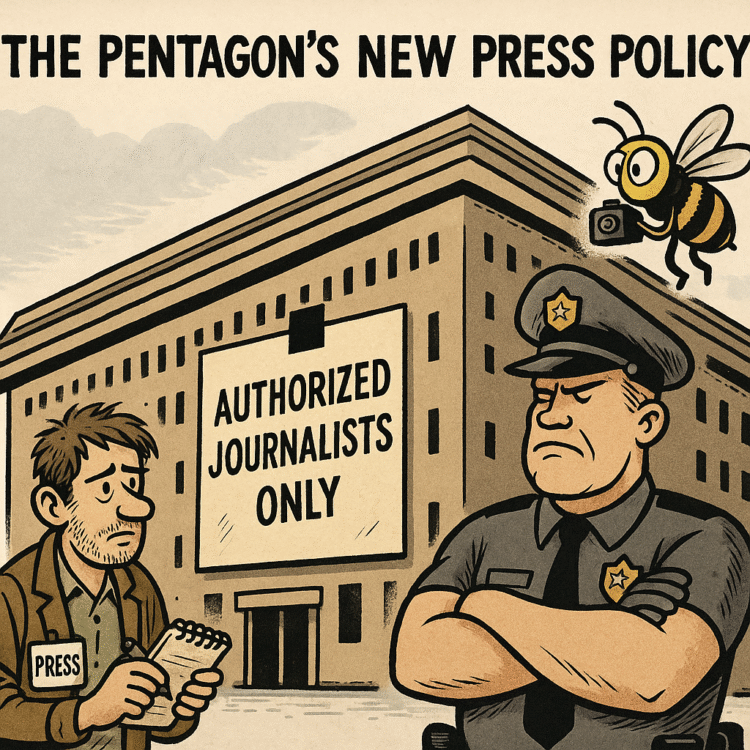
There’s a strange kind of quiet settling over Washington, the kind that hums beneath fluorescent lights and seeps into locked hallways. You can almost hear it in the Pentagon now, where the familiar chaos of reporters—phones buzzing, keyboards clacking, voices volleying across corridors—has been replaced by the steady whirr of an air vent. The silence isn’t accidental. It’s the sound of journalists packing up their desks, turning in their credentials, and walking out.
Across more than thirty major outlets—The New York Times, CNN, Reuters, Politico, Fox News, NPR, and beyond—reporters have refused to sign the Defense Department’s new “access policy.” The rules, drafted under Secretary Pete Hegseth, compel anyone who wants to cover the Pentagon to sign a loyalty-style pledge agreeing not to solicit or publish “unauthorized information.” In practice, that means nearly everything the government doesn’t explicitly approve. It’s censorship by form letter.
The administration insists it’s about national security, about keeping the wrong details from falling into the wrong hands. But anyone who’s watched power long enough knows that secrecy is rarely about safety—it’s about control. What began as an argument about leaks has evolved into a formal document that criminalizes curiosity.
A Building That’s Gone Quiet
Inside the Pentagon’s press corridor, the emptiness feels almost cinematic. Desks sit cleared, chairs pushed in with unnatural precision. For decades, this wing buzzed with the friction of democracy—questions shouted, answers dodged, truths unearthed. Now the walls echo back nothing. The building hasn’t been this silent since the early days after 9/11, and the difference is profound: that silence then came from grief. This silence comes from fear.
The few remaining voices belong to press liaisons reading statements no one can question. Briefings have thinned to photo ops. Reporters once accused of being too adversarial are now barred entirely. And in the strangest twist, the only network still welcome inside is One America News, which called the policy “a patriotic safeguard.” To everyone else, it reads like a gag order with a flag pin.
The Bureaucracy of Obedience
The genius of this policy is its subtlety. It doesn’t need to ban journalism outright—it just makes journalism incompatible with employment. The pledge doesn’t merely prohibit leaking classified data; it expands “unauthorized” to mean any information not explicitly cleared by the Pentagon. That could include spending figures, troop injuries, or even the timing of a briefing. The rulebook has been rewritten so that truth itself now requires clearance.
And when truth requires clearance, power no longer answers to the people—it answers only to itself. The government calls it “common sense.” Reporters call it what it is: prior restraint. Lawyers have already begun crafting lawsuits, citing the First Amendment’s ban on government interference in a free press. Yet the damage is already underway. Every day the policy stands, it normalizes the idea that access is conditional on compliance.
When the Press Packs Its Bags
It’s rare for journalists to agree on anything more than where the coffee is, but in this moment, they’ve managed unity. From Fox to The Guardian, from CNN to The Atlantic, the press corps has drawn a hard line. Dozens of veteran Pentagon correspondents left together, some after decades of service. They weren’t fired; they walked out.
That act of refusal has become its own kind of statement—a quiet rebellion against the idea that government permission is a prerequisite for public knowledge. It’s a reminder that the Fourth Estate was never meant to be housebroken. The irony, of course, is that the Pentagon’s quest for message control has done the opposite: it’s turned a policy rollout into a global headline about authoritarian drift.
The Collapse of Transparency
The decline in press freedom didn’t begin with this administration. It began years ago, in the slow erosion of trust between the public and the institutions built to serve it. But the current moment feels different. It’s not just hostility toward the press—it’s structural. It’s procedural. It’s the creation of a system where access itself becomes a weapon.
Without reporters embedded in the building, the public loses its only consistent window into the workings of a trillion-dollar military. Who tracks how funds are spent? Who monitors civilian casualties or investigates procurement failures? The Pentagon may argue that it must protect secrets for national security, but democracy cannot function when the government becomes its own sole witness.
The rot doesn’t start with lies—it starts with the quiet belief that the public doesn’t deserve the truth in the first place.
Paper Shields and Paper Chains
Freedom rarely dies in a coup. It dies in compliance. It dies in the polite signatures on paperwork that no one reads until it’s too late. The Pentagon’s pledge might look like a harmless form—something a legal team can review, something easily rationalized—but that’s precisely how bureaucratic censorship works. It relies on the fatigue of professionals who just want to keep doing their jobs.
In the language of the new policy, words like “integrity,” “security,” and “cooperation” appear again and again. They sound noble until you realize they’re being used to justify the removal of transparency. This is not the blunt-force authoritarianism of censorship by decree. It’s the subtler kind, the one that turns participation into complicity.
The Legal Fallout
Lawyers for the Pentagon Press Association have already signaled they’ll challenge the policy in court. Civil liberties groups are preparing briefs. There’s even bipartisan muttering on Capitol Hill, with lawmakers pretending surprise at the government’s appetite for secrecy. But these legal processes move slowly, and in the meantime, the precedent calcifies.
The longer the press stays outside, the more the Pentagon’s narrative becomes the only one the public hears. For an institution obsessed with “information operations,” that’s the ultimate victory—no need to suppress a story if you’re the only one allowed to tell it.
Manufacturing Silence
The most dangerous part of this crackdown isn’t what it hides—it’s what it normalizes. Once the government proves it can control the press under the banner of “security,” every agency will try it. Homeland Security. Justice. Energy. The EPA. Each will discover that limiting scrutiny is easier than surviving it.
This is how authoritarianism takes root in modern democracies: not through tanks or coups, but through paperwork and compliance. When journalists must sign loyalty pledges, the Constitution becomes a museum piece.
The Disappearing Witnesses
Imagine the next time a drone strike goes wrong, or a weapons contractor doubles its costs, or an internal audit reveals missing billions. Who reports it? Who asks for accountability when the very act of asking becomes disqualifying? The government will say oversight still exists—Congress, inspectors general, the courts—but oversight without transparency is just theater.
A republic that cannot tolerate scrutiny is no longer a republic. It’s a performance.
The Human Cost of Silence
Behind the abstractions of policy and access lies something more human—the loss of people who’ve spent careers cultivating trust. The Pentagon press corps isn’t just a collection of reporters; it’s an institutional memory. These are the individuals who’ve tracked wars, documented waste, exposed cover-ups, and, yes, sometimes made the government look bad because the truth was worse.
Now, they’re gone. The vacuum they leave behind will not be filled by press releases or official statements. What vanishes with them is the connective tissue between the public and the people making decisions in its name. Without that connection, the distance between citizen and state becomes infinite.
The Illusion of Control
The Pentagon believes it’s shoring up discipline. What it’s actually doing is eroding legitimacy. You can manage information for a while—you can spin, redact, and classify—but you can’t do it forever. The truth leaks, and when it does, it’s always more damaging than if it had been told outright.
Governments obsessed with controlling narratives always mistake fear for strength. They believe that silence equals order, when in reality, silence is rot. It’s what happens when institutions become so brittle that they mistake the absence of criticism for health.
A Republic of Empty Halls
If you want to know what the end of transparency looks like, picture those Pentagon hallways again—rows of empty desks where democracy used to live. That’s what the price of silence looks like in real time. The building still hums with power, but the witnesses are gone. The Fourth Estate has vacated the premises, and the echoes left behind aren’t just physical—they’re civic.
For now, the government insists everything is under control. That the new rules are temporary, necessary, pragmatic. But power rarely rolls back its own privileges, and bureaucracy never forgets a precedent that worked.
The Quiet Test of the Republic
This is how democracies are tested—not in war, not in crisis, but in paperwork. It’s in the moment a government decides that the public’s right to know is conditional on loyalty. The question is whether the press, the courts, and the people recognize what’s happening quickly enough to stop it.
The Pentagon can label silence as security, but the truth is simple: a nation that requires its journalists to sign away their independence isn’t safer—it’s weaker. The enemy isn’t the reporter with a question. It’s the system that no longer believes it should be asked.