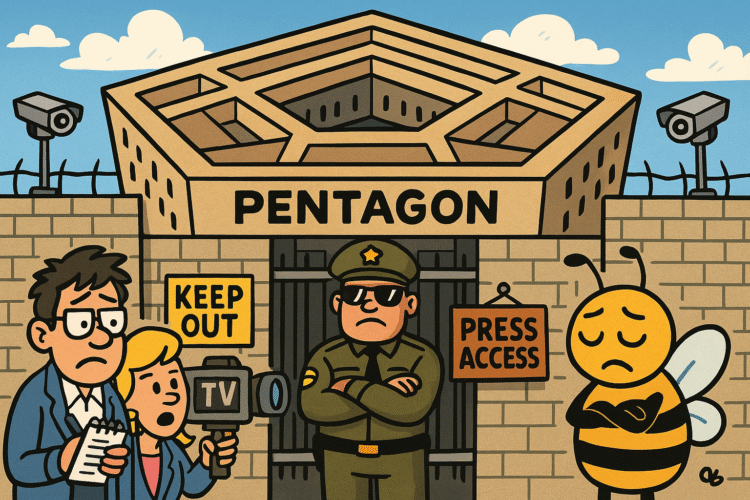
The building that invented acronyms, leaks, and irony has decided it’s allergic to all three.
According to CNN’s media desk, the Pentagon under Defense Secretary Pete Hegseth has rolled out sweeping new restrictions that would make even the Kremlin’s press office blush. The new “access pledge” requires journalists to sign away their ability to do journalism — barring them from seeking or publishing “unauthorized” information and forbidding movement without an escort. For reporters who refuse, credentials vanish. For those who comply, credibility does.
By day’s end, a broad coalition — CNN, The New York Times, The Washington Post, Reuters, AP, The Guardian, The Atlantic, Fox-adjacent Newsmax, and others — refused to sign. In a twist only 2025 could produce, One America News stood as the sole outlet proudly ready to ink the deal. Somewhere in a corner of the internet, irony died of laughter.
The Ministry of Managed Narratives
Let’s pause on the phrase “unauthorized information.” It’s the bureaucratic cousin of “unflattering truth.”
Under the new Pentagon policy, journalists are prohibited from seeking information not pre-cleared by the Department of Defense. In plain English, that means you can quote press releases, parrot official statements, and maybe cover the ribbon-cutting of a tank museum — but not, say, investigate civilian casualties, contracting fraud, or the internal Signal group where Hegseth allegedly posted the wrong meme to the wrong chat about Yemen strike targets.
This isn’t about leaks or national security. It’s about narrative monopoly. It’s the logical endpoint of a political culture that wants every story wrapped in a government-issued safety harness.
The Pentagon has always had gatekeepers, but never before has it required journalists to sign an oath of silence to enter the building. It’s like demanding a food critic promise not to mention the roaches before being seated.
The Hegseth Doctrine: Security Through Secrecy
Pete Hegseth, a man whose résumé reads like a Twitter thread about performative patriotism, defended the rules as “common sense.”
He argues that limiting access is about protecting national security — an idea as old as power itself. Every regime from Louis XIV to Richard Nixon has believed that sunlight endangers the kingdom. Hegseth’s twist is rebranding it as “defending freedom.”
It’s the same logic that once led officials to classify coffee orders because “enemy forces could infer fatigue.” But the new rule doesn’t just protect secrets; it criminalizes curiosity.
This comes on the heels of other access cuts: closed workspaces, vanishing press briefings, and new escort-only zones that turn the Pentagon into a high-security kindergarten where journalists are always holding someone’s hand.
To call this overreach would be an understatement. It’s a policy straight out of Authoritarianism for Dummies — Chapter 3: “Control the Optics, Control the History.”
When Everyone Agrees You’ve Gone Too Far
For once, the press corps achieved something rarer than bipartisan cooperation: consensus.
CNN and Fox, The Atlantic and Newsmax, Reuters and The Guardian — all spoke in one voice to say: absolutely not. The Pentagon Press Association retained legal counsel and fired off a letter citing the First Amendment, which, as it turns out, still applies even if you have a flag pin.
Think about that coalition. These outlets can’t agree on lunch, yet here they are, uniting against a man who believes journalism should be a spectator sport.
When Newsmax and The New York Times are on the same side, it’s either the apocalypse or the first real civics lesson of the decade.
From Signal Chats to Silence
Of course, none of this happens in a vacuum.
Just months ago, Hegseth accidentally added Atlantic editor Jeffrey Goldberg to a Signal thread discussing U.S. targeting in Yemen. Goldberg, realizing what he’d been looped into, promptly reported the breach. The Pentagon responded not with contrition but with vengeance — curbing briefings, cutting workspace allocations, and hinting that Goldberg’s access might be revoked “for security reasons.”
The episode was the perfect metaphor: a government so terrified of being overheard that it decided to muzzle everyone within range of a Wi-Fi signal.
Now, the Hegseth Doctrine makes that paranoia official. No leaks, no unapproved quotes, no stories that don’t match the PowerPoint.
As a concept, it’s less “national security” and more “emotional support bureaucracy.”
The One America News Exception
Meanwhile, One America News eagerly agreed to sign the access pledge.
Their reasoning? “If you have nothing to hide, you have nothing to fear.”
It’s a phrase historically used by people who have everything to hide and no understanding of fear. OAN’s willingness to comply is almost performance art — a network built on grievance now volunteering to be gagged by the very government it claims to worship.
Imagine a watchdog that asks for a muzzle. Imagine the free press applauding its own captivity.
It’s not patriotism. It’s Stockholm Syndrome with a teleprompter.
Prior Restraint, Rebranded
The legal implications are staggering.
The Pentagon’s pledge amounts to prior restraint — the act of censoring speech before it happens. Courts have repeatedly ruled that such restraint is unconstitutional, especially when it concerns matters of public interest.
Yet here we are, in a country that once enshrined press freedom as democracy’s bedrock, now flirting with a system where journalists must ask permission to tell the truth.
The Pentagon’s lawyers may argue that this is about access, not censorship — but when access requires silence, the distinction collapses. It’s like saying you’re free to speak, but only in the soundproof room we built for you.
The Chill That Follows
Already, the effects are visible.
Reporters embedded with military units face delays, denials, and digital escort tracking. Whistleblowers are ghosting journalists who can no longer guarantee confidentiality. Sources within the Pentagon whisper that even routine requests for comment are being logged as “potential security risks.”
The press corps has seen chilling effects before, but this one is colder because it wears the mask of professionalism. “Common sense protocols.” “Information integrity.” “Safety measures.” Every euphemism hides a brick in the wall.
When the government stops answering questions, the questions don’t disappear. They multiply — and move underground.
The Press Is the Canary
What we’re witnessing isn’t just a battle between reporters and bureaucrats. It’s the slow suffocation of transparency itself.
The Pentagon’s information lockdown is part of a wider trend: the shutdown-era secrecy surge. Across agencies, access is shrinking while layoffs and budget crises widen the void. The civil service is being gutted under the pretense of “realignment,” while watchdogs and auditors face “temporary suspensions.”
When you combine reduced staffing with media muzzles, you don’t just reduce oversight — you erase it.
That’s the real play. Not to fight the press, but to make it irrelevant.
The Cost of Silence
The press isn’t perfect — it makes errors, inflates scandals, and sometimes confuses urgency with importance. But the alternative is worse: a world where “authorized information” is whatever the state says it is.
The Pentagon’s move threatens to normalize that alternative. If the Department of Defense can label truth as unauthorized, how long before the Treasury, the EPA, or the CDC do the same?
Democracy doesn’t collapse through coups anymore; it collapses through credential policies.
And when those policies arrive wearing suits, badges, and polite language about “national security,” the decline feels less like a fall and more like an HR update.
The Irony of “Common Sense”
Hegseth called his plan “common sense.”
He’s right, in the same way that banning books is “common sense” for controlling literacy. Every authoritarian project begins with a rational-sounding premise: order, safety, patriotism, decency. The justifications change; the outcome doesn’t.
Once, “common sense” meant knowing the Pentagon’s cafeteria served freedom fries. Now, it means knowing you’ll need an escort to the bathroom.
What Happens Next
The immediate question is practical: will reporters refuse and risk exile, or comply and risk their integrity? The lawsuits will come — fast. The ACLU, the Reporters Committee for Freedom of the Press, and the Pentagon Press Association have all retained counsel.
But litigation moves slower than censorship. By the time a court rules, the news cycle may have adjusted to silence. That’s the real risk — not losing in court, but losing momentum.
The administration is betting that exhaustion will outlast outrage. It’s a solid bet. Authoritarianism rarely wins through force; it wins through fatigue.
Closing Argument: The Sound of a Locked Door
Picture it: a Pentagon press corridor, once loud with questions, now empty. The badges deactivated. The notepads replaced by NDAs. The only light, fluorescent and unblinking.
In one room, a spokesperson recites sanitized updates about “progress in our global missions.” In another, a single approved journalist from One America News nods along, tweeting nothing but “Great briefing.”
And somewhere outside the building, reporters from across the political spectrum — left, right, and everything in between — realize they are the last coalition capable of defending the First Amendment from the country that wrote it.
When even the war machine fears words, you know the truth is doing its job.
Summary Section: The Quiet War for Truth
The Pentagon’s access pledge isn’t a press policy; it’s a declaration of war on information itself. Beneath its polite jargon lies the simplest equation in authoritarian math: control the narrative, and you control the people.
Whether through silence, fatigue, or fear, the outcome is the same — a democracy where news is a product of permission.
But the absurdity of this moment is also its hope. When CNN and Newsmax share a legal brief, when journalists from opposite ends of the spectrum stand shoulder to shoulder, it’s proof that the line has not yet broken.
For now, the pen still matters — though it may soon require an escort.