A farewell love letter to the woman who governed like a mother of five who never had time for your nonsense
I start this story the way all sensible political elegies should start: on my knees at the National AIDS Memorial Grove in San Francisco, crying hard enough that a tourist couple asked whether I needed medical attention. I did not need medical attention. I needed a moment. I needed the kind of reverent collapse that happens when you stand in a place built for mourning and remember that someone fought for you long before it was safe, long before it was fashionable, long before corporations learned how to rainbow-wash their logos every June.
I stood under those trees whispering thank you to Nancy Patricia D’Alesandro Pelosi, and I meant it with the marrow of someone whose government once debated whether people like me deserved to survive. She fought when it was unpopular. She fought when it was dangerous. She fought when the other side called empathy a liability and queer people a contagion. And she kept fighting until her hair held more national secrets than the entire intelligence community.
This is the part where someone inevitably says that crying at a memorial is melodramatic. To which I say: she shepherded the Affordable Care Act, saved preexisting condition protections, expanded Medicaid, stabilized the drug benefit, and built mental health parity into federal law. She earned my tears. She earned a whole reservoir.
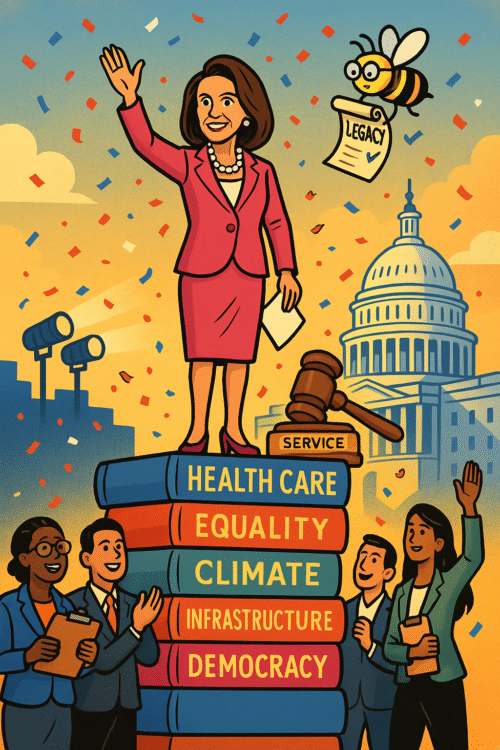
What we are losing in her retirement is not just a lawmaker. It is the most substantive legislative record any modern American leader has ever assembled. A record built by a mother of five who entered Congress after raising her kids and then promptly rewrote the definition of political power with the blunt efficiency of someone who has negotiated with toddlers, lobbyists and presidents using the same tone of voice.
The Ledger of a Life Spent Governing While People Performed Politics Nearby
Start at the beginning: first woman Speaker. Highest ranking woman in American political history. Longest serving House Democratic leader. These are easy to say now, softened by years of familiarity. They were not easy to say when she became them. She broke glass ceilings by cleaning them first, then reorganizing the room, then whipping votes so hard the shards filed themselves alphabetically.
She did not merely preside. She delivered.
She shepherded the Affordable Care Act through the most vicious political firestorm in modern history. And not some watered-down relic. The version with preexisting condition protections. The version with Medicaid expansion. The version with drug benefit fixes. The version with mental health parity treated as necessity, not charity. When a generation says health care is a right, not a privilege, they are quoting her work even if they do not know it.
After the financial crash she delivered Dodd Frank and the Consumer Financial Protection Bureau. A law that Wall Street still mutters about when they think no one is listening. She stabilized the economy with the Recovery Act while the opposition argued that hunger builds character.
She ended Don’t Ask Don’t Tell and passed the Matthew Shepard and James Byrd Junior Hate Crimes Act, advancing LGBTQ protections long before it became common sense. The Democrats who later brand themselves as allies learned the choreography from her sheet music.
She enacted the Lilly Ledbetter Fair Pay Act. She passed the PRO Act in the House. She guided the Infrastructure Investment and Jobs Act, CHIPS and Science, the PACT Act for toxic exposed veterans, and the Bipartisan Safer Communities gun law.
Then there is the Inflation Reduction Act. The largest climate investment in American history, the one that finally forced fossil fuel executives to imagine a future in which their grandkids breathe actual air instead of shareholder dividends. Medicare drug negotiation, clean energy tax credits, environmental justice priorities, and emission targets big enough to matter. She held that bill together like someone who has carried a family on her back and knows exactly how to carry a Congress the same way.
Her work during the pandemic remains a masterclass in crisis governance. The CARES Act, PPP, and the American Rescue Plan held the country together with fiscal twine and moral clarity. Child poverty plummeted. Evictions slowed. People lived because she understood logistics as intimately as grief.
Add the Respect for Marriage Act, which protected same sex and interracial marriages after the Supreme Court sent up a flare warning that its ideological ambitions had not yet peaked. She repeatedly passed voting rights expansions with the For the People Act and the John Lewis Voting Rights Act. She reauthorized CHIP. Grew NIH. Defended and strengthened the ACA through dozens of repeal attempts. Invested at scale in clean energy, broadband, semiconductors, childcare and science.
And while she did all of that she also led two impeachments of Donald Trump, established the January Sixth Committee, upheld constitutional norms across four presidencies, and mentored the most diverse caucus the House has ever seen.
The Myth of Soft Power and the Reality of Discipline
People like to pretend Pelosi’s magic was charm. It was not charm. It was discipline. It was counting votes like a parish hall organizer who knows who brought the casserole and who thinks they are too important to wash dishes. She governed with the precision of a trial lawyer and the warmth of a godmother who never forgets a birthday but also never forgets a promise.
She understood the House as a living organism, one that rewards steadiness and punishes delusion. That is why she delivered results while others delivered press conferences. That is why she ran circles around men who mistook volume for power.
Pelosi’s real secret was that she made competence look easy. Not sexy. Not glamorous. Just functional. She turned boring governance into a superpower. She made the cameras chase her rather than the other way around. And she did all of it without measuring her success in outrage, likes or soundbites.
She built a caucus that looked like the country. She built a legislative record that will outlive any of the men who belittled her. She built infrastructure both literal and metaphorical. And she did it while navigating a political landscape that wanted chaos, spectacle and collapse.
Civics in the Age of Celebrity Distraction
Her exit lands in a moment when politics has the attention span of a scrolling toddler and the emotional regulation of a livestream. Celebrities become pundits. Pundits become influencers. Influencers become prophets. But actual legislators? They are rare. They are quiet. They are the adults left in the room after everyone else exits to chase notifications.
Pelosi never confused attention with impact. She chose the latter every time. That discipline is why her record reads like a national blueprint rather than a memoir of what might have been.
And that is why her retirement should make the country pause. Because she leaves behind not a myth but a map. A map of what governance looks like when you care more about math than melodrama.
The House Without Her
What happens now is not elegy but audit.
Which protections survive the next Congress? The ACA provisions that transformed health coverage. The climate investments that must be defended from rollback. The Medicare drug negotiation powers that pharmaceutical lobbyists would happily bury in procedural grids forever.
Where will the gaps show first? Childcare funding. Climate timelines. Science appropriations. Voting rights protections. LGBTQ equality. The infrastructure dollars that need implementation guardrails rather than legislative sabotage.
Her departure resets the House leadership bench. It forces a new generation to decide whether governance or theater will define their tenure. The instinct for spectacle will tempt them. The cameras will demand it. But the country does not need another performer. It needs what she modeled: relentless, unglamorous, spreadsheet-driven work.
The Weight of a Public Motherhood
It matters that she began this career after raising five children. It matters because she entered Congress already fluent in conflict resolution, triage, logistics and emotional intelligence. She knew that the moral arc of governance is not abstract. It is daily. It is granular. It is measured in consent forms, hospital visits, mortgage payments, transit schedules and prescription costs.
She mothered a caucus the way she mothered a family. With high standards and low tolerance for nonsense. With precision and patience. With the kind of authority that comes from having already survived harder things than a government shutdown.
A Thank You That Goes Beyond the Grove
When I cried at the AIDS Memorial, I did not cry for a politician. I cried for the boys who died alone in hospital rooms. I cried for the lovers who were told their grief did not count. I cried for the men who were buried without their names spoken. And I cried because Nancy Pelosi fought for all of us when the world was content to let us disappear.
She fought for us again when she passed the hate crimes act. When she ended Don’t Ask Don’t Tell. When she defended marriage equality. When she passed the Respect for Marriage Act in a moment when the Supreme Court signaled open season on civil rights. She fought in every chamber where cruelty was allowed to masquerade as morality.
I cried because she stood between us and oblivion more times than she will ever admit.
What We Owe Her Now
We owe her the honesty she always gave the country. We owe her an evaluation based on accomplishments rather than personality. We owe her gratitude free of mythmaking, clear-eyed and unromantic.
We owe her the work of continuing what she built. Climate policy that survives appropriations cycles. Drug pricing reforms that need enforcement, not nostalgia. Voting rights that require federal backbone. LGBTQ protections that need expansion, not symbolism.
And we owe her the promise to remember that governance is not a performance. It is a job. She did the job. She did it with historic precision. She did it without asking to be worshipped. She did it while presidents came and went.
Section Title: The Stewardship Audit
As she exits, the checklist becomes ours.
Which provisions need shoring?
Which institutions need defending?
Which rights need expansion rather than posthumous apology?
Which leaders will rise with the steadiness she modeled?
Nancy Patricia D’Alesandro Pelosi did the work. She left behind a legislative map so detailed that future leaders will have no excuse to wander off into performance politics unless they choose to.
The question now is whether we honor her not with statues or speeches but with continuation. With governing. With truth. With the courage to be boring in a country addicted to crisis.
She showed us how to do it.
She did the job.
And she left the map so the rest of us do not get lost.