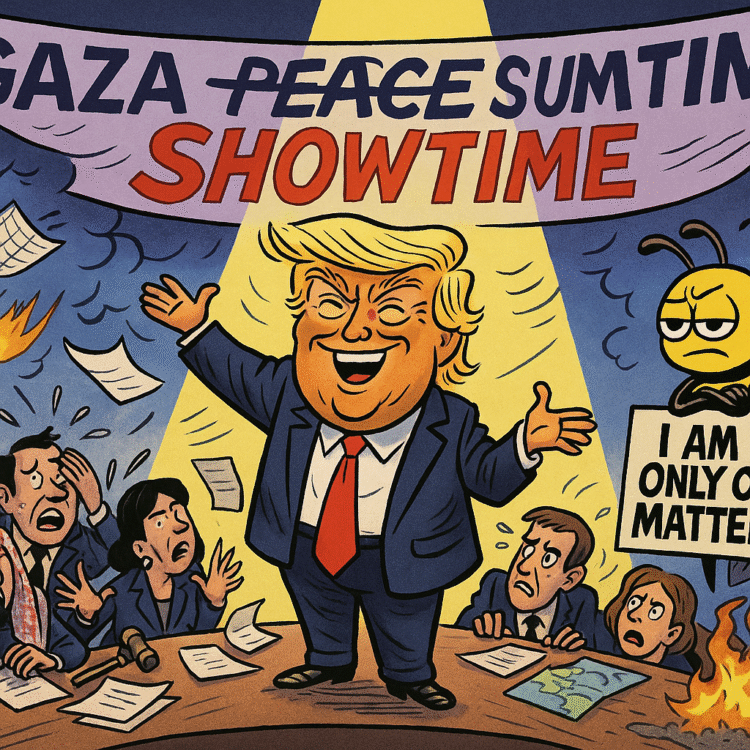
It began the way every Trump summit begins—late, loud, and somehow missing a sense of reality. The Guardian’s report from Sharm el-Sheikh reads like dispatches from an international hostage situation where the hostages are diplomacy, grammar, and basic adult decorum. Picture a beachfront hotel filled with exhausted world leaders, their aides clutching binders, waiting for a man who treats multilateral crises the way toddlers treat finger paint: as a chance to make a mess and then declare himself an artist.
When Donald Trump finally arrived—half an hour behind schedule, entourage in tow, camera crews rolling—the ceasefire talks about Gaza had already turned to the operational details: hostages, aid corridors, inspection teams, and verification protocols. You know, the boring parts that save lives. Trump’s instinct, as always, was to save the show.
“I Am the Only One That Matters” — Live from the Sinai
What followed, according to multiple accounts, wasn’t a summit so much as a variety hour with body counts. Trump opened with a rambling salute to Egypt’s Abdel Fattah el-Sisi—“great guy, very tough on crime, just like me, maybe tougher”—before pivoting to praise Turkey’s Recep Tayyip Erdoğan as “a strong man, a real man’s man,” and then announcing, apropos of nothing, that Hungary’s Viktor Orbán “gets it.”
By the time he turned to Italy’s Giorgia Meloni, calling her “beautiful, strong, and beautiful again,” the delegates from Norway and Spain were quietly drafting a group text that read, “Dear God, make it stop.”
Trump then managed to insult half the table by forgetting Emmanuel Macron’s name (“that little guy from France, he’s always mad”), mistaking the U.K.’s Keir Starmer for a journalist, calling Canada’s Mark Carney “the president,” and referring to Iraq’s Prime Minister Mohammed Shia’ al-Sudani as “the oil guy.” Somewhere between these flubs, he announced to the cameras, “I am the only one that matters,” which, for once, was accurate—but only because everyone else had mentally checked out.
Diplomacy as Improv Comedy
The Sharm el-Sheikh summit was supposed to mark a fragile turning point. Hamas had just handed over the last living Israeli hostages to the Red Cross, and Israel was beginning the first stage of prisoner releases. Diplomats had spent weeks negotiating inspection corridors, fuel deliveries, and mechanisms for preventing rearmament in Gaza.
Then Trump entered, stage right, and turned it into a televised ego séance.
Foreign ministers who’d spent decades mastering the art of poker-faced patience reportedly struggled to suppress visible disbelief as Trump interrupted humanitarian briefings to workshop applause lines. When one EU official mentioned verification protocols for aid trucks, Trump cut him off with, “You know, I did more for trucks than any president, maybe in history.”
When the Jordanian foreign minister warned that escalating drone strikes could derail the truce, Trump replied, “Drones are great, I love drones, beautiful technology.”
Somewhere in the corner, Antony Blinken stared into the middle distance like a man realizing he’d devoted his life to a genre of public service now indistinguishable from reality TV.
The Art of the Distraction
Every administration claims its summits are about “substance over optics,” but the Trump team has flipped that equation into a mission statement. The Sharm event—ostensibly about sustaining a ceasefire—was, in practice, a set piece designed to rebrand someone else’s homework as a Trump Original™.
The irony is that the ceasefire plan itself, from the humanitarian corridors to phased withdrawals, was largely built from the Biden-era framework: Qatari and Egyptian mediation, Red Cross logistics, oversight mechanisms to keep both sides from cheating. In other words, it was a product of the exact institutions Trump once called “globalist nonsense.”
But Trump’s strategy, if you can call it that, has always been aesthetic theft. He repackages functioning systems as personal genius and then runs victory laps around the rubble.
It’s the same formula he’s used for everything—vaccines, peace deals, even weather forecasts (“I predicted that hurricane, nobody gives me credit”). The man could walk into a functioning fire station, slap his name on the hose, and declare himself the savior of water.
Flattery as Foreign Policy
Trump’s entire diplomatic playbook can be summarized in three words: praise the autocrat.
He praised el-Sisi’s “crime control,” a euphemism for imprisoning tens of thousands. He called Erdoğan “strong,” meaning authoritarian. He called Orbán “a favorite,” meaning ethnonationalist. And then he turned to the press corps with that familiar carnival-barker grin, asking if anyone else “felt the vibe.”
This is Trumpism in foreign policy form—a perverse inversion of democracy where strength equals virtue and accountability equals weakness. You could see it in the way he kept glancing at the cameras rather than the interpreters. He wasn’t talking to leaders. He was talking to voters, to donors, to himself reflected in the teleprompter.
For him, the summit wasn’t about preventing another humanitarian disaster. It was about staging a performance of dominance. Diplomacy, like everything else, is a mirror he holds up to admire his own reflection.
When Ceasefire Becomes Prop Theater
The tragedy, of course, is that this performance has consequences. The ceasefire’s survival depends on cooperation between countries Trump alternately insults and fetishizes. When the person nominally leading enforcement spends half his time calling female heads of state “beautiful” and the other half threatening to “disarm” entire movements by fiat, credibility becomes the first casualty.
Trump’s pattern of praising dictators while undermining democratic allies isn’t just cringe—it’s geopolitically corrosive. It signals to fragile coalitions that America’s commitments are conditional, whimsical, and subject to the emotional weather of one man’s ego.
It’s not that he doesn’t understand diplomacy. It’s that he rejects it on principle. Negotiation requires patience, humility, and shared reality—three things Trump considers liberal propaganda.
Ego in the Time of Ceasefire
Meanwhile, the people tasked with implementing the truce—inspectors, aid workers, logisticians—are left holding the bag. Every offhand Trump remark (“Maybe Hamas should handle its own security, we’ll see”) ripples through the system, muddying chains of command and confusing the very partners who must enforce compliance.
It’s hard to police smuggling routes when the U.S. president implies he might back whoever compliments him next. It’s harder still to maintain trust when you’re not sure if your country’s policy is a tweet, a thought, or a tantrum.
That’s the quiet horror of the Sharm summit: amid the laughter and the gaffes, there are real families waiting for fuel deliveries, real inspectors risking their lives to keep the peace, and real hostages who might not make it home if the machinery seizes.
The World’s Longest Group Therapy Session
You could see it in the faces of the European delegates: the thousand-yard stare of people realizing they were extras in someone else’s self-esteem exercise.
Every few minutes, Trump would veer off script to talk about crowd sizes (“the biggest summit, everyone says so”) or his supposed record of Middle East success (“I made peace, Biden broke it”). The translators gave up trying to match his syntax. The stenographers started timestamping his digressions like geological strata: [15:04 — begins anecdote about Miss Universe Moscow 2013].
At one point, he allegedly asked if “the Gaza tunnels could be turned into something positive, maybe luxury bunkers.” The room went silent long enough for an aide to fake a coughing fit.
Even veteran diplomats admitted afterward that the atmosphere felt surreal. One likened it to “watching a man narrate a parade that only he could see.”
The Problem With Being the Only One That Matters
There’s a bitter irony in Trump’s refrain, “I am the only one that matters.” He says it as boast, but it functions as diagnosis.
Every system he touches—political, legal, international—eventually becomes a one-man echo chamber. Rules dissolve, allies disengage, and the structure collapses into spectacle. The Gaza ceasefire, fragile by design, now has to survive not only militants and hardliners but also the gravitational pull of his narcissism.
And that might be the final test of modern diplomacy: whether institutions built to manage complexity can withstand the simplicity of ego.
The Applause Line Presidency
For Trump, every crisis is an opportunity to chase the next applause line. He doesn’t want peace; he wants ratings. You can almost hear the production notes: Cut to leader clapping. Pan to Meloni laughing. Zoom on Trump’s face as orchestra swells.
What’s tragic is how easily this performance substitutes for governance. In the post-truth era, optics are policy, and policy is whatever fits into a chyron. When he declares “the war is over,” millions believe it, even as aid convoys are still shelled. When he says “we brought everyone home,” it doesn’t matter that inspectors can’t reach half the detainees. The soundbite is the truth now.
The rest of us just live in its shadow.
The Global Consequences of the Clown Show
So where does this leave the world? Somewhere between exhausted and endangered.
Arab partners are reportedly reassessing whether to host inspection teams under U.S. leadership. European officials are openly debating bypassing Washington to coordinate directly with Cairo and Doha. Even within Trump’s own circle, aides privately admit they can’t tell which statements are policy and which are performance art.
And while the world argues about tone, Gaza teeters. Without sustained coordination, aid trucks stall, borders close, and civilians pay the price for a summit that was never really about them.
Because in Trump’s cosmology, suffering is just set dressing. What matters is the camera, the spotlight, the applause that says he’s still the protagonist.
Post-Summit Hangover
When the Sharm el-Sheikh summit finally wrapped, exhausted delegates shuffled out like survivors of an avant-garde play that ended without applause. The headlines back home were predictable: “TRUMP BROKERS PEACE,” “WORLD LEADERS PRAISE DEAL,” “ONLY ONE THAT MATTERS.”
And in a way, that’s the truest headline of all. Not because he actually mattered to the outcome, but because he’s succeeded in turning governance itself into a spectacle so total that even his irrelevance feels central.
It’s the perfect Trumpian paradox: a man who contributes nothing but still defines the moment.
Final Reflection: When Theater Replaces Architecture
The Gaza ceasefire may hold, at least for now. But the architecture holding it together is buckling under the weight of vanity. Real peace is invisible—measured in quiet logistics, patient diplomacy, and hard data. Performative peace is loud, photogenic, and empty.
Sharm el-Sheikh was supposed to be the former. It became the latter. And somewhere between the fumbled introductions and the “beautiful” compliments, the machinery of global cooperation slipped one notch closer to parody.
If the next round of violence erupts, we’ll be told it was “unexpected.” But the warning signs were all there—flashing like a teleprompter. The problem isn’t that Trump thinks he’s the only one that matters. The problem is that everyone else keeps letting him prove it.